


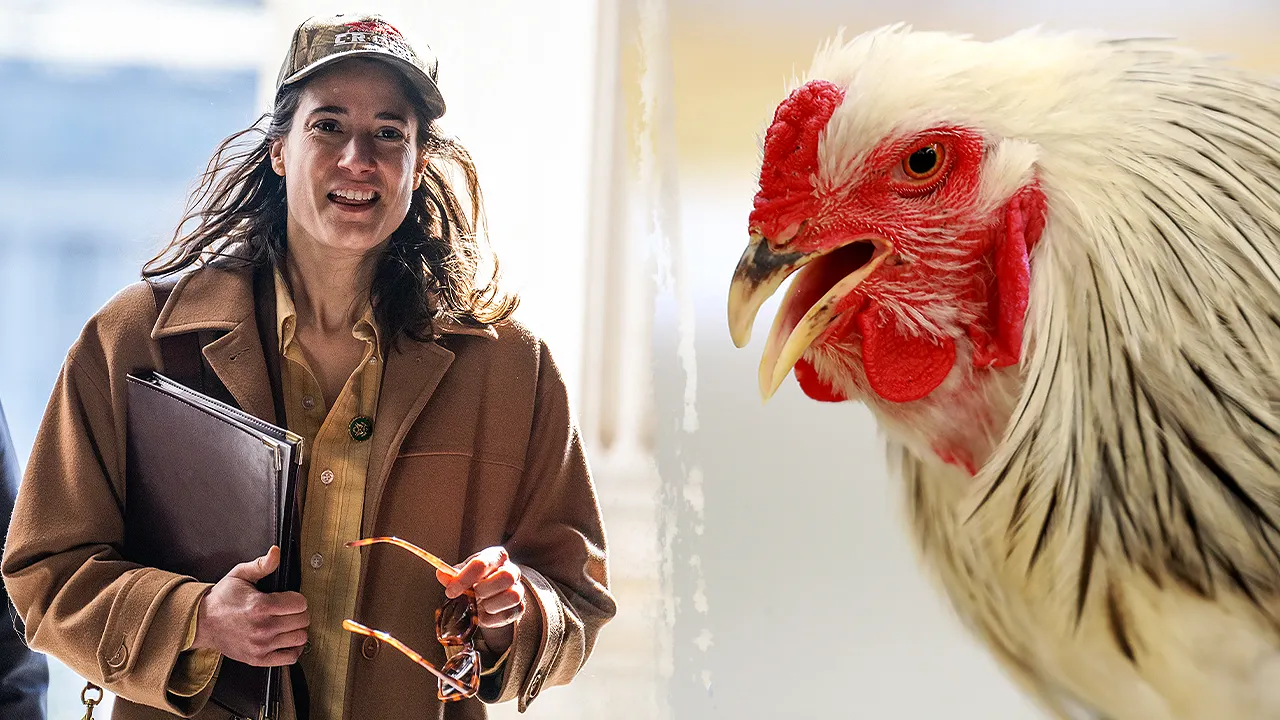
It was back in college, around the early 2010s, when a group of roommates at Reed College in Portland, Oregon, decided to dabble in “urban farming.” They were young, idealistic liberals, experimenting with sustainable living in the city. Among them was Marie Gluesenkamp Perez, a determined young woman who would later become a Democratic congresswoman from Washington state. Their little project involved raising backyard animals, but one day, things took a dark, unexpected turn with a chicken. The roommates, including Isaac Eger, Sam, and Boguslaw, recalled being horrified when Perez, frustrated with their hesitation over how to humanely dispatch the bird, grabbed a dull kitchen knife and took matters into her own hands. What followed was a gruesome scene that left lasting impressions on her former housemates. This anecdote emerged recently in a podcast episode Eger hosted, where he laughed about it while revealing deeper reflections on Perez’s character. It’s a story that paints her not just as brave, but perhaps overly impulsive, highlighting the raw edges of someone driven to lead, even if it meant stepping into messy, chaotic situations. In their shared house, these kids navigated the awkwardness of adulthood, balancing books, protests, and these half-baked attempts at self-sufficiency. Perez, always the one to take charge, embodied a fire that made her stand out. But as they reminisced, it wasn’t just about the chicken; it was about glimpsing the traits that would propel her into politics—confidence bordering on hubris, a willingness to ignore norms, and a stubborn streak that could alienate as much as inspire. Years later, these memories resurfaced in Eger’s podcast, “Absolutely Sweet Marie Gluesenkamp Perez,” a tongue-in-cheek title for a paid episode that invited listeners to peek into her past. Eger, ever the entertainer, refused to provide clarifications to media like Fox News, insisting the podcast was meant to be a joke, not a serious inquiry. It was a way to poke fun at their old friend, now a figure of power, while reflecting on how far they’d all come. The incident symbolized for Eger the very qualities needed in Congress: unyielding confidence and a devil-may-care attitude. Yet, it also showed Perez’s darker side—a disregard for consequences that echoed in her career choices. As the story spread, it humanized her rise, reminding us that politicians aren’t born polished; they’re forged in the fires of youthful misadventures. This tale of a chicken’s violent end became a metaphor for debates on humanity, cruelty, and leadership, sparking conversations about what it means to be proactive in a complicated world. Perez’s roommates weren’t just shocked; they were confronted with the reality of how one person’s decisiveness could leave chaos in its wake, bloodied feathers and all.
Delving deeper into the podcast, the recollection painted a vivid, almost surreal picture. Eger set the scene: the group huddled around a computer in their modest Portland home, frantically searching YouTube for humane ways to kill the chicken they’d been raising. “Dude, I will never forget, like, frantically YouTubing how to humanely kill a chicken and Marie was just like, ‘You f—ing pussies, like, you’re on YouTube?'” Sam remembered, his voice animated over the airwaves. They were all caught in that awkward limbo of intention versus execution, fear versus action. But Perez, always the one to call out cowardice, declared, “Marie bravely was like, ‘I’ll dispatch of this chicken,'” as Eger narrated. She snatched the bird, which must have been clucking nervously, and began what Eger described as “serrating” its head with the dull knife—grinding it down in a brutal, inefficient struggle. The roommates watched in horror as the chicken thrashed, its beak opening and closing in desperate gasps for air, its severed head still twitching on the ground like a bizarre, macabre puppet. “It was really bad,” Eger admitted, his tone mixing laughter with genuine unease. Blood spattered everywhere, turning their kitchen into a scene straight out of a dark horror film, or as Sam quipped, “like some crazy Santeria voodoo ritual.” The body convulsed, spasming in Perez’s hands as she held it aloft, undeterred. Sam contested the exact method but confirmed the dullness of the blade and the gory aftermath, noting how the head continued to function momentarily, a severed limb of poultry demonstrating the cruel inefficiency of it all. “Everyone knows that you can run around like a chicken with your head cut off, but what that saying leaves out is what happens to the head without the body and it’s, like, also still completely functioning for a second,” Sam added, eliciting chuckles from Eger. This wasn’t just a prank; it was a moment that bonded and divided them, revealing Perez’s unapologetic boldness. She wasn’t squeamish about the gore, charging ahead where others faltered. In reflecting, Eger respected her “bravery” in the face of taboos, yet questioned the “hubris” that allowed her to inflict suffering so cavalierly. It spoke to her personality—a proud, stubborn woman with unbreakable confidence, traits Eger linked directly to her success in Congress. “I think [that] is what it takes to become a f—ing congressperson,” he remarked, underscoring how such decisiveness could overlook empathy in the pursuit of goals. For these former friends, the story wasn’t malicious; it was humanizing, showing a congresswoman as a flesh-and-blood young adult, grappling with ethics buried in backyard ventures gone wrong. The podcast turned the grim tale into comedy, but it lingered as a reminder of how college antics could foreshadow political pitfalls, like ignoring humane debate in favor of swift action. Perez’s actions that day, impulsive and visceral, mirrored broader themes in her life: a willingness to embrace discomfort, to wield power unyieldingly, even if it drew blood—literal or figurative.
Beyond the chicken fable, the podcast unearthed other oddities from their Reed College days, painting a fuller, quirkier portrait of young Marie Gluesenkamp Perez. They lived in a bustling house full of eccentricities, shared among students navigating the turbulence of liberal arts education. One constant companion was Meatball, Perez’s rabbit, a fluffy creature she brought along, symbolizing her quirky side amidst the urban farming experiments. But Meatbal wasn’t just a pet; the stories reveal a disturbing cycle that left her roommates shaken. According to Eger and Boguslaw, Perez bred the bunny repeatedly, only to eat its offspring. “A friend of mine said that when he came back to the house once, she started a rabbit-eating cult,” Eger quipped during the episode, blending horror with humor. It was bizarre, almost cult-like, as if Perez viewed her animals not as individuals with rights, but as resources in her quest for sustainable living. The roommates recounted feeding them, watching them multiply, and then, presumably, consuming the results—a practice that horrified the group. “Did you go with her to breed her rabbit and we watched them, like, smash the rabbit against the wall?” Eger asked Sam, who affirmed it with a casual “Meatball? Hell yeah.” These moments highlighted Perez’s “absent-minded” approach; she often neglected the creatures, leaving roommates to intervene lest they perish. Eger and others described stepping in to care for the animals during her lapses, revealing a woman deeply engaged in ideals but prone to oversight when things got messy. This rabbit saga added layers to her character—an earnest urban farmer, perhaps, but one blurring lines between self-sufficiency and cruelty. It humanized her as someone passionate yet irresponsible, traits that might explain her political tenacity. In the podcast, it wasn’t scornful; it was fond, almost endearing, as they laughed about the “epic fail” of their ventures. Yet, it raised questions about empathy—how could someone so invested in humane farming disregard animal suffering? For Eger, it was part of the “thread” connecting college Marie to Congress Marie: stubborn confidence that forged forward, consequences be damned. “Being headstrong” and taking care of business, even poorly, defined her. This tale of Meatball wasn’t just about a pet gone wrong; it was about youthful experimentation morphing into lifelong patterns. As adult listeners, it reminded them (and us) that leaders like Perez carried the weight of their past choices, blending idealism with real-world harm. The podcast episode wove these anecdotes into a tapestry of friendship and friction, turning her into a relatable figure—flawed, funny, formidable.
As the podcast dove into Perez’s background, the tone sharpened, revealing accusations of dishonesty that painted her not as a genuine local, but as an outsider playing a role. Eger, voicing frustrations that simmered for years, called her a “carpetbagger,” someone parachuting into Washington state politics without deep roots. He alleged she wasn’t the fifth-generation Washingtonian she claimed, but hailed from Houston, Texas. “She grew up in Houston, Texas. Her father was Mexican, born in Mexico, where her mother, who is from Washington, met him,” Eger stated. “She brought him over the border, and then Marie’s kind of an anchor baby.” The term “anchor baby” carries heavy connotations, implying her identity was leveraged for political narrative rather than authentic experience. This revelation stripped away layers of her public persona, questioning how she positioned herself. Beyond origins, Eger accused her of “cosplaying as a poor person” during college, despite her family’s wealth. He argued that attending Reed College, with its $40,000 annual tuition plus living costs, wouldn’t have qualified her for financial aid if her parents were indeed affluent. “If you can afford to pay for a $40,000 a year college… that means she wouldn’t have qualified for financial aid,” he claimed, sarcastically noting her penchant for portraying hardship. “Now, what she says in order – this is part of her lore, she’s definitely cosplaying as a poor person.” Boguslaw chimed in sarcastically, “Which never happened at Reed. As far as I’m concerned,” underscoring the group’s skepticism. These allegations humanized Perez by exposing perceived hypocrisies—hailing from privilege while standing for the underdog. It wasn’t just personal jab; it critiqued her political brand, suggesting she manufactured a backstory to appeal to voters in her southwestern Washington district, encompassing Portland suburbs and Clark County. This insight made her more relatable and flawed, showing a woman crafting narratives to fit ambitions. In the podcast, it elicited laughs but also serious undertones about authenticity in politics. Eger’s lived experience lent credibility, even if the intent was comedic. For listeners, it prompted reflection on how leaders reinvent themselves, blurring truth and aspiration. Perez’s supposed lies about roots and finances echoed the hubris seen in the chicken incident—bold moves that could backfire. Yet, it also revealed resilience; she rose despite these doubts, first elected to Congress in 2022 and reelected in 2024. This scrutiny wasn’t destructive; it added depth, portraying her as a strategist navigating a diverse electorate.
Transitioning to her current political landscape, Marie Gluesenkamp Perez’s story evolves into one of rising prominence despite these past shadows. Now 37, as a Democratic representative for Washington’s 3rd Congressional District since 2010—expanded under her tenure—she oversees a region vital yet divided, stretching from Vancouver to Portland-area suburbs. Her initial election in 2022 marked a victory founded on progressive appeals, and a 2024 reelection solidified her hold, outpacing rivals financially with nearly $2.5 million cash-on-hand, per Ballotpedia. Her closest opponent, Republican John Braun—a state senator—holds just over $700,000, highlighting her fundraising prowess in a battleground district. Perez embodies the Democratic torch, rallying for issues like environmental protection and community rights in a state grappling with urban-rural divides. But the anecdotes from her college days linger, humanizing her ascent. They suggest her “unbelievable confidence” wasn’t just youthful energy but a steel that propelled her through Congress. Her bravery in “dispatching” the chicken paralleled perhaps her willingness to tackle policy head-on, disregarding hesitation. Yet, criticisms from Eger echo in political circles, questioning her sincerity. Some see her as hypocritical, championing for the disenfranchised while allegedly obscuring privilege. This duality makes her campaign relatable— a woman from humble (or crafted) beginnings, forging ahead. Her focus on empowerment resonates with voters, yet debates persist on her methods, much like her blunt approach to farming. In the public eye, Perez remains enigmatic, declining interviews amid these revelations. Supporters praise her dedication; detractors highlight inconsistencies. As the 2026 midterms loom, her story underscores themes of ambition and adaptation. What began as college capers has shaped a legislator navigating national divides. Perez’s trajectory inspires, reminding that even flawed beginnings can lead to influential platforms. Her refusal to comment on the podcast added mystery, a silence that let stories speak for themselves.
In wrapping up her humanized saga, the podcast and ensuing coverage remind us that public figures are more than headlines; they’re people with histories rife with humanity and controversy. Marie Gluesenkamp Perez, from Reed College misadventures to congressional halls, embodies paradox—bold yet questioned, proactive yet imperfect. The chicken incident, rabbit escapades, and background claims aren’t mere gossip; they’re windows into a life of choices, some admirable, others bewildering. Eger’s candid reflections humanize her, showing a woman whose stubbornness drove success, yet raised ethical flags. No official response came from Perez or her team, leaving narratives unchallenged, a void filled by memories. As she campaigns in Washington, these tales add color to her profile, inviting empathy amid scrutiny. They teach that leadership demands unflinching resolve, yet caution against ignoring repercussions. Perez’s journey, marked by reelection victories, proves determination pays off, but at what cost? Her story captivates, urging reflection on truth in personal and political narratives. Ultimately, it’s a reminder: behind every leader lies a person, shaped by mishaps and triumphs alike.