





China’s Military Escalation Around Taiwan: A Delicate Balance of Power in the Strait
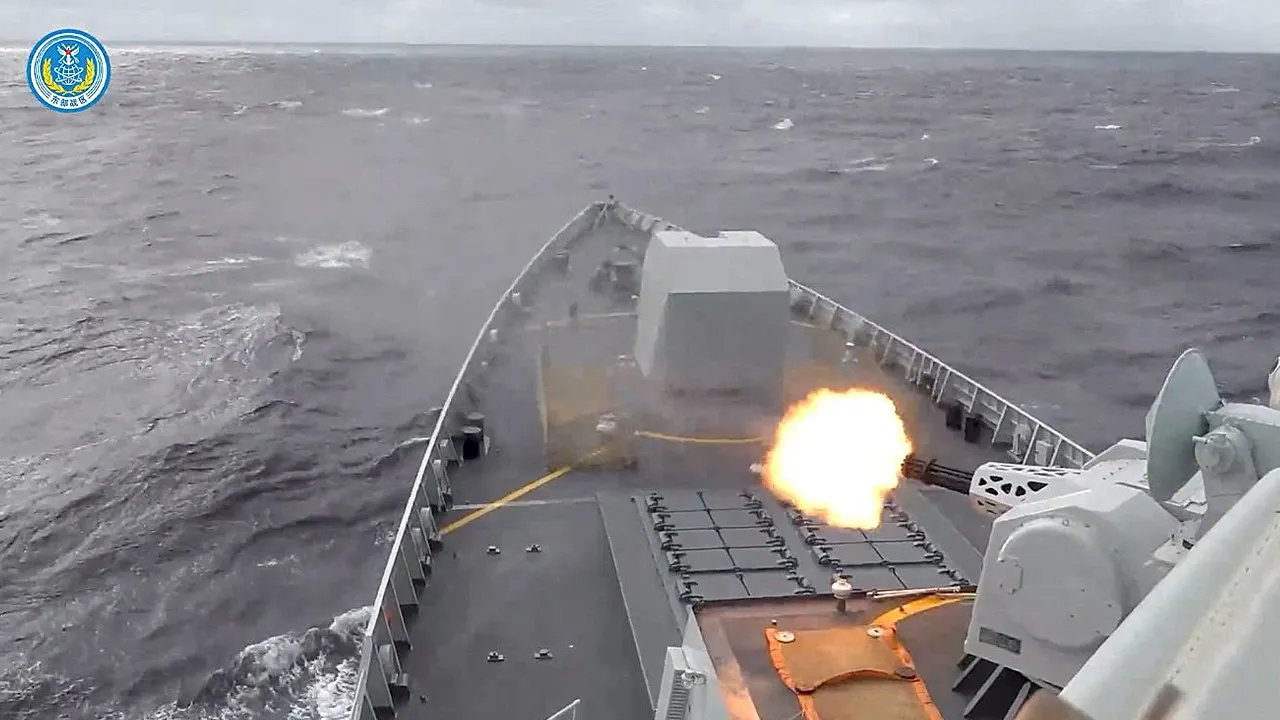
In a dramatic show of force, China has launched its most extensive military exercises ever around Taiwan, dubbed “Justice Mission 2025.” These drills, which began on Monday, involve a comprehensive deployment of China’s military might—including warships, aircraft, ground forces, drones, and artillery—creating a near-complete encirclement of the island. The Eastern Theater Command of the People’s Liberation Army has orchestrated these exercises across seven maritime zones surrounding Taiwan, with activities ranging from simulated strikes on land and sea targets to rehearsals for blockading Taiwan’s major ports. This maritime chokehold strategy appears to be a central component of China’s potential playbook for isolating or pressuring the island nation. The live-fire exercises, scheduled through Tuesday, have established danger zones closer to Taiwan’s shores than any previous drills, significantly disrupting civilian maritime traffic and air travel, forcing airlines to reroute flights and compelling Taiwan’s aviation authorities to develop alternative airspace corridors.
Chinese officials have framed these exercises as a necessary response to what they characterize as separatist movements and foreign interference. Senior Colonel Shi Yi, speaking for the Eastern Theater Command, described the drills as “a stern warning against ‘Taiwan independence’ separatist forces and external interference forces,” claiming they represent a legitimate defense of China’s sovereignty and national unity. This military escalation arrives at a particularly sensitive moment, less than two weeks after the United States approved an unprecedented $11.1 billion weapons package for Taiwan—the largest arms sale in the history of U.S.-Taiwan relations. The package includes 82 High Mobility Artillery Rocket Systems (HIMARS) paired with 420 Army Tactical Missile Systems (ATACMS) long-range missiles, giving Taiwan significant deep-strike capabilities that could reach mainland China across the Taiwan Strait. Beijing has reacted with predictable fury, warning that such transfers risk transforming Taiwan into a “powder keg” and pushing the region toward “military confrontation and war.”
Chinese Foreign Ministry spokesperson Guo Jiakun amplified this narrative, accusing Taiwan’s leadership of “seeking independence through force” and “squandering the hard-earned money of the people to purchase weapons at the cost of turning Taiwan into a powder keg.” Guo’s statement reflected Beijing’s consistent position that American support for Taiwan will only “accelerate the push of the Taiwan Strait toward a dangerous situation of military confrontation and war” and ultimately “backfire” on U.S. interests. As the drills unfolded, Taiwan’s Defense Ministry reported substantial Chinese military activity encircling the island, including 89 military aircraft, 14 naval vessels, and 14 coast guard ships operating in proximity to Taiwan. Additional Chinese warships were detected further out in the Western Pacific, and some vessels engaged in close encounters with Taiwanese ships near the island’s contiguous zone, approximately 24 nautical miles from shore. This multi-domain pressure campaign represents a significant escalation in China’s ongoing efforts to assert dominance over what it considers a renegade province.
Taiwan’s military response has been measured but resolute. Defense officials placed their forces on high alert and signaled readiness to conduct rapid response exercises should the situation deteriorate further. Taiwan’s deputy chief of the general staff for intelligence, Hsieh Jih-sheng, noted that China’s live-fire exercises “would not only constitute military pressure on us, but could also pose more complex challenges and impacts for the international community and neighboring countries.” In a show of determination, Taiwan’s defense ministry released video footage highlighting its own military capabilities, including recently acquired U.S.-made HIMARS systems. Meanwhile, the coast guard deployed large patrol vessels to monitor Chinese naval movements near Taiwanese waters. Chinese state media emphasized that the exercises are specifically designed to rehearse sealing off Taiwan’s critical deep-water ports, including Keelung in the north and Kaohsiung in the south—reinforcing analysts’ concerns that Beijing is refining its ability to implement blockade options without resorting to a full-scale invasion.
The psychological dimension of these exercises is equally significant. China has released an array of propaganda videos and posters alongside the drills, including futuristic footage depicting automated humanoid robots, swarms of micro-drones, and weaponized robotic dogs attacking Taiwan. Some imagery appears to show civilian vessels that military analysts suggest could support an amphibious assault, blurring the line between civilian and military operations in a potential conflict scenario. These psychological operations aim to undermine Taiwanese morale and create an atmosphere of inevitability regarding eventual reunification. However, the immediate impact on Taiwan’s civilian population appears limited. Lin Wei-ming, a 31-year-old teacher in Taipei, expressed skepticism about the drills, saying, “I think these drills are just meant to scare us. Similar drills have happened before… the political side of things can only be handled by Taiwan’s current government and how they choose to respond.”
The fundamental dispute underpinning these tensions remains unchanged. China claims Taiwan as an inseparable part of its territory and has repeatedly stated it has not ruled out using military force to bring the island under its control. Taiwan, functioning as a self-governing democracy with its own military, currency, and diplomatic relationships, firmly rejects Beijing’s claims, maintaining that only the Taiwanese people have the right to determine the island’s future. This standoff has grown increasingly precarious as China’s military modernization continues and as Taiwan strengthens its defensive capabilities with American support. The current exercises reflect Beijing’s growing frustration with what it perceives as “separatist” tendencies in Taiwan and “interference” from Washington. As tensions rise across the Taiwan Strait, the international community watches nervously, recognizing that miscalculation or escalation in this longstanding dispute could have profound consequences not only for the immediate region but for global security and economic stability. The delicate balancing act between deterrence and provocation continues, with Taiwan’s 23 million citizens caught in the middle of a geopolitical competition with no clear resolution in sight.