





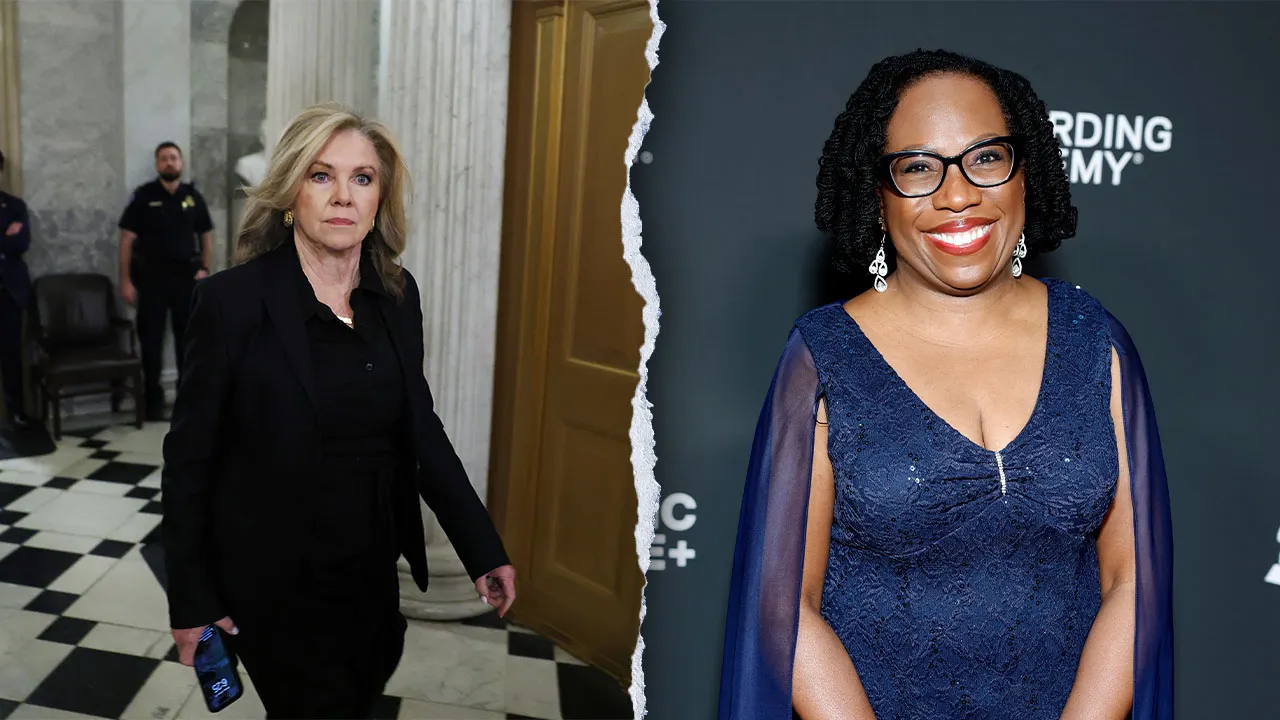
In the ever-turbulent world of American politics, where Supreme Court justices are expected to uphold the highest standards of impartiality, a single event can spark a firestorm of controversy, especially when it involves a Hollywood awards show. Picture this: It’s the 2024 Grammy Awards, that glittering spectacle where music’s elite gather to celebrate brilliance and, increasingly, inject their voices into social and political debates. Senator Marsha Blackburn, the sharp-tongued Republican from Tennessee, found herself compelled to act after learning that Justice Ketanji Brown Jackson, the court’s newest member nominated during a deeply divisive confirmation process, had attended the event. Not just as a fan or a casual observer, mind you, but because she was honored for narrating the audiobook edition of her own memoir, Lovely One. For many Americans, this might seem innocuous—a moment of personal accomplishment in a demanding career. But in Blackburn’s eyes, it was anything but, given the event’s atmosphere that night. This wasn’t just about music; it was a platform for bold, anti-establishment messages, particularly against U.S. Immigration and Customs Enforcement (ICE), the agency tasked with enforcing federal immigration laws. Blackburn, ever the vigilant watchdog on the Senate Judiciary Committee, couldn’t ignore Jackson’s reported actions: clapping along as stars and presenters lambasted ICE. In a meticulously drafted letter to Chief Justice John Roberts, she painted Jackson’s attendance as a potential breach of the judiciary’s ethical boundaries. This wasn’t about denying someone a night out; it was about safeguarding the court’s integrity. Roberts, as the head of the judicial branch, holds the reins of oversight, and Blackburn was essentially handing him a torch, urging him to shine light on what she saw as a troubling incident. Her move resonated in a political landscape where trust in institutions like the Supreme Court has eroded, with accusations of partisanship flying from both sides. As someone who’s watched these dynamics unfold through countless Senate hearings and media scrutiny, I can see why Blackburn felt this warranted attention. It’s not every day that a sitting justice gets caught in the crossfire of celebrity activism, and the implications—particularly if the court is poised to tackle immigration-related cases tied to the Trump era—could ripple through our legal system for years. Blackburn’s stance wasn’t born in isolation; it was fueled by her belief that appearances matter, especially in a role as revered as that of a Supreme Court justice.
Diving deeper into the Grammy scene Jackson found herself in, it’s worth appreciating the context she navigated that evening. The event, held on February 4, 2024, in Los Angeles, wasn’t merely a awards ceremony; it had morphed into a modern-day forum for progressive voices to amplify their grievances against systemic injustices. Jackson, a trailblattering figure in her own right, was there specifically because her narration of her memoir—a candid exploration of her life experiences, from her upbringing in Washington, D.C., to her ascent through the judiciary—had been recognized. As the first Black woman to serve on the Supreme Court, her presence at such an event could be seen as a celebration of her artistry beyond the bench. Yet, the atmosphere was charged with political undertones that many in conservative circles viewed as hostile to law enforcement. Guests sporting “ICE Out” lapel pins walked the red carpet, signaling their disdain for the agency Blackbrurn holds dear. Presenters and performers used their platforms to deliver lines that critics like Blackburn deemed inflammatory. Messages like “No one is illegal on stolen land” and the expletive-laden “F— ICE” echoed through the Crypto.com Arena, drawing applause and whoops from the crowd. Jackson, reportedly seated in the audience, was observed clapping during these moments. For someone advocating a humanized take on this, it’s easy to empathize with her situation: Imagine being honored at a prestigious event, surrounded by colleagues and friends, and feeling the emotional pull of the moment. Was she fully endorsing every word? Or was it a polite gesture in line with audience etiquette, much like clapping at a concert or a public speech? Conservative commentators, however, argued it crossed a line, especially for a justice who might soon adjudicate cases affecting ICE and immigration policy. The event organizers, always pushing boundaries, leaned into advocacy, with performers like Rita Ora and the hosts weaving in calls for immigration reform and critiques of federal policies. From a human perspective, the Grammys represent a microcosm of America’s cultural divides—where entertainment and activism collide. Jackson’s choice to attend, while understandable, unwittingly placed her at the epicenter of a debate over judicial neutrality. Blackburn’s letter highlighted this, noting that while justices attend public events, few had faced such “far-left rhetoric” head-on. This incident didn’t just spotlight Jackson; it underscored how personal life intersects with professional duty in the high-stakes role she holds.
The anti-ICE rhetoric at the Grammys wasn’t out of nowhere; it was part of a broader narrative stirring in Hollywood and beyond. Celebrities have increasingly used platforms like the Oscars, Emmys, and Grammys to challenge policies they oppose, painting ICE as an aggressive force in immigrant communities. Winners like Taylor Swift or Billie Eilish paused their acceptance speeches to decry what they see as dehumanizing tactics, such as family separations at the border. The “ICE Out” pins, popularized at the event, became a symbol of solidarity for those advocating for abolishing or radically reforming the agency. In Jackson’s case, her applause was captured on cameras and social media, with clips circulating among critics who saw it as tacit support for the anti-ICE stance. To humanize this, think about the human element here: These are real people, not just cardboard figures. Jackson, a mother and a scholar with degrees from Harvard and her own legal battles as a defender of civil liberties, might have genuine complexities in her views on immigration. But in the black-and-white world of judicial expectations, such ambiguity can seem suspect. Blackburn pointed out concerns that Jackson’s actions could compromise her impartiality, potentially influencing decisions in cases stemming from the Trump administration’s immigration policies, including debates over birthright citizenship—a constitutional interpretation that could redefine America’s approach to citizenship for millions. The court’s upcoming docket includes matters that directly or indirectly touch these issues, making Jackson’s attendance a potential thorn. As a senator who’s grilled nominees for years, Blackburn knows the optics matter. Democrats and media have blasted conservative justices for perceived biases, and now the shoe is on the other foot. Yet, from an observer’s vantage, it’s frustrating how quickly these moments escalate. Was Jackson merely enjoying the show, or was she signaling alignment with the left’s agenda? The yearning for true impartiality in our divided times makes this question tough to answer. Her memoir, which she narrated, delves into her personal journey, including her ideals of justice. Attending a cognitively diverse event like the Grammys where such views were expressed could be seen as reinforcing those ideals outside the courtroom. Nonetheless, the backlash illuminated a fault line: When does personal expression bleed into professional obligation?
Blackburn’s call for an investigation stemmed from her firm conviction that such actions might warrant recusal, a legal term for stepping aside from cases where bias is possible. In her letter, she invoked the Supreme Court’s Code of Judicial Conduct, urging Roberts to probe whether Jackson’s participation at the Grammys necessitated her exclusion from relevant cases. This wasn’t a hasty shot in the dark; she articulated concern over the court’s ability to remain “fair-minded, impartial, and independent.” Recusal is a serious matter in the judiciary—think of when justices bow out of cases tied to friends, family, or prior involvements. Here, Blackburn suggested that by attending and participating in applause at an anti-ICE event, Jackson could be seen as prejudging issues related to the Trump-era policies shaping immigration law. The letter drew parallels to past scandals, like those involving Justices Thomas or Alito, whose ethics have been questioned amid allegations of partisanship. Yet, Blackburn distinguished this from what she called “meritless claims” against Republicans, emphasizing the direct nature of Jackson’s involvement. For anyone following this closely, it’s a reminder of how politics infiltrates every corner of society, including our highest court. Roberts, as Chief Justice, has the authority to lead such an inquiry, perhaps through an internal review or referral to the judicial conference. But humanizing this reveals the high-wire act justices walk: They’re humans, after all, with lives that extend beyond marble halls. If an investigation proceeds, it could impact Jackson’s role in key rulings, potentially altering outcomes in divisive cases. Blackburn’s push isn’t just partisan; it’s rooted in a desire to protect the institution. After all, when public trust in the court plummets—fueled by leaks and recusal debates—the entire judiciary suffers. As Senate Judiciary Committee members go, Blackburn brings a prosecutorial energy, honed through debates on policing and justice reform. Her letter closed with a plea for action, highlighting that unlike silent criticisms, this issue demanded scrutiny. In our polarized era, where every action is dissected through a partisan lens, one wonders if such investigations will unify or further divide.
This episode also sparked comparisons to other moments where Supreme Court justices faced ethical scrutiny, painting a picture of a bench under constant siege from both sides of the political aisle. Blackburn invoked examples like the 2023 letter from Senators Durbin and Whitehouse, who sought Justice Alito’s recusal from January 6-related cases due to his wife’s flag-raising—an episode that fueled accusations of conservative bias and led to an FBI investigation into security threats against justices. On the left, these calls often stem from headlines and social media stunts, like Alito’s involvement in leaked opinions from the Dobbs controversy, turning the court into a media spectacle. Now, with Justice Thomas under fire for undisclosed gifts and apparent conflicts, the pendulum swung to Jackson. Blackburn wrote that, unlike those instances, Jackson’s participation in a “brazenly political, anti-law enforcement event” raised “serious questions” about her impartiality. From a human angle, it’s disheartening to see justices vilified for mundane choices—Alito’s vacations, Thomas’s friendships, Thomas’s wife’s symbolic gestures. These aren’t nefarious plots; they’re snapshots of ordinary lives intersecting with extraordinary jobs. The court’s Code of Conduct, while not strictly enforceable by law, is a moral compass, guiding justices to avoid impropriety. Roberts has previously downplayed demands as interference, but Blackburn’s letter adds to the chorus. Democrats and the media recently labeled Republican justices “corrupt” over partisanship, yet the response to Jackson’s Grammy stint feels like tit-for-tat. Broader implications linger: If justices must quarantine every political utterance, how do they engage in society? Jackson’s confirmation hearings already saw her questioned on progressive leanings, with critics citing her sentencing record. Attending the Grammys might have been a nod to her civilian side, but in today’s charged climate, it became ammunition. Fox News Digital reached out for responses, but silence from the court underscores the delicacy. Ultimately, this isn’t just politics; it’s about preserving faith in an institution that defines justice for 330 million Americans. As someone reflecting on these events, it’s a call to see justices as people, not partisans, urging a path where ethics trump sensationalism.
Looking ahead, the fallout from Jackson’s Grammy attendance could subtly reshape the Supreme Court’s dynamics, especially with upcoming cases that intersect immigration and Trump-era policies looming large. While Fox News reached out to Blackburn’s office and the Supreme Court for comment, the incident has already ignited debate over judicial boundaries. From a human perspective, it’s understandable why Jackson might have embraced the honor—career accolades don’t come every day, especially for a trailblazing woman in a male-dominated field. Yet, in the era of instant media, such moments become cardinal sins overnight. Blackburn’s investigation push seeks to enforce a line between personal and professional, a necessary guardrail in a democracy where courts settle our fiercest disputes. If Jackson is forced to recuse from birthright citizenship or related immigration matters, it could tilt outcomes, given the court’s tight 6-3 conservative majority. Friends and critics alike watch closely, knowing that the next term will test whether justices can wield impartiality amid external pressures. This Grammy controversy, trivial at first blush, exposes broader fractures: How do we expect impartiality from humans embedded in a partisan world? Justices aren’t monks; they have lives, passions, and yes, perhaps biases. Blackburn’s letter, while partisan, champions accountability—a value everyone can rally behind. As discussions evolve, they might foster a renaissance in judicial ethics, ensuring the court remains a beacon. But in the meantime, the drama reminds us of the fragility of trust, urging cooler heads in an overheated landscape. Whether Roberts initiates an inquiry or not, the conversation it spurs could humanize the judicial process, making justices seem more approachable and less like untouchable icons. In a nation divided, perhaps starting with empathy—understanding why a justice claps at an awards show—can bridge divides, even if just a little. The path forward demands vigilance, but also compassion, toward the people upholding our highest laws.