







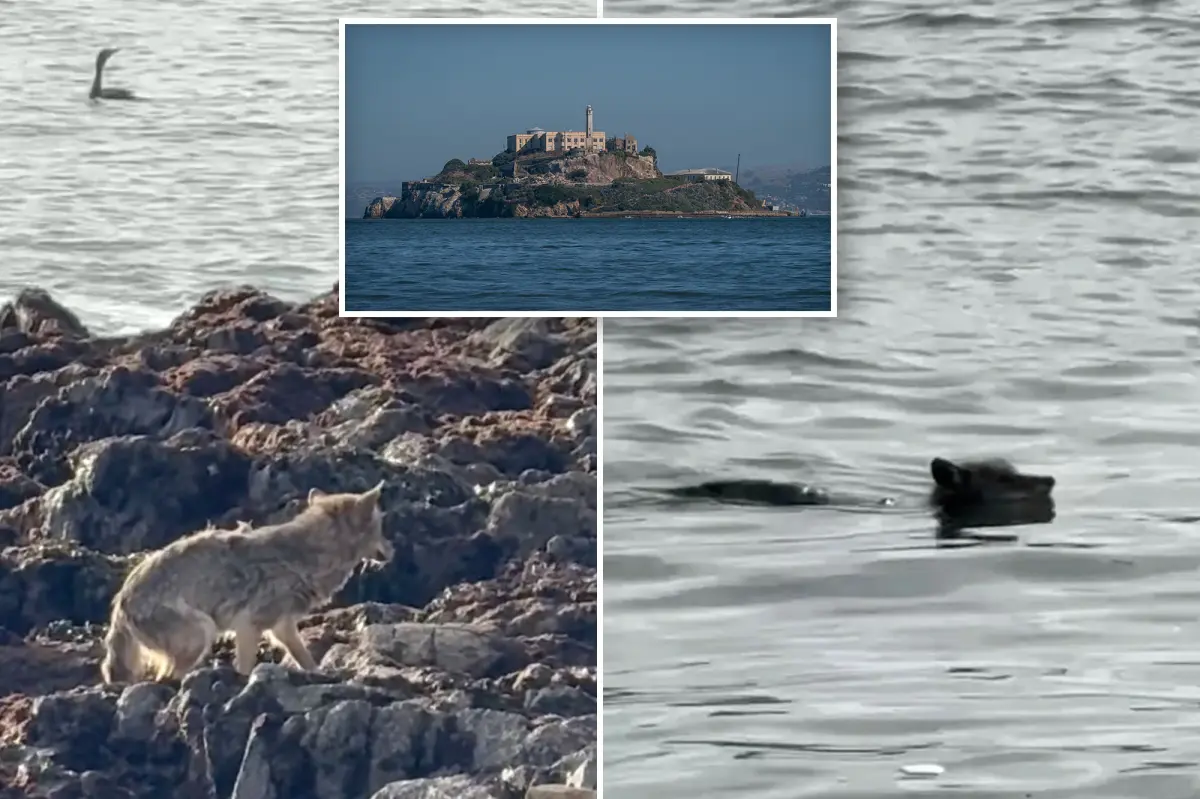
Unlikely Escapee: The Coyote That Swam to Alcatraz
In a remarkable twist of fate that would make even the most notorious Alcatraz inmates proud, a coyote completed what many humans had failed to do – successfully navigating the treacherous waters surrounding the infamous former prison island. On an otherwise ordinary Sunday, visitors and staff at Alcatraz were left astounded as they witnessed a coyote doggie-paddling its way to shore, creating a moment of wilderness wonder amid the historic human confinement site. The incredible scene was captured on video by a quick-thinking tourist, who documented the exhausted animal as it reached the rocky shoreline, visibly shivering from its journey through the cold Bay waters. “It can barely stand,” noted one concerned onlooker in the footage, their voice reflecting the collective concern for this wild adventurer who seemed so out of place among the prison’s formidable architecture and turbulent surrounding waters. The video, promptly shared with Aidan Moore, a guest relations employee for Alcatraz City Cruises, set off a chain of events as park rangers were notified about the unusual visitor who had somehow conquered one of the most notorious swimming challenges in America.
The mystery of how this wild canine managed to overcome the notorious San Francisco Bay currents that had deterred countless human escape attempts deepened when park officials arrived to find no trace of the coyote. Moore speculated to SFGATE that the animal may have “fell into the water chasing something and was swept away,” suggesting this remarkable journey might have been more accident than intention. This theory gained credibility when a boat captain familiar with the area’s dangerous waters noted that the currents were particularly challenging that day, making it nearly impossible for any creature to navigate them voluntarily. The coyote’s bedraggled appearance upon arrival supported this assessment, with Moore observing that “He didn’t look like he was in very good condition, which I’m not surprised by given the harrowing experience.” Despite extensive searches throughout the island following the sighting, staff members were unable to locate the adventurous animal, raising questions about its fate after completing such an extraordinary journey.
The source of the coyote’s journey remains as mysterious as its current whereabouts, though several possibilities exist. San Francisco’s shoreline sits approximately 1.25 miles away, representing one potential starting point for the ambitious swim. Alternatively, the animal could have departed from Marin County or perhaps most intriguingly, from Angel Island, where a family of coyotes has established residence according to local reports. This connection to Angel Island adds another layer to the story, suggesting possible ties between coyote populations adapting to life on the Bay’s islands. The distance and dangerous currents between any of these locations and Alcatraz highlight just how remarkable the animal’s achievement was, particularly given the challenges that thwarted human escape attempts throughout the prison’s operational history. The fact that a wild coyote managed what desperate inmates could not creates an ironic footnote in Alcatraz’s storied history of confinement and escape.
What makes this story particularly compelling is that this may not have been an isolated incident. Comments on social media posts about the video suggested previous coyote sightings on Alcatraz, with one visitor writing, “Such a brave coyote but all tired. When I went to Alcatraz a week ago I saw one.” Another commenter compared it to similar sightings at nearby Angel Island, writing “Wow! I’ve seen this at Angel Island but this is impressive.” These observations raise fascinating questions about whether a small population of these adaptable predators might somehow be establishing themselves on these islands, or if individual animals are regularly making the dangerous crossing, perhaps accidentally swept there as Moore suggested. The presence of wild predators on an island famous for containing human predators creates a poetic parallel that adds yet another layer to Alcatraz’s complex legacy.
The coyote’s journey represents more than just an unusual wildlife sighting; it showcases the remarkable adaptability of these animals that have not only survived but thrived alongside human expansion. Coyotes have demonstrated an extraordinary ability to adapt to urban environments across North America, with populations established in major cities including San Francisco. Their intelligence and resourcefulness have allowed them to navigate human landscapes with remarkable success, though swimming to Alcatraz represents an extreme example of their adaptive capabilities. Whether intentional or accidental, this coyote’s journey demonstrates the species’ remarkable resilience in the face of challenging circumstances. The concerned reactions from witnesses also highlight the complex relationship between humans and wildlife in shared spaces – even as visitors expressed worry for the animal’s welfare, they were witnessing firsthand the untamable spirit of a wild creature navigating a landscape shaped by human history.
As staff continued searching for the elusive island visitor, Moore acknowledged the challenge ahead: “We’ve been wandering around the island looking for him, but no one has been able to spot him. It’s possible he might not be seen for a while.” This uncertainty adds a final layer of mystery to an already remarkable tale. Has the coyote found shelter somewhere among the abandoned prison buildings? Did it manage to swim back to mainland shores? Or has it established itself as Alcatraz’s newest resident, roaming the grounds once walked by the likes of Al Capone and Machine Gun Kelly? Whatever its fate, this wild swimmer has earned its place in Alcatraz lore – not as a notorious criminal, but as an unlikely pioneer that conquered the same waters that kept countless humans confined. In doing so, it has added a new chapter to the island’s rich tapestry of escape attempts, reminding us that sometimes, nature finds a way to accomplish what humans cannot, swimming against the currents of both water and expectation to reach improbable shores.