




US Marines Display Military Prowess in the Caribbean Amid Increased Pressure on Venezuela’s Maduro Regime
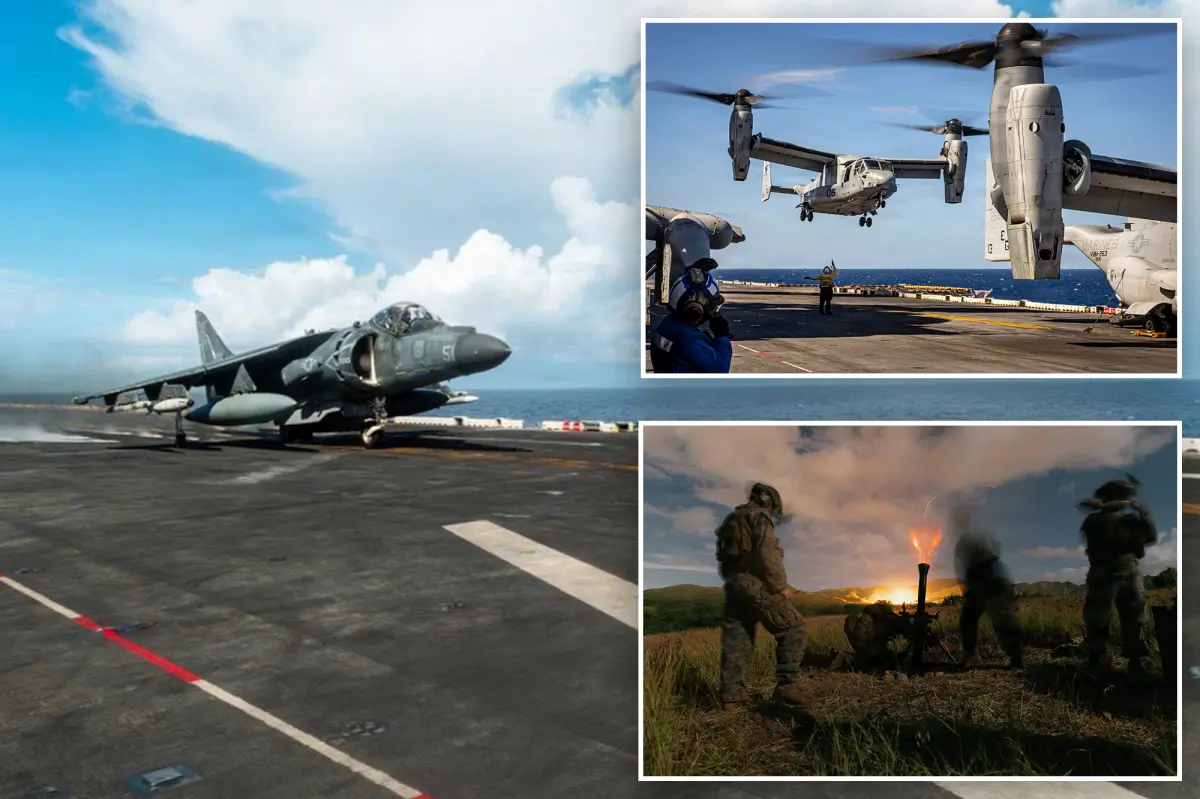
In a powerful demonstration of military readiness, US Southern Command recently showcased approximately 2,200 Marines from the 22nd Marine Expeditionary Force conducting training exercises in the Caribbean. The impressive display, documented in a series of striking photographs released on December 16, captured Marines executing live-fire drills with mortar systems, practicing with first-person view attack drones in Puerto Rico, and performing flight operations aboard the USS Iwo Jima. These images, taken between November 20 and December 16, effectively communicate America’s combat capabilities at a time when the Trump administration is intensifying its pressure campaign against Venezuelan dictator Nicolas Maduro. According to Alex Plitsas of the Atlantic Council, these military exercises serve a dual purpose: demonstrating American military capability while also sending a clear message to adversaries in the region. The timing of these photographs is particularly significant given the current geopolitical climate and the United States’ increasingly confrontational stance toward the Maduro regime.
While the presence of 2,200 Marines in the Caribbean represents a show of force, experts note that this deployment falls far short of what would be required for an actual ground invasion of Venezuela. Plitsas, a former senior US intelligence officer and Iraq war veteran, emphasized that overthrowing Maduro and stabilizing Venezuela afterward would require an estimated 100,000 troops – roughly 45 times the current deployment. This disparity suggests that the primary goal remains applying diplomatic and military pressure to encourage Maduro to step down voluntarily. Nevertheless, Plitsas acknowledges that airstrikes on land targets remain a possibility, an option that President Trump has mentioned on multiple occasions. The military exercises thus represent one component of a broader strategy aimed at demonstrating American resolve while avoiding the complexities and costs associated with a full-scale invasion.
The heightened military activity comes in the wake of strong statements from Secretary of State Marco Rubio, who recently characterized the Maduro regime as the foremost threat to American security in the Western hemisphere. During a year-end press conference, Rubio declared the status quo in Venezuela “intolerable for the United States,” making America’s desire for regime change unmistakably clear. The Secretary outlined several concerning developments that justify this hardline position, including Venezuela’s hosting of Hezbollah terrorists and Iranian operatives on its soil. Additionally, Rubio highlighted how the Maduro government permits Colombian terrorist groups like ELN and FARC dissidents to operate freely within Venezuelan territory. These factors, combined with Venezuela’s involvement in narcoterrorism, have elevated the South American nation to the top of America’s regional security concerns and explain the increased military presence in nearby waters.
Concurrent with the Marine exercises, the US Coast Guard has been pursuing an oil tanker off Venezuela’s coast suspected of participating in what American officials describe as illicit “black-market” oil shipments connected to the Maduro regime. The vessel, believed to be sailing under a false flag and subject to a US judicial seizure order, was spotted in international waters in the Caribbean Sea and has been tracked by the American military since at least Sunday. If intercepted and seized, this would mark the third tanker taken over by US military assets in less than two weeks, signaling an aggressive enforcement of sanctions against Venezuela’s oil industry. These interdiction efforts represent another dimension of America’s multi-faceted approach to isolating the Maduro government and cutting off its revenue streams.
The White House has defended its assertive posture toward Venezuelan shipping as part of a comprehensive strategy to eliminate funding sources for Maduro’s regime. American officials contend that the Venezuelan leader uses oil sales to finance drug trafficking operations and other criminal networks that destabilize the region and threaten US interests. The targeted vessels are described as components of a “shadow fleet” that undermines both international sanctions and global energy regulations. This characterization serves to justify the interception of tankers in international waters as enforcement of legitimate sanctions rather than acts of aggression, though critics might view these actions differently. The maritime interdiction campaign complements the military exercises in presenting a united front of American power projection in the region.
These recent developments – from military exercises to maritime interdictions and diplomatic declarations – illustrate the Trump administration’s multidimensional approach to pressuring the Maduro regime. By deploying Marines for visible training exercises, intercepting oil tankers, and making forceful diplomatic statements, the United States is utilizing various instruments of national power to isolate Venezuela economically and politically. While full-scale military intervention appears unlikely given the limited forces currently deployed, the administration clearly wants Maduro and his supporters to understand that all options remain under consideration. As tensions continue to escalate, the presence of American military assets in the region serves as a constant reminder of potential consequences should diplomatic and economic pressure fail to produce the desired outcome of regime change in Caracas. The situation remains fluid, with American forces maintaining their vigilant posture in the Caribbean as the pressure campaign enters a new, more assertive phase.