





Nuclear Arms Control at a Crossroads: U.S. Signals Potential Return to Testing
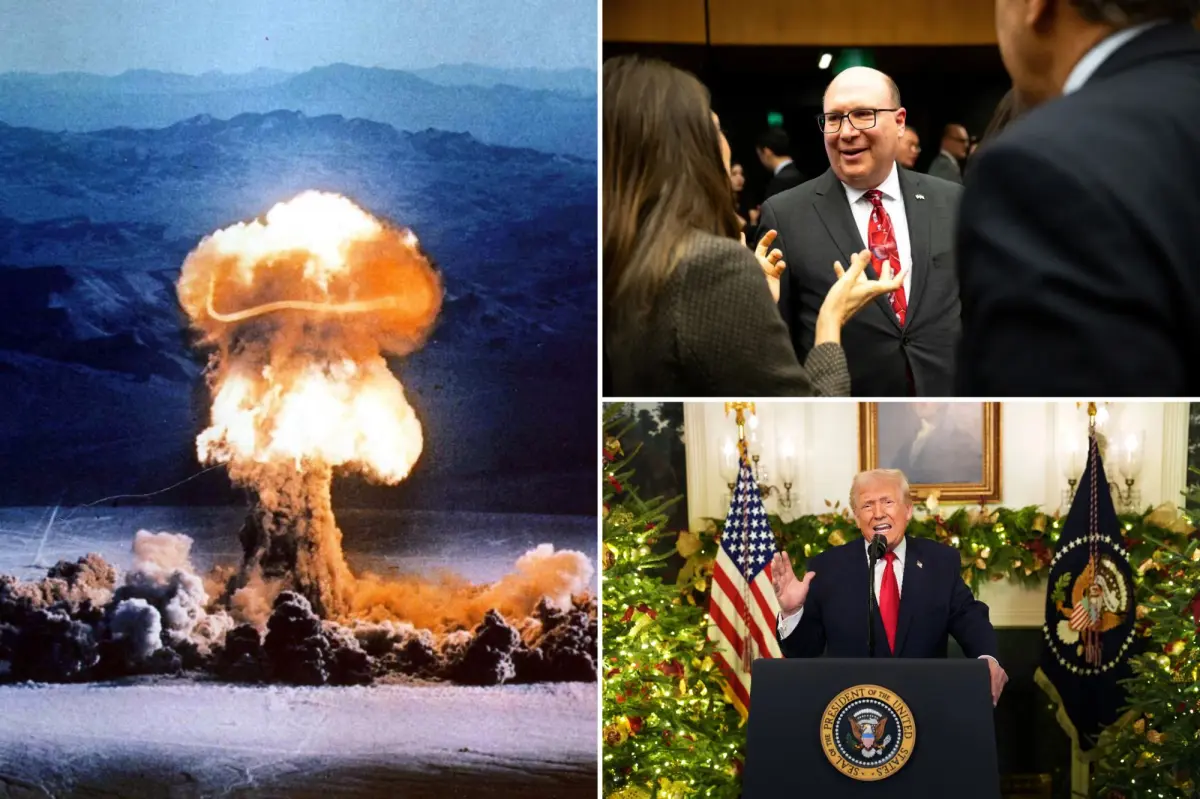
In a significant shift in global nuclear politics, U.S. Chargé d’Affaires Howard Solomon recently defended President Donald Trump’s suggestion that America would resume nuclear testing, citing provocations from Russia, China, and North Korea. Speaking at the Vienna-based Comprehensive Nuclear-Test-Ban Treaty Organization (CTBTO) in November, Solomon stated, “The United States will begin testing activities on an equal basis with other nuclear-armed states,” adding that this process would commence immediately. This announcement marks a potential turning point in international nuclear arms control, which has been painstakingly built over decades through treaties and moratoriums. Solomon emphasized that context matters, pointing to longstanding American concerns that Russia and China have not adhered to the “zero-yield” nuclear test moratorium since 2019. This refers to the ban on supercritical nuclear test explosions where fissile material is compressed to create a self-sustaining nuclear chain reaction, resulting in an explosion with measurable yield. The treaty prohibits any nuclear explosion with a yield, even minimal, following what’s known as a zero-yield standard. These American concerns exist alongside North Korea’s six nuclear explosive tests conducted this century, all of which were detected by the global monitoring network established with the treaty in 1996.
The controversy centers on whether certain nations are conducting very low-yield supercritical nuclear tests underground in metal chambers—tests that experts say are difficult for the current monitoring network to detect. Since 2019, the U.S. State Department has publicly expressed concerns about possible testing activities at China’s Lop Nur site in northwestern Xinjiang and Russia’s Novaya Zemlya site in the remote Arctic. In a November interview with “60 Minutes,” Trump echoed these concerns, stating, “Russia’s testing, and China’s testing, but they don’t talk about it… they test way underground where people don’t know exactly what’s happening.” While China and Russia have signed but not ratified the Comprehensive Nuclear-Test-Ban Treaty (CTBT), both maintain they adhere to a nuclear testing moratorium. However, a White House official, speaking on condition of anonymity, indicated that Trump had directed tests be conducted “on an equal basis” to other countries, suggesting that other nations have accelerated their testing programs. The lack of specificity about what kind of testing the U.S. might pursue has created significant uncertainty in the international community, raising questions about whether Washington plans to conduct subcritical tests (which don’t produce a nuclear chain reaction and are permitted) or supercritical tests (which are banned under the zero-yield standard).
The debate has sparked a diplomatic confrontation, particularly with Russia. At the CTBTO meeting, Russia’s Permanent Representative Mikhail Ulyanov warned that resuming nuclear testing “could cause significant damage to the nuclear non-proliferation regime and international security” and demanded clear explanations from the U.S. about its position. Ulyanov forcefully rejected what he called “completely unacceptable and unsubstantiated allegations” that Russia is conducting nuclear tests, declaring them “false accusations” and considering such rhetoric “unacceptable.” Solomon countered by expressing surprise at “such statements coming from a state that has not adhered to the zero-yield nuclear test moratorium.” This exchange highlights the deteriorating state of nuclear arms control dialogue between the former Cold War rivals, with accusations and counter-accusations creating an environment of mistrust that further complicates verification and compliance efforts. The technical challenges of detecting and verifying very low-yield tests add another layer of complexity to an already tense situation, making it difficult to conclusively prove or disprove allegations of treaty violations.
Beyond testing concerns, Solomon cited additional U.S. worries, including Russia’s “ongoing violations” of New START (the last remaining nuclear arms control treaty between Moscow and Washington), Russia’s “disproportionately large” stockpile of non-strategic nuclear weapons, and Russian nuclear doctrine. Non-strategic nuclear weapons—those designed for battlefield use rather than targeting civilian population centers or military installations deep within enemy territory—remain a particularly troubling area. Despite having lower explosive power than strategic weapons, these tactical nuclear arms are considered especially dangerous by experts because they lower the threshold for nuclear use in conflict. The Federation of American Scientists highlighted this concern in their annual Nuclear Notebook report, noting: “Of particular concern is the role that nonstrategic nuclear weapons play because it may be this category of nuclear weapon that would be used first in a potential military escalation with NATO.” According to U.S. State Department assessments, Russia maintains between 1,000 and 2,000 nonstrategic nuclear warheads—significantly more than the approximately 200 such weapons in the U.S. arsenal—and these weapons remain unconstrained by any arms control treaties, allowing development without oversight or limits.
By contrast, strategic nuclear weapons—the more powerful warheads designed to strike targets deep within enemy territory—are currently limited by the New START treaty, with Russia deploying approximately 1,718 such weapons and the United States 1,770, according to the Stockholm International Peace Research Institute. However, even this last pillar of bilateral nuclear arms control now stands on shaky ground. Russia suspended its participation in New START in 2023, though it did not fully withdraw from the treaty. In September, Russian President Vladimir Putin declared Moscow’s readiness to adhere to the treaty’s limits for one more year, a prospect that Trump described as sounding “like a good idea” in October. The precarious state of this agreement reflects broader challenges facing the global nuclear arms control architecture, which has eroded significantly in recent years with the collapse of the Intermediate-Range Nuclear Forces (INF) Treaty and other agreements that once helped manage nuclear risks. The potential lapse of New START when it expires on February 5 would mark the first time in decades that U.S. and Russian strategic nuclear arsenals would be completely unconstrained by formal agreements.
The current tensions over nuclear testing and arms control occur against a backdrop of increasing global instability and great power competition. The war in Ukraine has raised nuclear tensions to levels not seen since the Cold War, with Putin making thinly veiled nuclear threats and Russia modifying its nuclear doctrine to lower the threshold for potential use. China, meanwhile, continues a significant expansion of its nuclear arsenal, with some experts projecting it could reach 1,000 operational warheads by 2030. North Korea regularly conducts missile tests and continues to expand its nuclear capabilities despite international sanctions. In this volatile environment, the potential American return to nuclear testing would represent not just a technical decision but a profound geopolitical shift that could accelerate nuclear competition worldwide. As the global community watches these developments with growing concern, the future of nuclear arms control—a framework that has helped prevent nuclear use for over seven decades—appears increasingly uncertain. Whether diplomacy can prevail over escalation remains one of the most consequential questions facing international security today.