

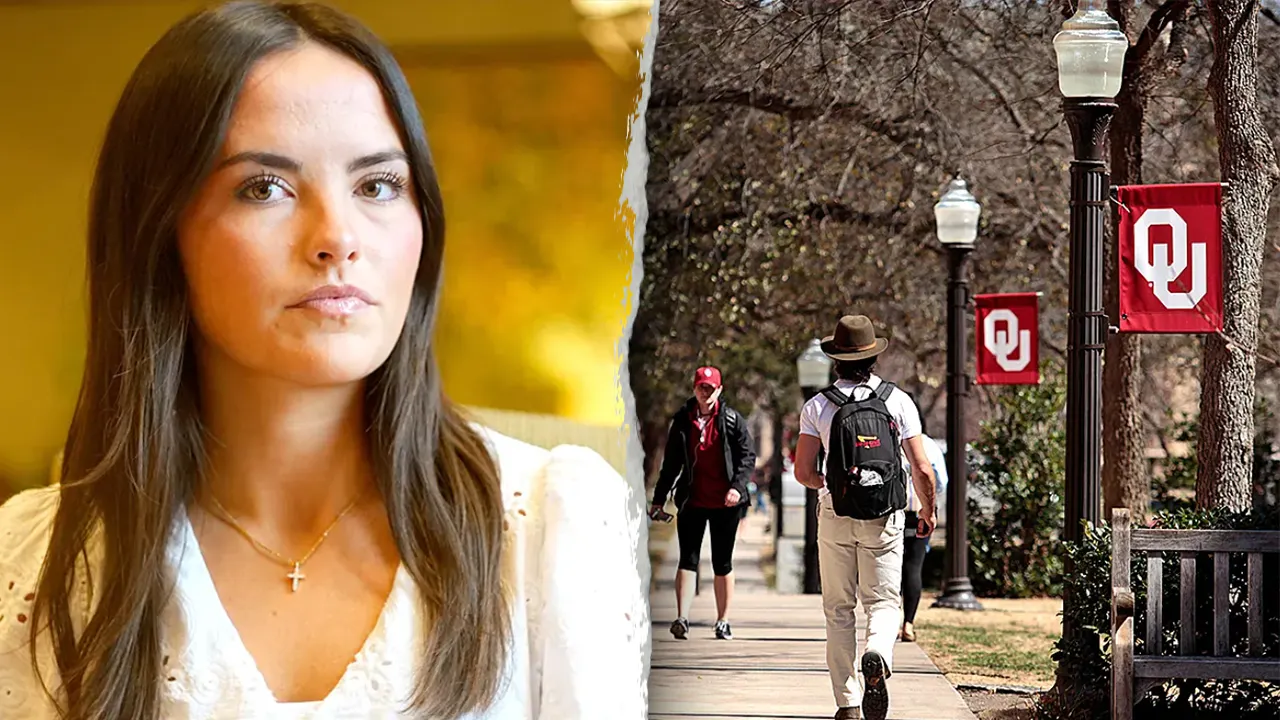
University of Oklahoma Embroiled in Academic Freedom Controversies
In a series of events that has drawn national attention, the University of Oklahoma has found itself at the center of multiple controversies involving allegations of viewpoint discrimination and academic freedom. What began with a dispute over a student’s religiously-informed essay has cascaded into a broader examination of how political and religious perspectives are treated in university classrooms.
At the heart of the initial controversy is junior student Samantha Fulnecky, who received a zero grade on an essay in which she expressed her Christian beliefs in response to a scholarly paper about gender norms among middle schoolers. Teaching assistant William “Mel” Curth, who uses she/they pronouns, failed Fulnecky’s essay despite the assignment asking for students’ personal reactions. In the essay, Fulnecky supported traditional gender norms with biblical references, writing that “society pushing the lie that there are multiple genders and everyone should be whatever they want to be is demonic and severely harms American youth.” Curth’s feedback claimed the paper lacked empirical evidence (though this wasn’t listed as a requirement in the grading rubric) and stated, “I am not deducting points because you have certain beliefs, but instead I am deducting point[s] for you posting a reaction paper that does not answer the questions for this assignment, contradicts itself, heavily uses personal ideology over empirical evidence in a scientific class, and is at times offensive.” Fulnecky expressed shock at receiving a zero, explaining to Fox News Digital that she approached the assignment just as she had others in the class, offering her opinion through her Christian worldview lens.
The situation escalated when the university removed Curth from the classroom after the incident became public. This removal sparked organized protests by students advocating for Curth’s reinstatement. It was at this point that a second controversy emerged: assistant teaching professor Kelli Alvarez allegedly offered excused absences to students who wished to participate in the pro-Curth protest, but denied the same accommodation to a student who wanted to attend a counter-protest. Kalib Magana, president of the local Turning Point USA chapter, reported that when he requested an excused absence to counter-protest, Alvarez denied his request unless he could organize a “documented group” of counter-protesters. Turning Point USA characterized this decision as discriminatory, stating: “His freedom of speech and his ability to receive an excused absence were made dependent on others agreeing to participate in his counter-protest and share his beliefs. This is incredibly anti-free speech and discriminatory toward an opposing viewpoint.”
The university responded swiftly to these allegations of viewpoint discrimination. In a statement released on social media, the University of Oklahoma acknowledged that “a lecturer allegedly demonstrated viewpoint discrimination by excusing students who intended to miss class to attend a protest on campus, but not extending the same benefit to students who intended to miss class to express a counter-viewpoint.” The university affirmed that a school director had immediately stepped in, declaring that the lecturer’s actions were “inappropriate and wrong” and emphasizing that “the university classroom exists to teach students how to think, not what to think.” The statement further clarified that all students, regardless of viewpoint, would be excused without penalty if they attended either the protest or counter-protest.
Taking decisive action, the university removed the professor (reportedly Alvarez) from teaching for the remainder of the semester and placed her on administrative leave pending investigation. The university’s statement underscored the principle that “classroom instructors have a special obligation to ensure that the classroom is never used to grant preferential treatment based on personal political beliefs, nor to pressure students to adopt particular political or ideological views.” This response demonstrates the institution’s formal commitment to maintaining viewpoint neutrality in academic settings, though critics may question whether such principles are consistently applied across the university.
These incidents at the University of Oklahoma highlight the ongoing tensions in higher education between religious expression, political viewpoints, and academic expectations. For students like Fulnecky, the ability to express religiously-informed perspectives in academic settings feels increasingly constrained, while advocates for Curth might argue that certain religious viewpoints can create hostile environments for other students. Meanwhile, the second controversy involving protest participation reveals how these tensions extend beyond course content to affect administrative decisions about student attendance and participation in campus activities. These events illustrate the complex challenge universities face in balancing multiple commitments: to academic rigor, to religious and political pluralism, and to creating learning environments where diverse perspectives can be expressed and evaluated respectfully.
As the investigations continue, the University of Oklahoma case joins a growing number of disputes nationwide over how religious and political viewpoints are treated in university classrooms. For conservative students who often feel marginalized in academic settings, incidents like these reinforce concerns about ideological bias in higher education. For university administrators, the challenge remains finding ways to uphold academic freedom while ensuring that classrooms remain spaces where students can express diverse viewpoints without fear of punishment for holding unpopular beliefs. The resolution of these incidents will likely be watched closely by students, faculty, and higher education observers across the country as universities continue to navigate these difficult terrain.