





The Uncomfortable Privilege: Reflecting on Activism, Grief, and Self-Awareness
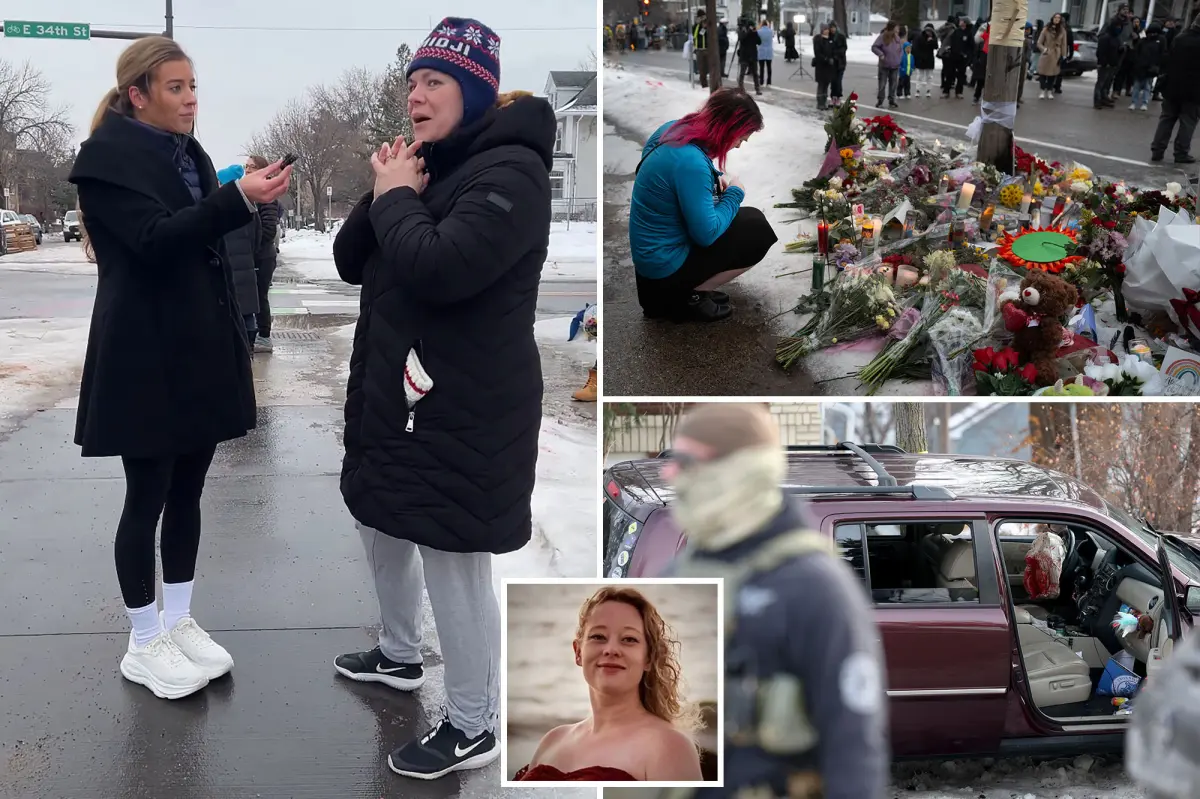
In a moment that captured the complex interplay of privilege, activism, and grief, a protester in Minnesota found herself at the center of social media scrutiny after expressing her discomfort about visiting Renee Nicole Good’s memorial site. In footage that quickly spread across platforms, the woman, who identified herself as white and privileged, told a Daily Wire reporter that being at the memorial “feels kind of wrong.” Her comment—”I feel like white tears are not always helpful or necessary”—sparked immediate reactions online, with many pointing out that Good herself was white. The protester continued by acknowledging that “Black and brown people have been experiencing this for a long time,” suggesting that her presence might somehow appropriate or diminish others’ long-standing struggles. This brief interview illuminates the sometimes confusing territory of allyship, where well-meaning individuals can become so concerned with acknowledging their privilege that they create additional barriers to authentic human connection across racial lines.
The social media response to the woman’s comments revealed the polarized nature of discussions around race, privilege, and mourning in America. Users quickly labeled her remarks as examples of being “propagandized” or suffering from “woke mind virus,” while others simply described her perspective as “insane.” These reactions highlight how expressions of racial awareness, even when well-intentioned, can sometimes appear performative or disconnected from the specific context at hand. The comment “Does she realize Renee was also white?” emerged as a common critique, suggesting that the protester had perhaps applied a racial lens to a situation where it wasn’t entirely applicable. This disconnect demonstrates how frameworks for understanding privilege can sometimes be applied broadly without attention to the specific details of individual cases, potentially creating confusion rather than clarity in conversations about social justice.
The incident occurred against the backdrop of widespread anti-ICE protests that erupted following the fatal shooting of Good by an Immigration and Customs Enforcement agent in Minneapolis. According to federal authorities, the agent fired after Good allegedly attempted to hit him with her SUV, though this account has become the subject of intense dispute and public outcry. The politically charged nature of immigration enforcement in America provided fertile ground for the rapid politicization of Good’s death, with reactions splitting predictably along partisan lines. While then-President Trump quickly defended the agent’s actions as self-defense, many Democratic leaders and activists viewed the incident as emblematic of excessive force by federal authorities, particularly those involved in immigration enforcement.
This local tragedy, quickly elevated to national attention, exemplifies how individual deaths increasingly become symbolic battlegrounds in America’s culture wars. The memorial site where the protester expressed her discomfort wasn’t simply a place of mourning but had transformed into a politically charged space where one’s presence could be interpreted as taking a position. In such contexts, even expressions of grief become complicated by considerations of identity, privilege, and political alignment. The protester’s concern about the appropriateness of her presence reveals how deeply these considerations can affect even the most human response to tragedy—showing up to acknowledge a life lost. Her hesitation reflects a broader uncertainty many Americans feel about how to navigate spaces where identity politics and genuine human empathy intersect.
The response to this brief interview demonstrates how social media amplifies and often distorts moments of vulnerability or confusion. What might have been a stumbling, imperfect expression of solidarity became fodder for mockery and political point-scoring online. Comments like “Critical theory has extruded her emotions into thermoplastic string” reflect how academic frameworks around privilege and race have entered mainstream discourse, often becoming simplified or caricatured in the process. The suggestion that New York City’s “socialist Mayor” should “hire this lady, stat!” further politicizes what might have been simply an awkward moment of a person trying to reconcile her desire to show support with her concern about centering herself in someone else’s tragedy. This transformation of personal reflection into political spectacle has become increasingly common in our digital age, where nuance is frequently sacrificed for virality.
Perhaps what’s most telling about this incident is how it reveals the genuine confusion many Americans feel when trying to navigate the intersection of racial awareness and basic human empathy. The protester’s concern that her “white tears are not always helpful or necessary” suggests she has internalized certain critiques about white emotional responses to racial injustice, but applied them in a context where they created more confusion than clarity. Her discomfort represents a broader societal growing pain—the sometimes messy process of developing greater awareness around privilege while maintaining authentic human connections across differences. Rather than simply mocking her comments as “woke mind virus,” we might consider how this moment reflects the difficult, imperfect work of reconciling personal identity with collective solidarity. In a nation still struggling to have productive conversations about race, privilege, and justice, perhaps these awkward moments are inevitable steps on the path toward more authentic understanding.