






The Evolution of Military Recruitment Advertising in Ukraine: Shifting Strategies in a Long War
In the urban landscape of Ukraine, military recruitment advertisements have become as much a part of the visual environment as traffic lights or street signs. From towering billboards to street corner posters, these visual appeals for military service offer more than just recruitment messaging—they chronicle the psychological evolution of a nation at war, reflecting changing public attitudes and military needs as the conflict with Russia has stretched into its third year.
From Patriotic Fervor to Nuanced Appeals: The Shifting Tone of Ukraine’s Military Recruitment
When the first recruitment campaigns emerged in spring 2023, Ukraine was preparing for a highly anticipated counteroffensive to reclaim Russian-occupied territories in the south and east. The messaging at this time reflected a nation united in purpose, with brigades like the Third Assault Brigade—founded by former far-right politician Andriy Biletsky—deploying stark imagery of armor-clad soldiers advancing across scorched battlefields. “Join the decisive battle,” these early ads proclaimed, drawing on a national spirit of resistance that had characterized Ukraine’s response to the Russian invasion.
“We wanted to show that if you don’t fight now, darkness will prevail,” explained Khrystyna Bondarenko, the Third Assault Brigade’s head of media, describing the unit’s early campaign strategy.
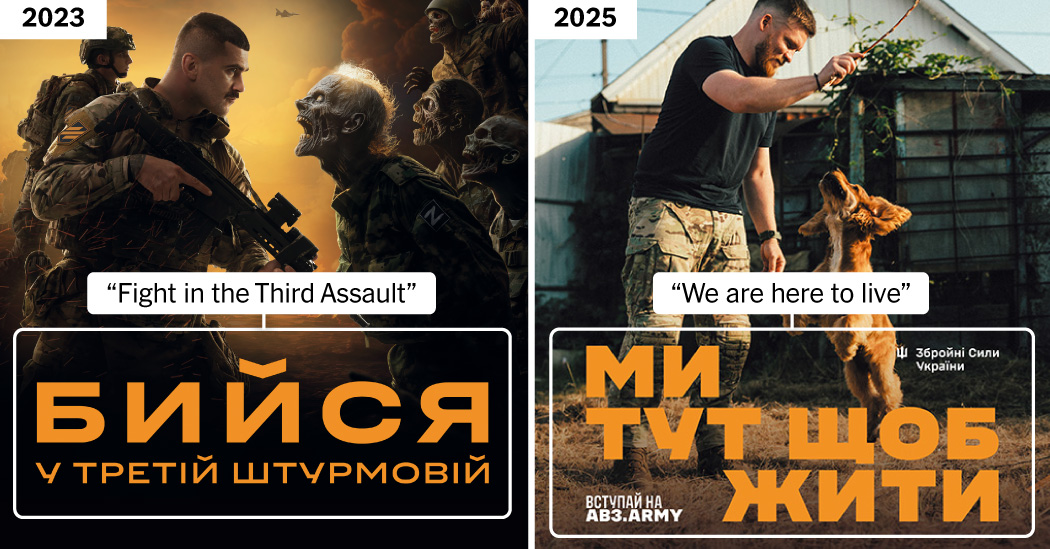
But as the months passed and the counteroffensive faltered, capturing only a handful of villages at significant human cost, the initial enthusiasm for military service began to wane. By late 2023, the Third Assault Brigade’s advertisements had evolved to portray the conflict as an existential battle, featuring Ukrainian fighters confronting zombies and monsters—a metaphorical representation of Russian forces that the campaign creators said reflected how many Ukrainians viewed Moscow’s troops as “brainwashed by Kremlin propaganda and mindlessly killing at will.”
This shift marked the beginning of a strategic evolution in how Ukraine’s military units would approach recruitment advertising, responding to the public’s changing relationship with a war that showed no signs of ending quickly.
“Fighting Doesn’t Mean Dying”: Addressing Fear Through Diversified Military Roles
By the end of 2023, with the war settled into a bloody stalemate and Ukraine needing to replenish its ranks after the failed counteroffensive, military recruitment faced a significant challenge: growing reluctance among eligible Ukrainians to enlist for what many feared would be a one-way ticket to the front lines.
The response from brigade marketing teams was swift and strategic. Campaigns shifted to emphasize that military service encompassed far more than direct combat roles. The Azov National Guard unit launched advertisements with the tagline “The military needs different professions,” featuring illustrations of hands holding stethoscopes, wrenches, and pens—visual reminders that doctors, mechanics, and administrative staff were as vital to the war effort as frontline soldiers.
Similarly, the Third Assault Brigade highlighted how technological evolution, particularly the proliferation of drones on the battlefield, was creating new military roles that required technical expertise rather than traditional combat skills. Their advertisements began featuring soldiers in goggles piloting drones or working on laptops, signaling that modern warfare required minds as much as muscle.
“People were afraid that as soon as they joined the army, they would be sent to the front lines not knowing what to do,” explained Vsevolod Kozhemyako, a businessman who founded the Khartiia brigade at the start of the war. To counter this perception, his unit launched ads promising NATO-style training and financial support, featuring images of brigade members who “looked more like IT workers than soldiers” with weapons notably absent from many photographs.
These campaigns addressed not only fear of combat but frustration with Ukraine’s military administration system, which many viewed as bureaucratic and inefficient, often assigning recruits to roles that didn’t match their skills after minimal training. Khartiia’s advertising promised something different: “We always need people with good business skills,” Kozhemyako noted. “So we were telling them they would be used based on their skills.”
“It’s Cool to Be in the Army”: Glamorizing Military Service to Counter Draft Avoidance
The summer of 2024 saw Ukraine embark on a major mobilization drive, with new legislation requiring all men aged 18 to 60 to register on a government website—potentially the first step toward being drafted. With authorities setting ambitious targets of 30,000 new soldiers monthly, many eligible men went into hiding to avoid conscription.
Military units responded by reimagining their recruitment campaigns once again, this time portraying military service as not just necessary but desirable and even fashionable. The Third Assault Brigade led this shift with campaigns targeting younger men through cultural references designed to resonate with youth demographics. Their advertisements incorporated anime-style visuals and narratives showing brigade members battling “zombie-like Russian soldiers” while forming strong bonds with comrades on the training ground.
The brigade’s media team embraced artificial intelligence to produce these advertisements—a practical solution that saved resources by eliminating the need to pull soldiers from the front for photo shoots while opening new creative possibilities. “Summer, FPV, Third Assault,” proclaimed one such AI-generated advertisement showing a drone pilot relaxing in a deckchair on a beach, playing on the widespread belief that drone operation offered a safer alternative to traditional combat roles—though this perception would later change as drone pilots themselves became prime targets for enemy strikes.
Perhaps the most controversial campaign came when the Third Assault Brigade ran advertisements showing models lounging on soldiers’ laps or embracing them on motorcycles. “If you join the brigade, beautiful girls will love you,” was the unsubtle message, according to Bondarenko. While criticized as sexist by many observers, she maintained that the campaign proved highly effective, generating up to 250 applications daily to join the brigade.
Playing on Pride: Appeals to Duty and Honor in a Fatigued Nation
By early 2025, as Ukraine entered its fourth year of full-scale war, national fatigue had become palpable. The message that military life was pleasant or glamorous no longer resonated with a population experiencing the grinding reality of protracted conflict. Military recruitment strategists pivoted again, this time appealing to people’s sense of pride, duty, and desire for respect.
Azov led this new approach with a video advertisement set in a hair salon, where two women contrast their situations: one laments being unable to celebrate her husband’s birthday because he fears being drafted if he leaves home, while the other casually mentions plans to travel to Italy. When asked if her husband received an exemption from service, she replies simply, “No. Mine is in Azov,” leaving the salon in meaningful silence.
The advertisement served multiple purposes: shaming those evading service, highlighting the pride associated with joining a unit renowned for its resistance to Russian assaults, and subtly noting that while martial law prevents most civilian men from leaving the country, soldiers can receive permission to travel abroad during leave periods.
Another Azov advertisement showed a young recruit video-calling his mother from training to tell her, with a slight smile, “Mom, I’m joining Azov.” According to Oksana Bondarenko, Azov’s communications head, the campaign addressed the reality that “most young men say that when they decide to join the army, they’re afraid to tell their parents—mostly so that their mothers do not get upset,” while suggesting that military service might actually make one’s family proud.
Preparing for the Long Haul: Military Service as a Career Path
As American-led peace talks faltered and Russia continued pressing its assaults in eastern Ukraine during mid-2025, Ukrainians increasingly recognized they faced a prolonged conflict. The military responded with organizational restructuring, expanding the Third Assault, Azov, and Khartiia brigades into corps with additional subordinate units.
These newly formed corps began marketing military service as a sustainable career path rather than a temporary sacrifice. Khartiia deployed advertisements showing giant soldiers in uniform working amid city skyscrapers, visually equating them with business professionals. Under the tagline “Grow With Khartiia,” the campaign framed enlistment as a strategic career decision with long-term benefits.
“You can build your career in the military,” explained Kozhemyako, emphasizing that recruits could gain skills valuable in the civilian job market after their service.
Meanwhile, the Third Assault Corps adopted perhaps its most striking shift in messaging. “We’re here to live,” declared advertisements showing soldiers cuddling babies and playing with dogs—with weapons conspicuously absent for the first time in the unit’s recruitment materials. “We want to show that life continues even during war,” explained Bondarenko, acknowledging the dramatic evolution from the unit’s earlier zombie-themed ads that had emphasized death and combat.
“We want to guess the moods of people to understand how to better recruit them,” Bondarenko reflected. “Moods really changed.”
Indeed, the transformation of Ukraine’s military recruitment advertising from urgent calls to battle to nuanced portrayals of military service as a normal part of life reflects not just marketing strategy but a nation’s psychological journey through prolonged conflict. As Ukraine continues to defend itself against Russian aggression, these visual appeals for service stand as cultural artifacts documenting how a society adapts to the realities of long-term warfare—balancing patriotic duty with human concerns about safety, career development, and maintaining normalcy amid extraordinary circumstances.