

US Lifts Sanctions on Brazilian Justice Alexandre de Moraes, Citing Strategic Interests
Trump Administration Shifts Position on Controversial Brazilian Judge
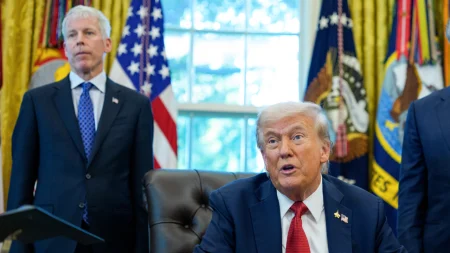
In an unexpected policy reversal that has significant implications for US-Brazil relations, a senior Trump administration official announced today that the United States would be lifting sanctions previously imposed on Brazilian Supreme Court Justice Alexandre de Moraes. The decision comes after months of diplomatic tension between the two nations, with the official stating that “maintaining sanctions against Justice Moraes is no longer in the interest of the United States.”
The sanctions, initially implemented following allegations that Moraes had overstepped his judicial authority in several high-profile cases involving social media regulation and political speech, had become a point of contention in the bilateral relationship between Washington and Brasília. The Brazilian government had consistently maintained that the sanctions represented an unwarranted intrusion into the country’s sovereign judicial matters, while supporters of the measures in the US argued they were necessary to uphold democratic principles and freedom of expression in the region.
“After careful review of the situation and extensive consultation with our diplomatic and intelligence communities, we have determined that our strategic interests are better served through engagement rather than continued punitive measures,” explained the administration official, who spoke on condition of anonymity due to the sensitive nature of the discussions. “This does not represent an endorsement of all of Justice Moraes’s decisions, but rather a recognition that our bilateral relationship with Brazil requires a more nuanced approach.”
Geopolitical Considerations Drive Policy Shift
The decision to lift sanctions appears to be motivated by broader geopolitical considerations, coming at a time when the United States is seeking to strengthen alliances in South America amid growing Chinese and Russian influence in the region. Brazil, as the largest economy in Latin America and a member of the BRICS association, represents a crucial strategic partner for Washington in its efforts to maintain hemispheric stability and advance American economic interests.
“We’re witnessing a pragmatic recalibration of US foreign policy priorities,” said Dr. Elena Vasquez, director of the Center for Latin American Studies at Georgetown University. “While human rights and democratic governance remain important pillars of American diplomacy, the administration is clearly signaling that it values the overall relationship with Brazil enough to set aside specific disagreements about judicial conduct.”
The timing of the announcement is particularly noteworthy, coming just weeks before a scheduled regional summit where President Trump and Brazilian President Jair Bolsonaro are expected to discuss expanded trade opportunities and security cooperation. Sources familiar with the preparations for the summit indicate that the sanctions issue had emerged as a potential obstacle to more substantive agreements on economic and defense matters.
Justice Moraes at Center of Digital Speech Controversy
Justice Alexandre de Moraes has become one of the most polarizing figures in Brazilian politics in recent years, gaining both fierce critics and staunch defenders for his aggressive approach to combating what he has characterized as digital disinformation campaigns. As the head of Brazil’s electoral court and a sitting Supreme Court justice, Moraes has issued numerous orders demanding the removal of social media content and, in some cases, the suspension of entire platforms that failed to comply with Brazilian court directives.
These actions have placed him at the center of an international debate about the proper limits of judicial authority in regulating online speech. His supporters argue that his interventions have been necessary to protect Brazilian democracy from coordinated disinformation efforts, particularly during election periods. Critics, including many US lawmakers who supported the sanctions, contend that his rulings represent judicial overreach and pose a threat to free expression.
“Justice Moraes has been fighting a lonely battle against powerful forces seeking to undermine our democratic institutions through digital means,” said Maria Costa, a professor of constitutional law at the University of São Paulo. “While his methods may seem heavy-handed to outside observers, they must be understood within the context of Brazil’s specific challenges regarding misinformation and extremism.”
Implications for US-Brazil Relations and Regional Dynamics
The decision to lift sanctions is expected to remove a significant irritant in US-Brazil relations and potentially open the door to enhanced cooperation on issues ranging from environmental protection to regional security. Brazilian officials have reportedly welcomed the move, with Foreign Minister Carlos Alberto Franco França calling it “a positive step toward mutual respect and understanding between our nations.”
The shift also sends a signal to other countries in the region about the evolving nature of US foreign policy priorities under the current administration. Analysts suggest that practical considerations related to trade, security, and regional stability are taking precedence over ideological concerns about specific judicial practices, at least in cases where broader strategic interests are at stake.
“This represents a classic example of realpolitik,” observed former US Ambassador to Brazil Thomas Shannon. “The administration has made a calculation that whatever concerns exist about Justice Moraes’s approach to content regulation, they don’t outweigh the importance of maintaining productive relations with a key regional power like Brazil.”
Congressional Reaction and Domestic Political Considerations
The announcement has generated mixed reactions on Capitol Hill, where some lawmakers had been vocal advocates for the sanctions. Senator Marco Rubio, who chairs the Senate Foreign Relations Subcommittee on Western Hemisphere affairs, expressed disappointment with the decision, stating that it “sends the wrong message about America’s commitment to defending free speech globally.”
However, other members of Congress have supported the move, arguing that engagement rather than isolation is more likely to produce positive changes in Brazilian judicial practices. “We can continue to advocate for our values while recognizing that sanctions aren’t always the most effective tool,” said Representative Gregory Meeks, ranking member of the House Foreign Affairs Committee. “This opens the door for more productive dialogue on democratic governance.”
The decision also reflects certain domestic political calculations, as the administration seeks to demonstrate diplomatic achievements ahead of the upcoming election season. Improving relations with Brazil, a country with significant economic ties to the United States and a large diaspora community of Brazilian-Americans in key swing states like Florida, could potentially yield electoral benefits.
A Pragmatic Turn in US Foreign Policy
The lifting of sanctions against Justice Moraes represents more than just a shift in US-Brazil relations; it signals a broader pragmatic turn in American foreign policy that prioritizes strategic interests over ideological purity. By removing this particular point of friction, the administration appears to be acknowledging the complexity of international relationships and the need for flexibility in pursuing American objectives abroad.
“Foreign policy is rarely about perfect solutions,” said Richard Haass, president of the Council on Foreign Relations. “It’s about making difficult choices between competing priorities. In this case, the administration has determined that the benefits of improved relations with Brazil outweigh the symbolic value of maintaining sanctions on a single judicial figure, however controversial.”
As both nations prepare for their upcoming summit, attention will now turn to whether this gesture of diplomatic goodwill translates into tangible progress on other bilateral issues, from climate change cooperation to defense partnerships. What remains clear is that the decision represents a calculated strategic choice by the Trump administration to prioritize the broader relationship with Brazil over specific concerns about judicial conduct, reflecting the complex realities of great power competition in the 21st century.