





Iran’s Civilian Infrastructure in Ruins: The Hidden Toll of U.S.-Israeli Strikes
In the uneasy calm following a delicate ceasefire brokered amid escalating tensions, Iran’s landscape reveals a stark picture of widespread devastation. U.S.-Israeli airstrikes, initially aimed at military targets, have left deep scars on the nation’s civilian fabric, with schools and hospitals bearing the brunt of the destruction. A meticulous investigation by The New York Times has uncovered damage to at least 22 schools and 17 health care facilities across Iran—a grim tally that scratches the surface of a far larger catastrophe unfolding since the conflict erupted on February 28.
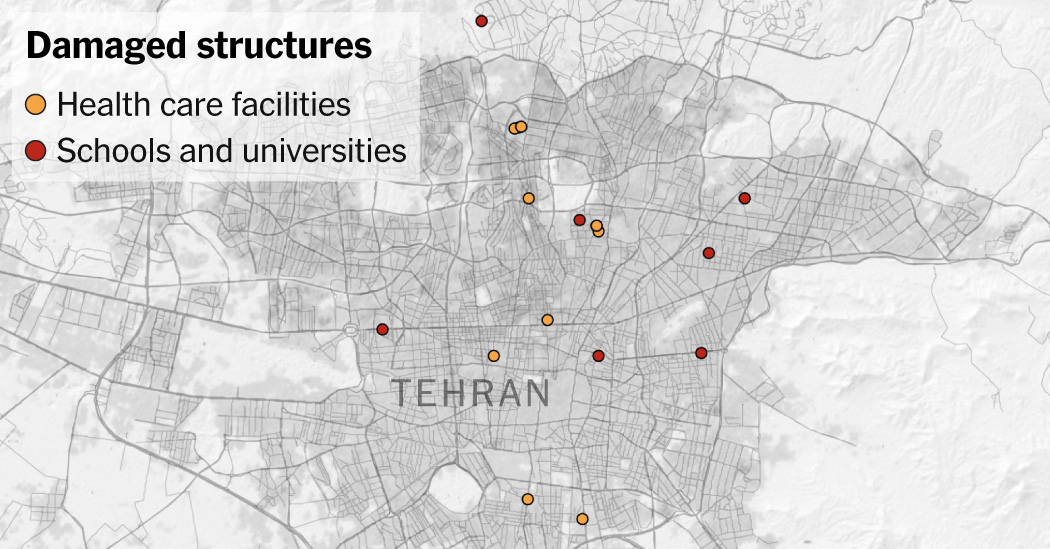
The Times’ analysis, drawing on high-resolution satellite imagery and verified footage from Iranian state media, social platforms like X (formerly Twitter), Telegram, and Instagram, mapped out these injuries to essential civilian structures. Among the sites identified, Hedayat Boys’ High School in Tehran stands as a poignant example, its once-bustling grounds now littered with debris. Nearby, Shajarah Tayyebeh Elementary School in Minab echoes a similar tragedy, its colorful walls—painted blue and pink, clearly marking it as a place of learning—shattered by the force of missiles. Shaghayegh Girls’ School and Shahid Mahallati Elementary School further illustrate the indiscriminate impact, with images captured by local outlets showing partial collapses and scattered furniture, remnants of lives interrupted. Health care outposts weren’t spared either; the Motahari Burn and Trauma Hospital and Dr. Safaeian Medical Clinic, as detailed in the grid of verified locations, suffered substantial blows, their roles in healing now compromised.
Yet this documented toll pales in comparison to the broader scale of ruin described by Iran’s humanitarian responders. The Iranian Red Crescent Society, the country’s lifeline in crises, assessed on April 2 that an alarming 763 schools and 316 health care facilities had been hit or obliterated since the war’s outset. Their figures paint a crisis far exceeding The Times’ verified count, underscoring how extensive the fallout has been. Areas like Tehran, a sprawling metropolis of 10 million teeming with daily life akin to New York City’s density, have seen relentless bombardments that turn urban hubs into battlegrounds. Residential buildings, commercial spaces, and transportation networks have also crumbled, with over 46,000 units damaged in the capital alone, according to the society’s reports.
This relentless cycle of strikes has exacted a human cost that’s impossible to fully quantify. The Human Rights Activists News Agency estimates at least 1,701 civilian deaths in Iran as of recent tallies, including students, educators, and medical personnel caught in the crossfire. In the fog of war, determining responsibility between U.S. and Israeli forces often proves elusive; strikes sometimes clipped nearby military installations, while others appeared to zero in directly on schools and hospitals. International humanitarian law holds intentional attacks on such protected sites as potential war crimes, demanding that commanders take every precaution to shield civilians. Even collateral damage from precision strikes on dual-use targets can breach these norms if precautions falter. Experts warn that this erosion of safeguards threatens the very foundations of ethical warfare, leaving communities shattered in its wake.
The war’s earliest salvos delivered some of its most harrowing blows, targeting vulnerable children and shattering families before they could even adjust to the chaos. On February 28, the first day of hostilities, a deadly strike ravaged Shajarah Tayyebeh Elementary School in the southern town of Minab, claiming at least 175 lives, mostly young students, according to Iranian health authorities. Preliminary findings from a U.S. military probe, shared with officials and sources close to the inquiry, pointed to American forces using outdated intelligence that misidentified the site as a military asset. The school, once integrated with a naval base, had been distinctly separated for at least a decade, its playgrounds and pastel exteriors unmistakable signs of civilian use. Despite this, it was bombed with new U.S.-manufactured ballistic missiles, sparking outrage and questions about oversight. White House press secretary Karoline Leavitt emphasized the investigation’s ongoing status, while sources noted lingering uncertainties about why faulty data wasn’t rechecked.
Even as the probe into Minab unfolds, that day’s attacks unleashed a chain of horrors elsewhere. In Abyek, west of Tehran, a blast near a communications tower less than 400 feet from Imam Reza Elementary School blasted out windows and sent children scattering for cover. Satellite footage and verified videos showed one boy fatally struck by debris, his image haunting reporters and families. Another assault in Tehran’s Narmak neighborhood, home to former president Mahmoud Ahmadinejad, damaged a nearby high school, killing two students as echoed by semiofficial news outlet Mehr. Down south in Lamerd, a U.S. ballistic missile struck a sports hall hosting a girls’ volleyball team, an adjacent elementary school, and a blood transfusion center, resulting in at least six deaths—including four children—among lists, funeral records, and victim photos scrutinized by The Times. These incidents, bound by their timing and brutality, exposed a ruthless start to the conflict that prioritized military momentum over child safety.
As the weeks wore on, bombings continued to obliterate educational havens, exposing deep flaws in strike planning amid Iran’s suspension of classes nationwide. Shaghayegh Girls’ School in Khomein bore the full weight of a direct hit, reduced to rubble via satellite imagery and social media clips. At the Iran University of Science and Technology in Tehran, a university building crumbled under similar scrutiny, its damage extending to academic institutions like Shahid Beheshti and Sharif University of Technology, as well as elite centers such as Isfahan University of Technology. Even Tamadonsazan Elementary and Shahid Imam Reza Boys’ School were caught in the barrage, their images from platforms like Facebook capturing partial ruins and scattered belongings. University structures, pivotal for Iran’s higher learning, suffered alongside, with the University of Science and Technology in Tehran directly impacted. These persistent assaults, verified through high-res lenses, highlighted how strikes morphed from isolated tragedies into a systemic assault on learning environments, leaving educators and pupils in perpetual limbo.
Medical networks fared no better, with hospitals becoming unintended battlefields forcing desperate evacuations that put lives at further risk. March 1 saw Gandhi Hospital in northern Tehran lose its facade to heavy strikes aimed at nearby Iranian state television facilities, compelling the evacuation of vulnerable patients—including an incubator-bound infant—amid cries from hospital President Dr. Mohammad Hassan Bani Assad about neonatal units, ICU beds, maternity wards, and fertility clinics. Footage from the Iranian Red Crescent, authenticated by The Times, captured emergency workers’ anguish in Bushehr, where a newborn ward’s infants teetered on the brink during forced relocations. One responder, choked with emotion, pleaded for mercy in videos shared via Telegram: “If we disconnect what they’re hooked up to, they will die. Look at them. This poor kid. This dear child.” Such heart-wrenching moments underscored how strikes turned healing spaces into zones of chaos, straining resources for the injured and ill alike.
Tehran’s dense urban sprawl, where half of the verified damages clustered, amplified the perils of such close-quarters warfare, blurring lines between military objectives and innocent bystanders. Strikes on Islamic Revolutionary Guards Corps installations mingled with hits on government offices, intelligence hubs, and police stations, inevitably spilling over into residential zones. In Vanak, repeated bombardments on police headquarters damaged adjoining hospitals, as revealed by satellite analyses. A striking clip near the Red Crescent building, posted on X, captured plumes of smoke enveloping Valiasr Street, a stark testament to the spillover. Legal scholars like Duke University’s Mara Revkin argue these consequences were “within the scope of foreseeable effects,” urging better minimization of civilian harm—a tenet of international law where military gains must outweigh risks to non-combatants.
Yet Pentagon assurances of precision ring hollow against this backdrop, with Defense Secretary Pete Hegseth dismissing Iranian claims of civilian shields as unsubstantiated while boasting about loosened rules of engagement. Critics, including Yale’s Oona Hathaway, decry the dismantling of safeguard systems, from fired legal advisors to shuttered oversight offices, as enabling this carnage. International experts, in an open letter citing potential war crimes, echoed these concerns. President Trump’s flippant dismissal of such allegations, alongside mutual accusations of civilian strikes by both sides, further muddles accountability. U.S. Central Command spokesperson Capt. Tim Hawkins affirmed seriousness but declined specifics on mitigation efforts, while Israeli military statements underscored efforts to comply with armed conflict laws. As the World Health Organization’s Dr. Hanan Balkhy lamented 23 verified attacks on health infrastructures—including 11 on facilities and six in Tehran alone—there’s a growing consensus: this war grinds on, eroding the bedrock of Iran’s societal well-being, one strike at a time. With civilian harm escalating, the path to true resolution demands not just ceasefires, but unflinching scrutiny of the methods leaving these enduring wounds.