




A FAMILY JOURNEY GONE AWRY: THE DOLPHIN RESCUE STORY
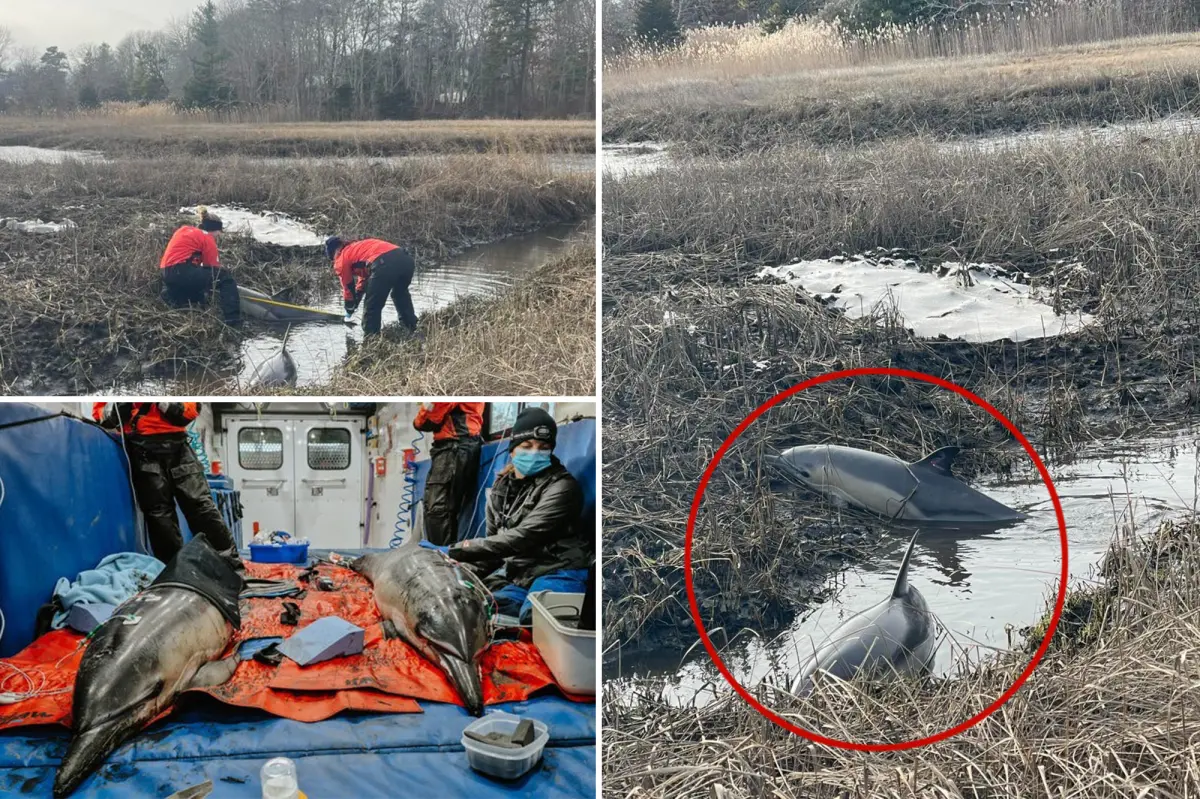
In the quiet waters of Massachusetts, a touching tale of maternal bonds and human compassion unfolded when a mother dolphin and her calf found themselves in a precarious situation. Early December brought an unexpected challenge for these marine mammals when they strayed from their usual oceanic routes and became stranded in the marshlands of Beaverdam Creek, a tributary of the Weweantic River that eventually feeds into the Atlantic Ocean. What began as perhaps a simple navigational error or pursuit of food turned into a life-threatening predicament for this dolphin family, highlighting the delicate balance between wildlife and their ever-changing environments. The Wareham Department of Natural Resources received the distress call on December 8th, immediately responding to reports of the stranded pair. Upon arrival, responders found two common dolphins – alive and alert but partially beached in the marsh, their sleek bodies unsuited for the shallow, muddy terrain they had unwittingly entered. The sight of these magnificent creatures, designed for the open ocean yet trapped in a marshy dead end, prompted quick action from local authorities who recognized the urgency of the situation.
Understanding the specialized care needed for such marine rescues, the Wareham authorities reached out to experts at the International Fund for Animal Welfare (IFAW) Marine Mammal Stranding Response Team based in Cape Cod. These specialists, equipped with years of experience and proper resources for marine mammal rescue, quickly mobilized to the scene. The rescue operation demonstrated the remarkable coordination between local and specialized response teams when wildlife emergencies arise. The IFAW team approached the stranded dolphins with careful precision, aware that such situations create immense stress for marine mammals accustomed to the weightlessness of deep water. “Our teams were easily able to extract the animals and transport them via our custom-built rescue vehicle,” explained Stacey Hedman, IFAW’s senior director of communications. This specialized equipment proved crucial in safely moving the dolphins without causing additional trauma or injury – a testament to how modern conservation efforts have evolved to address wildlife emergencies with increased sophistication and care.
The rescue process involved placing the dolphins on specially designed stretchers that provided support while preventing further injury. Once safely removed from the marsh, the IFAW team conducted preliminary examinations to assess their condition after the ordeal. The smaller dolphin, weighing approximately 90 pounds, was identified as a socially-dependent juvenile female, while the larger 150-pound dolphin was confirmed to be an adult female – establishing them as a mother and calf pair. This familial connection added an emotional dimension to the rescue, as dolphin calves typically remain dependent on their mothers for several years, learning vital survival skills through this extended relationship. Had either animal been left behind or separated during the rescue, the consequences could have been fatal, particularly for the younger dolphin who still relied on her mother for guidance and protection in the vast ocean.
The examination revealed concerns about the mother dolphin’s condition, including decreased responsiveness and abnormal blood work that worried the rescue team. These marine mammals, despite their intelligence and adaptability, can rapidly deteriorate when removed from their natural environment. The stress of stranding can compromise their immune systems and affect vital functions, creating a race against time for rescuers. After thorough assessment, however, the IFAW team determined that both dolphins were healthy enough for release back into the ocean – a decision that balanced immediate medical concerns with the knowledge that prolonged captivity could create additional stress and complications for wild animals. The team selected West Dennis Beach in Dennis, Massachusetts, as the optimal release location, considering factors such as water depth, current patterns, and proximity to known dolphin populations.
The release strategy demonstrated the thoughtful approach modern marine mammal rescuers employ, looking beyond the immediate rescue to the animals’ long-term survival prospects. “By releasing them into an area with many other dolphins around, this would hopefully increase their chances of socialization and survival,” Hedman explained. This consideration highlights how dolphin welfare depends not just on individual health but on social connections within their communities. Common dolphins are highly social creatures that typically travel in pods ranging from dozens to hundreds of individuals, sharing hunting techniques, communication systems, and protective behaviors. Reintroducing the mother and calf to an area with established dolphin presence gave them the best opportunity to either rejoin their original pod or integrate into a new social group, both critical factors for their continued wellbeing in the wild.
The story continues beyond the dramatic rescue and release, thanks to modern tracking technology that allows researchers to monitor the dolphins’ movements without intrusive intervention. “Both animals have satellite tags that are still successfully tracking,” Hedman reported, providing reassurance that the pair remained together and were navigating appropriately after their return to the ocean. These tracking devices, small and minimally disruptive to the animals, represent the intersection of conservation science and compassionate intervention. They allow researchers to gather valuable data on dolphin movements, habitat use, and behavior while confirming the success of the rescue operation. The continued signals from both tags suggest this mother and calf have resumed their oceanic journey together – a happy ending to what could have been a tragedy, made possible by quick-thinking local authorities, specialized rescue teams, and the remarkable resilience of these intelligent marine mammals. Their story stands as a testament to the positive impact humans can have when we respond with knowledge, care, and respect to wildlife in crisis.