






Gaza Under Siege: Israel’s Post-Ceasefire Demolitions Continue Despite Truce Agreement
Satellite Evidence Reveals Extensive Destruction in Gaza Since November Ceasefire
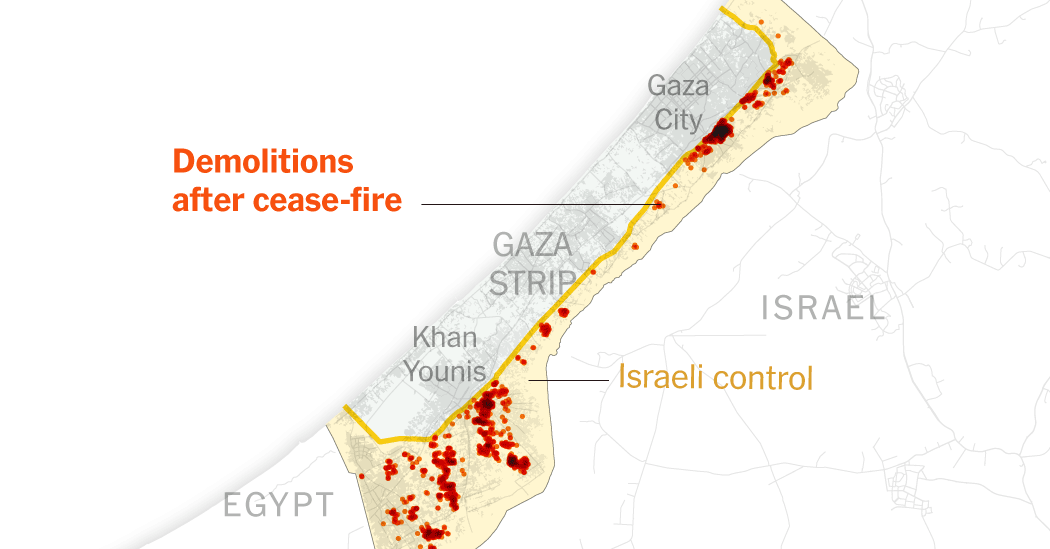
More than two months after Israel and Hamas signed a cease-fire agreement that offered Palestinians a glimmer of hope following two years of devastating bombardment, Gaza continues to witness widespread destruction despite the formal truce. According to an extensive analysis of Planet Labs satellite imagery conducted by The New York Times, Israel has demolished over 2,500 buildings in Gaza since the cease-fire went into effect in November, transforming entire neighborhoods into wasteland.
The Israeli military claims these operations are necessary to dismantle Hamas’s extensive tunnel network and neutralize booby-trapped structures as part of a broader effort to “demilitarize” the enclave. However, the scale and location of these demolitions—including dozens of buildings beyond the agreed-upon withdrawal boundary—have raised serious questions about Israel’s adherence to the terms of the ceasefire. Particularly troubling is evidence from Shejaiya, a Gaza City neighborhood where nighttime footage from October 30 revealed what appears to be a large-scale controlled demolition in an area under Israeli military control, with destruction continuing well past the established boundaries.
“Israel is wiping entire areas off the map,” said Mohammed al-Astal, a Gaza-based political analyst. “The Israeli military is destroying everything in front of it—homes, schools, factories, and streets. There’s no security justification for what it’s doing.” For residents like Niveen Nofal, 35, who was forced to leave Shejaiya, the emotional toll is devastating: “Our hopes and dreams have been turned into mounds of rubble,” she told reporters, expressing the profound sense of loss shared by countless displaced Gazans who watch their former neighborhoods being systematically erased.
Ceasefire Boundaries Breached as Demolitions Extend Beyond Agreed Lines
The ceasefire agreement, based on then-President Trump’s 20-point plan, established a clear demarcation—represented on Israeli military maps as a yellow line—that divided Gaza roughly in half, with Israeli forces maintaining control of approximately 50% of the territory while withdrawing from the remainder. While most demolitions have occurred within Israeli-controlled areas, satellite imagery analysis reveals dozens of buildings have been destroyed beyond the yellow line in areas that were supposed to be free from Israeli military operations under the terms of the truce.
In some locations, the destruction extends as far as 900 feet beyond the withdrawal boundary. Satellite images comparing Shejaiya shortly after the truce with more recent views show clusters of formerly intact buildings reduced to rubble, with significant destruction visible on both sides of the demarcation line. While an Israeli military official, speaking on condition of anonymity, insisted to reporters that ground forces had not crossed the line to conduct demolitions, they acknowledged that aerial strikes and tunnel detonations were occurring that affected structures near and beyond the boundary, raising questions about the ceasefire’s effectiveness and enforcement.
The agreement explicitly called for the suspension of “all military operations, including aerial and artillery bombardment,” while also stating that “all military, terror, and offensive infrastructure, including tunnels and weapons production facilities, will be destroyed.” This apparent contradiction has created a gray area that Israel appears to be exploiting, despite Hamas officials insisting the terms were clear. “The agreement isn’t vague, it’s clear,” said Husam Badran, a senior Hamas official in Qatar. “Destroying people’s homes and property isn’t allowed. They’re hostile actions.”
Tunnel Network Justification Versus Scale of Destruction
Israeli defense officials have repeatedly cited the destruction of Hamas’s underground tunnel network as the primary justification for continued demolitions. At the war’s height, Israeli intelligence estimated that these tunnels spanned hundreds of miles with thousands of entrances, creating a vast subterranean infrastructure that Hamas has used to store weapons, hide hostages, and launch surprise attacks on Israeli forces. Defense Minister Israel Katz underscored this rationale in November, posting on social media that operations would continue “until the last tunnel,” adding bluntly, “If there are no tunnels, there is no Hamas.”
The Israeli military allowed The New York Times to view classified intelligence maps showing an extensive tunnel network beneath Shejaiya and numerous locations where they believe militants have booby-trapped homes and roads. An unnamed military official claimed they aren’t indiscriminately demolishing buildings, suggesting that many structures collapse when explosives are detonated in tunnels beneath them. However, the systematic nature of the destruction visible in satellite imagery raises doubts about this explanation’s completeness.
Former Israeli military commander Shaul Arieli, who led forces in Gaza during the 1990s, expressed skepticism about the current approach, stating: “This is absolute destruction. It’s not selective destruction, it’s everything.” His assessment reflects growing concerns—even among some Israeli security experts—that the demolitions may exceed what is tactically necessary for tunnel elimination, potentially constituting collective punishment of Gaza’s civilian population.
Human Cost of Continued Destruction
The ongoing demolitions compound an already dire humanitarian situation. A United Nations assessment from October found that more than 80 percent of Gaza’s structures were already damaged or destroyed after two years of bombardment. Most residents had already been displaced by evacuation orders and intense fighting, leaving behind homes, businesses, and infrastructure that represented generations of investment and communal life.
For Palestinians, the continued destruction since the ceasefire represents not just physical damage but the erasure of personal and collective memory. “Our memories have been erased,” said Ashraf Nasr, 32, a displaced resident of Shejaiya, who balanced his grief with criticism of both sides: “But Hamas gave Israel the pretext to carry out this disaster. It militarized civilian spaces.”
The scale of destruction extends beyond residential areas. Satellite imagery reveals that entire agricultural zones have been cleared, including farmland and greenhouses vital to Gaza’s food security. This agricultural devastation will have long-term implications for the territory’s ability to recover economically and feed its population, even if fighting permanently ceases.
Implications for Peace Process and Reconstruction
As Israel’s defense minister vows to continue tunnel-elimination operations indefinitely, the prospects for meaningful reconstruction remain distant. The systematic demolition of remaining infrastructure raises profound questions about Gaza’s future habitability and the international community’s role in eventual rebuilding efforts.
The destruction also complicates broader peace negotiations. While both sides agreed in principle to the ceasefire terms, the continued demolitions—particularly those beyond the established withdrawal line—threaten to undermine trust in the agreement and potentially reignite full-scale hostilities. For Gazans caught in this limbo, the ceasefire has provided little actual relief as they witness their homeland being methodically dismantled.
International observers, humanitarian organizations, and displaced residents increasingly question whether security justifications can account for the sheer scale of destruction. As one neighborhood after another is reduced to rubble, the physical landscape of Gaza is being permanently altered in ways that will shape the territory’s reality for generations. The continued demolitions not only violate the spirit of the ceasefire but also create facts on the ground that may make a sustainable peace even more elusive, leaving Palestinians in Gaza to wonder if anything will remain to rebuild once the fighting truly ends.