





A Tale of Faith, Politics, and Immigration: The Minneapolis Controversy
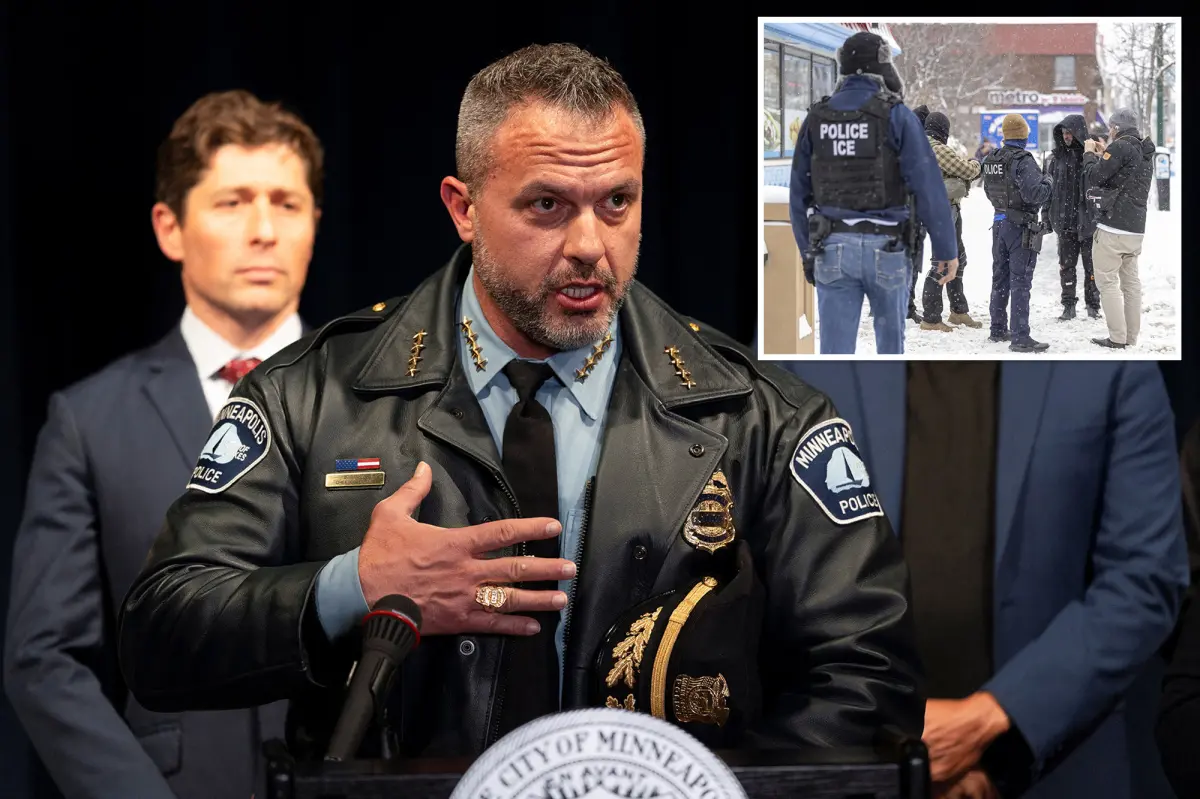
In a striking moment that blended religious imagery with contentious political debate, Minneapolis Police Chief Brian O’Hara found himself at the center of national controversy after invoking the Nativity story during a press conference addressing immigration enforcement. As Christmas approached, O’Hara, standing alongside Mayor Jacob Frey, expressed concern about Immigration and Customs Enforcement (ICE) operations in Minneapolis communities. Drawing from his Catholic upbringing, the police chief made a comparison that would spark intense reaction across the political spectrum: “I cannot help but think of what is happening in our city today and how that echoes with how outsiders have been treated for thousands of years. How Mary and Joseph themselves were considered outsiders and forced to stay in a barn.” This heartfelt reflection, intended to express solidarity with vulnerable community members during the holiday season, instead ignited a firestorm of criticism that revealed deep divisions in how Americans view both religious symbolism and immigration policy in contemporary society.
The response from members of the Trump administration was swift and severe. Stephen Miller, White House deputy chief of staff under the incoming administration, criticized urban police leadership, claiming they inappropriately use phrases like “our community” to include undocumented immigrants. Even more pointed was the reaction from Department of Homeland Security Assistant Secretary Tricia McLaughlin, who accused the Minneapolis Police Chief of refusing to “do his job” and allowing dangerous criminals to “terrorize Minneapolis.” McLaughlin backed her criticism with specific examples, listing the names and criminal histories of four individuals who had been arrested by ICE in Minneapolis, suggesting these cases justified the enforcement operations that O’Hara had questioned. The administration’s position was further solidified by White House spokesperson Abigail Jackson, who called O’Hara’s comparison “unconscionable,” stating firmly: “It’s unconscionable that anyone would compare criminal illegal aliens to the Son of God. Law enforcement officials should enforce the law, not allow dangerous criminal illegal aliens to terrorize American communities while making absurd comparisons.”
The controversy quickly spread beyond government circles, finding particular resonance among conservative commentators and public figures. Women’s rights activist Riley Gaines offered a historical correction to O’Hara’s biblical analogy, noting simply: “Mary and Joseph weren’t illegally in Bethlehem. Hope this helps!” This straightforward challenge to the comparison highlighted a fundamental disagreement about the appropriateness of using the Nativity story as a parallel for modern immigration situations. Former NFL player Benjamin Watson approached the issue from a different angle, expressing concern about the politicization of scripture: “We have to stop using Mary, Joseph and Jesus as pawns in a culture war. Let scripture stand on its own merits without manipulating it to fit an unrelated modern narrative. Problem is most of us don’t read the text.” Watson’s comment reflected a sentiment shared by many people of faith who feel uncomfortable when sacred stories are employed in political contexts, regardless of which side does so.
Other prominent voices added their perspectives, further demonstrating how O’Hara’s comments had touched a nerve in America’s ongoing struggle with questions of immigration, security, and religious values. Conservative radio host Jesse Kelly took a particularly adversarial stance, characterizing O’Hara’s invocation of Christian imagery as manipulative: “Never let the communist use your values against you. He hates you. He hates your values. They’re just tools to him. Tools he can use for the revolution.” This reaction revealed how, for some Americans, discussions of immigration enforcement are viewed through a lens of ideological conflict rather than policy disagreement. Meanwhile, John Daniel Davidson, a senior editor at The Federalist, directed his criticism at what he perceived as religious insincerity, suggesting that O’Hara’s self-identification as “raised Catholic” indicated a superficial understanding of the faith tradition he was invoking. Davidson extended his critique beyond O’Hara, claiming that such “saccharine, brain-dead” interpretations of Christian charity were unfortunately common even among religious leaders.
At its core, this controversy illuminates the profound tensions that exist in American society regarding both immigration policy and the role of religious values in public discourse. O’Hara’s comments came during a period of heightened immigration enforcement activity, when communities with significant immigrant populations were experiencing fear and uncertainty. His impulse to draw on his religious background to express compassion for vulnerable people reflects a longstanding tradition of using faith-based frameworks to approach social justice issues. However, the fierce backlash demonstrates equally strong convictions from those who believe that enforcing immigration laws is itself a moral imperative and that comparing undocumented immigrants to holy figures trivializes both religious tradition and the rule of law. The intensity of the reaction also reveals how potent religious symbolism remains in American public life, even as the country becomes increasingly diverse in both religious affiliation and cultural background.
What began as a local press conference in Minneapolis thus became a national conversation about the intersection of law enforcement, immigration policy, religious faith, and political leadership. The controversy surrounding Chief O’Hara’s Nativity comparison demonstrates how seemingly straightforward expressions of religious sentiment can become lightning rods in America’s highly charged political environment. As Americans continue to wrestle with complex questions about borders, belonging, and belief, this episode serves as a reminder of how difficult it can be to navigate these issues in ways that respect both legal frameworks and human dignity. The debate sparked by O’Hara’s comments – whether they represented inappropriate politicization of religion or a legitimate expression of faith-based compassion – ultimately reflects larger questions about American identity and values that extend far beyond the streets of Minneapolis or the specifics of immigration enforcement policy.