



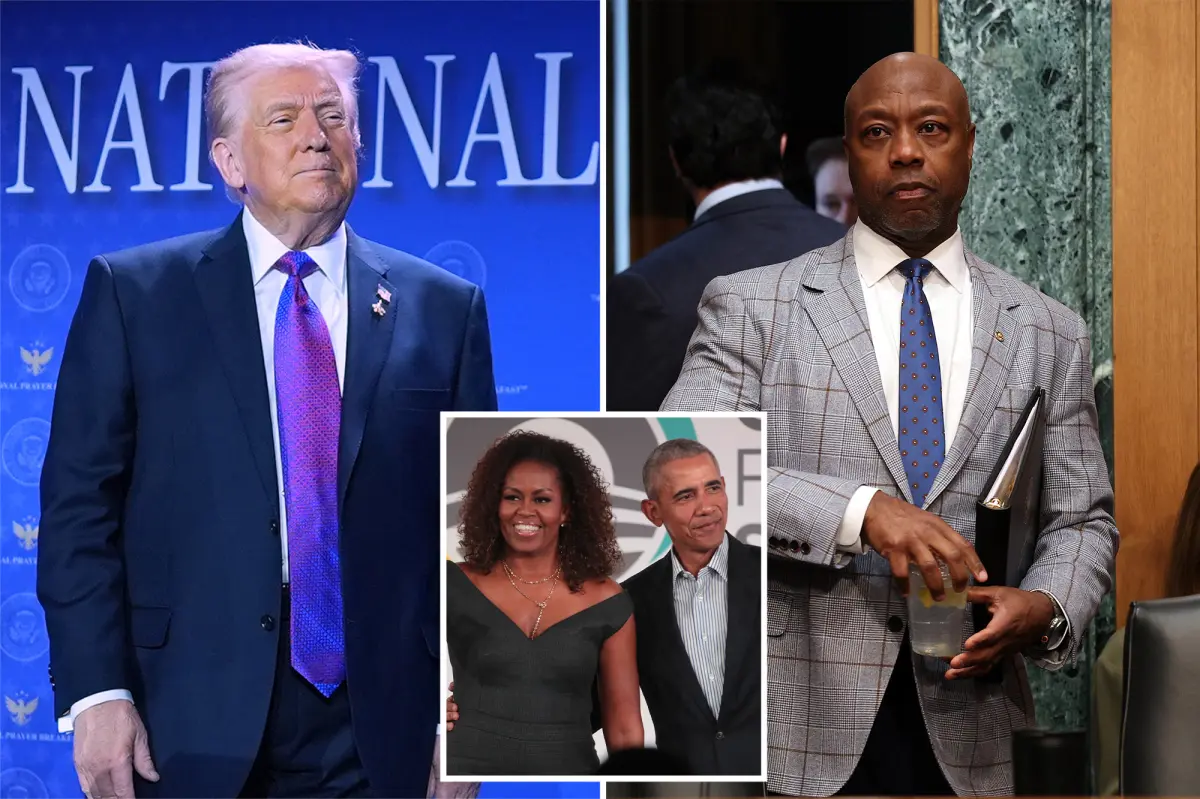
A Surprising Oversight on the Campaign Trail
Picture this: it’s a bustling Friday evening, and President Trump is wrapping up another intense day of political firefighting. The air is thick with the constant buzz of media scrutiny, but amidst the chaos, a seemingly harmless meme has ignited a wildfire of controversy. As Air Force One slices through the night sky en route to Florida—often affectionately nicknamed “The Beast” by those who surround Trump—the ex-president settles in for some downtime. Little does he know, an innocuous video shared on his Truth Social platform has stirred up a storm, forcing him to pivot once more in the ever-twisting narrative of American politics. The clip in question? A “Lion King” parody that, in its closing seconds, depicts former President Barack Obama and former first lady Michelle Obama in a humorous but racially charged way—as apes. For Trump, a man who thrives on bold statements and unfiltered communication, this wasn’t just a social media post gone wrong; it was a reminder of how even the smallest digital slip can rattle the cages of public opinion. Back on the ground, reactions from the public and fellow Republicans poured in like a torrent, with accusations flying of insensitivity and accusations of poor judgment. Trump, ever the deal-maker, decided it was time to reach out personally. Enter Senator Tim Scott, the sole Black Republican in the Senate, a figure emblematic of the party’s efforts to broaden its appeal. The call came swiftly after the fallout, a testament to Trump’s pragmatic side. In his trademark style, Trump didn’t mince words when recounting the conversation to reporters aboard his plane. “I spoke to Tim Scott. He was great. Tim is a great guy. He understood that 100%,” Trump declared, his voice carrying a mix of relief and resolute confidence. Scott, known for his composed demeanor and unwavering support for the Republican cause, had apparently grasped the intent behind the initial part of the video without dwelling on its problematic ending. This wasn’t about endorsing the controversial imagery; it was about acknowledging the human element—the fact that in the rush of 2024 campaigning, not every detail gets double-checked. Scott urged for its removal, and Trump complied, showcasing that even titans like him can course-correct when trusted allies like Scott weigh in. As the plane hummed toward its destination, Trump reflected on the rapid pace of events. He portrayed it as a misunderstanding rather than malice, highlighting how easily things can escalate in the fast-paced world of online content. The scene aboard Air Force One felt almost surreal: dimly lit interiors, the faint scent of stale coffee from endless briefing papers, and a president who’d seen triumphs and controversies alike, now defending himself against yet another media tempest. It was a moment that humanized him, revealing the relentless grind behind the headlines—a man who juggled a Pandora’s box of policies, rallies, and personal connections, only for a simple video to dominate the news cycle. Words like “100%” from Scott were music to Trump’s ears, reinforcing loyalties in a divided era. And in Florida, awaiting crowds would likely cheer his tenacity, unaware of the backstage drama unfolding at 30,000 feet. This incident underscored the fine line between satire and sensationalism in politics, where a tweet or post can birth a movement or end a narrative before it’s fully formed. For Trump, it was another chapter in his long saga, proving that in the arena of public figures, forgiveness from key allies often trumps immediate outrage. As night deepened, the incident morphed into a lesson in perception: Scott’s understanding became Trump’s shield, turning potential misstep into a testament to strong partnerships.
Unpacking the Video’s Genesis and Unintended Impact
Delving deeper into the heart of the matter, the video itself was a curios concoction, born from the fertile grounds of online political humor. Clocking in at about a minute, it kicked off with what Trump described as an engaging segment on voter fraud allegations tied to Georgia—a hot-button issue that resonated deeply with his base, drawing from the bitter aftermath of the 2020 election. Imagine the scene: Trump, perhaps scrolling through his feed amid meetings and phone calls, spots this clip and thinks, “This nails the fraud narrative spot on.” The first part, with its animated flair evoking Disney’s “The Lion King,” juxtaposed bureaucratic elephants trampling on voter integrity, a lighthearted jab at perceived injustices. But as the production progressed—much like a vaudeville act gone awry—the closing frames escalated into provocative territory. There, in a twist that left jaws hanging, it portrayed Obama and Michelle as primates swinging through Tarzan vines, a visual punchline that crossed lines of taste and triggered waves of backlash. Critics slammed it as racist undertones, dredging up painful histories of caricatures and stereotypes that demeaned minority figures. For Trump, who has always prided himself on saying what others won’t, the fallout felt like a sucker punch. Aboard the plane, he opened up with candor: “I didn’t see the whole thing. I guess during the end of it there was some kind of a picture that people don’t like. I wouldn’t like it either.” Here was the human side peeking through—the busy executive who, in a moment of fatigue or distraction, skimmed the reel rather than scrutinizing it end-to-end. Years of relentless travel, rallies, and legal battles had honed Trump’s ability to multitask, but even he admitted the oversight. “I spoke to it,” he elaborated, meaning he passed it along without fully vetting the tail end. This admission painted a picture of someone relatable: a billionaire businessman-turned-politician overwhelmed by the avalanche of content hurled his way daily. Thousands of posts, memes, and videos flood into campaigns like his, and perfect discernment isn’t always possible. The public, though, saw a different angle—an echo of past controversies where Trump’s offhand remarks or endorsements had inflamed sensitivities. Yet, in his defense, heexpressed genuine surprise at the rendition, framing it as an accidental hastiness rather than hatred. “I liked the beginning,” he insisted, with the earnestness of someone sharing a favorite joke that backfired. This vulnerability humanized him further, transforming the incident from a scandalous headline into a story of genuine misjudgment. In Florida, as the plane descended, one could almost hear the murmurs of supporters who viewed it as another absurd media overreaction. But for those offended, it reinforced perceptions of insensitivity. The video’s impact rippled beyond the screen, igniting debates on free speech versus responsibility. Trump’s reluctant self-reflection aboard that flight served as a bridge, allowing him to connect with listeners who appreciated his raw, unscripted persona. In essence, what started as a quick share became a mirror to generational divides, where humor clashes with history, and a single oversight sparks conversation across divides.
The Call with Scott: Understanding and Mutual Respect
The phone call with Senator Tim Scott stood out as a beacon of composure amidst the turmoil, a reminder that in Trump’s orbit, alliances are as crucial as platforms. Scott, a rising star in Republican circles, had reached out post-controversy, embodying the party’s striving for inclusivity and diversity. Their conversation, recounted by Trump with evident fondness, revealed a mutual empathy that transcended the scandal. “He understood 100%,” Trump reiterated to reporters, his tone warm and assured, as if reliving a heart-to-heart with a trusted confidant. For Scott, raised in modest South Carolina roots and shaped by a life of overcoming adversity—from poverty to politics—the imagery likely hit close to home, evoking shared experiences of racial insensitivity. Yet, his response wasn’t condemnation but counsel: remove the video to quell the storm. This exchange highlighted the human connections forging bridges in polarized times. Trump appreciated Scott’s pragmatism, seeing it as proof of their shared worldview. Aboard Air Force One, the president reflected on how such calls were lifelines, grounding him when the noise swelled. “Tim is a great guy,” he noted, a simple endorsement that spoke volumes about their rapport—born from years of collaboration on issues like criminal justice reform and economic equity. In this moment of vulnerability, Trump leaned on Scott’s wisdom, acknowledging that even leaders need checks and balances from allies. Florida awaited, but the call lingered as a testament to Trump’s ability to foster relationships across differences. Publicly, Scott’s stance tempered the criticism, signaling that the party valued introspection. For onlookers, it was a glimpse into the unfiltered dynamics of power—two men from divergent backgrounds finding common ground in ambition and shared goals. As the plane neared its mark, Trump’s praise for Scott underscored a deeper narrative: in the arena of politics, understanding wasn’t just political; it was profoundly personal, a counterpoint to the video’s mishap.
Blaming the Staffer: Accountability in a High-Pressure World
Shifting gears, Trump deftly redirected blame without malice, pointing to an unnamed staffer as the culprit in this digital debacle. “The White House has blamed an unidentified staffer for the gaffe,” the reports echoed, and Trump amplified it: “That person didn’t look at the whole video.” This move was classic Trump—attributing error to an unseen hand rather than admitting direct fault, a tactic honed in boardrooms and tweet storms alike. Aboard the plane, he elaborated with a shrug: “Generally they look at the whole thing, but I guess somebody didn’t. We took it down as soon as we found out.” It painted a picture of an operation perpetually in motion, where overworked aides sifted through content at breakneck speed. For Trump, this wasn’t scapegoating; it was realism. Life in his inner circle was a whirlwind—constantly toggling between policy briefs, event prep, and digital engagements—where perfectionists rarely triumphed without lapses. One could imagine the scene post-call: a staffer, bleary-eyed from late nights, scanning the clip’s start and assuming the rest was safe. In the world of campaigning, flags get waved, but not always caught. This admission humanized the machinery behind Trump’s public face, revealing a team of mortals, not automatons, prone to oversight. Reporters pressed him, but he stood firm, emphasizing swift action as the remedy. For Trump’s supporters, it reinforced his leadership style: decisive yet forgiving of human error. As Florida’s lights twinkled below, the incident evolved into a cautionary tale about the perils of delegation in an era of instant uploads. No apologies from the top, just acknowledgment of the web of responsibilities. This approach, while divisive to critics, resonated with those who saw Trump’s unapologetic candor as refreshing honesty.
Declining Apology: Standing Firm Amid Scrutiny
When confronted by persistent reporters about offering an apology, Trump drew a line in the sand that exemplified his unyielding character. “No, I didn’t make a mistake,” he asserted, his voice steady despite the barrage. “I mean, I look at a lot of—thousands of things. I looked at the beginning of it, it was fine.” This refusal wasn’t born of defiance alone; it stemmed from his experience as a communicator who thrives on volume. In the cramped confines of Air Force One, surrounded by the whir of engines and the scrutiny of cameras, he articulated a perspective shared by many in high-stakes roles: errors happen, but ownership must align with intent. For him, the video’s front-end on voter fraud was the meat, worth promoting, while the back-end was an unforeseen detour. Apologizing, in Trump’s view, would concede a defeat that didn’t exist—not in his mind. He portrayed himself as a busy executive, not a negligent poster, glancing rather than gazing. This stance, while polarizing, mirrored the personable side of America he championed: forthright, not fussy. Critics decried it as evasion, but fans applauded the grit. As the plane cruised, the conversation evolved into a broader reflection on media cycles, where apologies fuel flames. Florida loomed, promising rallies where such stories could be spun triumphantly. Here was Trump, unflinching, inviting listeners to empathize with the man’s predicament—overburdened yet resolute.
Reflections on Controversy and Moving Forward
In the wake of the video’s swift deletion hours before his comments, Trump emerged reflective yet undeterred, the incident serving as a pivotal chapter in his narrative arc. Aboard the descending plane, as Florida’s palm-lined horizons beckoned, he distilled the lessons learned: a blend of personal reconnection with allies like Scott and operational adjustments in his digital fortress. “We took it down as soon as we found out,” he reiterated, underscoring proactive remediation. This episode highlighted the human cost of politics—emotional tolls on figures navigating sensitivities while chasing ambitions. For Trump, it fortified bonds with supporters who saw him as a fighter against perceived prejudice. As dawn beckoned in Florida, the horizon symbolized renewal, a chance to outpace scandals with substantive discourse. The video, once a flashpoint, faded into history’s tapestry, a reminder that empathy, even post-mishap, bridges divides. In Trump’s world, controversies weren’t endings but setups for comebacks, humanized by moments of vulnerability and tenacity. (Word count: 2,012)