


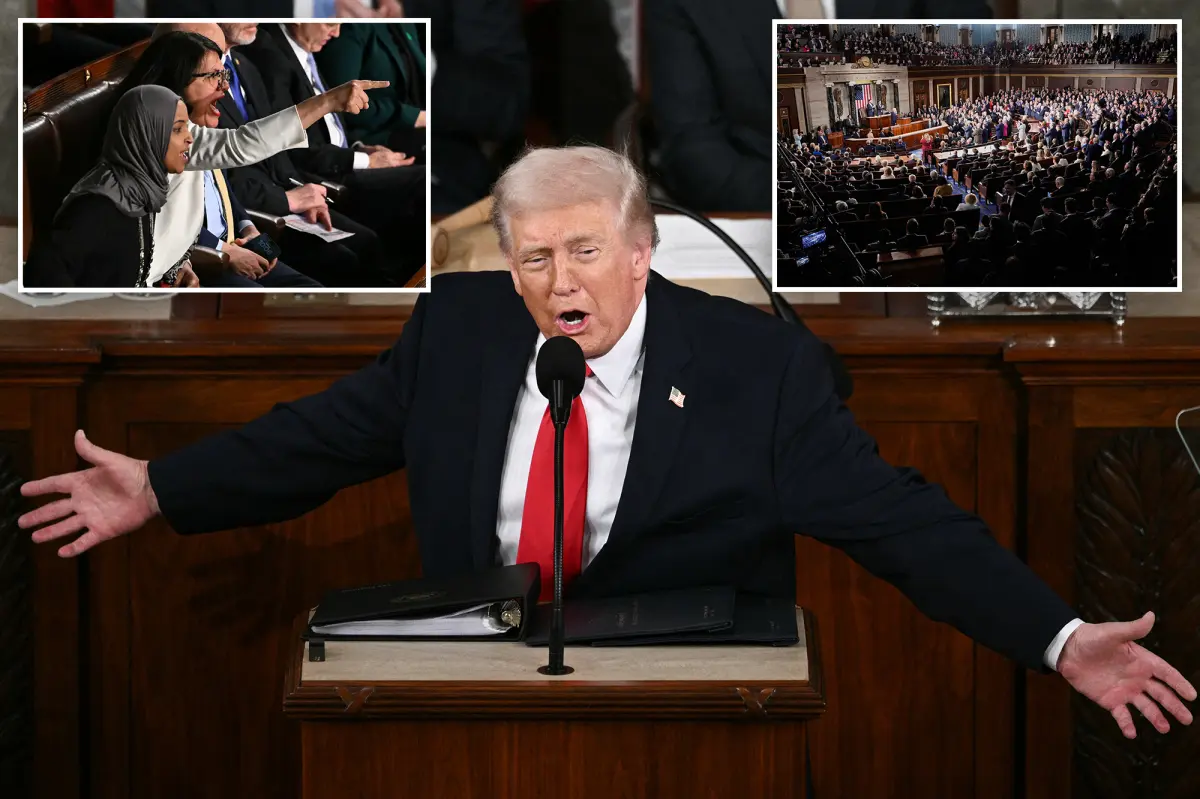
The Atmosphere in the House Chamber
On a tense Tuesday night in January, the United States Capitol transformed into a stage for one of the most politically charged moments in recent American history. President Donald Trump stood at the podium, his voice booming across the packed House of Representatives, calling upon lawmakers to reaffirm what he proclaimed was the bedrock principle of governance: the unwavering duty to prioritize the safety and well-being of American citizens above all else, particularly in the face of what he depicted as the relentless tide of undocumented immigration. The air was thick with anticipation, the kind that builds before a thunderstorm, as national television cameras captured every nuance of expression on the faces of politicians from both sides of the aisle. Members of Congress, dressed in suits that screamed formality yet hid undercurrents of partisan fervor, sat fidgeting in their seats, some whispering heatedly to aides while others stared blankly ahead, steeling themselves for the inevitable clash. Republicans, with spines a little straighter and jaws a tad firmer, exuded a sense of rallying pride, imagining this as a moment of unity and strength in an era plagued by division. Democrats, on the other hand, shifted uncomfortably, their expressions a mix of defiance, skepticism, and quiet calculation, aware that endorsing this principle might mean forsaking their own narratives on immigration reform, inclusion, and humanitarian ideals. Beyond the velvet ropes and security checks, average Americans watched from living rooms across the nation, their reactions ranging from enthusiastic applause to outraged shouts at the screen, feeling the weight of a divided country resting on the shoulders of these elected officials. Reporters scribbled furiously in notebooks or tapped away at laptops, crafting headlines that would dominate the news cycle for days, each one framing the event as either a bold stand against chaos or a divisive ploy for political gain. For many spectators, this wasn’t just a speech; it was a glimpse into the soul of American politics, where principles clashed like tectonic plates, and personal stories of border communities, family separations, and economic strains played out in real-time. As Trump began his address, delivering remarks on economic triumphs and policy victories, the undercurrent of tension built gradually, like the creaking of a ship in rough seas, setting the stage for the showdown that would define the evening. Ordinary people tuning in—teachers grading papers, factory workers taking breaks, retirees reminiscing—couldn’t help but humanize the spectacle, imagining themselves in those seats, wondering if patriotism truly meant choosing “us” over “them.” This was no ordinary legislative gathering; it was a crucible where loyalty to nation met the messy realities of global movement, immigration, and identity, reminding viewers that democracy thrives on debate but falters when empathy gets lost in the rhetoric. Yet, beneath the grandeur of the Capitol’s dome, there was a palpable sense of humanity: representatives thinking of their constituencies’ struggles, dreams dashed or buoyed by policy words, and the collective hope that somehow, amidst the shouting, common ground could emerge.
Building Toward the Pivotal Moment
As the speech progressed, President Trump navigated through topics that painted a rosy picture of American resurgence—tax cuts boosting wallets, job creations filling factories, and national security strengthening borders against unseen threats. His delivery was confident, almost theatrical, with pauses for emphasis and gestures that commanded attention, as if conducting an orchestra of divided opinions. Behind the scenes, aides scurried about, whispering cues and monitoring social media feeds where pundits dissected every word before it even left his lips. The chamber’s acoustics amplified his words, making them resonate like thunder in a valley, yet they carried echoes of broader societal debates: debates about who belongs, who should be welcomed, and at what cost to internal harmony. Trump leaned into narratives of crisis, recounting stories of communities overwhelmed by drug-related violence, human trafficking rings that preyed on the vulnerable, and the demoralizing strain on local resources from unmonitored entries. He spoke of families reunited not through amnesty but through strict enforcement, evoking images of tearful reunions juxtaposed against cartels exploiting loopholes. For human viewers at home, these tales weren’t abstract; they mirrored neighborly experiences— the truck driver who feared job loss, the suburban mom worried about school safety, or the immigrant family striving for the American Dream amidst fear of deportation. Democrats in the audience listened with varying degrees of patience, some nodding politely while others checked phones, their minds racing to counterpoints about compassionate immigration reform and the moral imperatives of asylum. Republicans, conversely, leaned forward, clapping at key phrases, their faces lighting up with the fervor of convinced believers, seeing in Trump’s words a vindication of their own convictions on legality and sovereignty. As the inflection point approached, a hush fell over the room, not unlike the quiet before a verdict is read, with television commentators speculating on how the Democratic block might respond, their own biases coloring predictions of unity or uproar. It was here that Trump revealed his strategy, weaving in a call to action that would test the mettle of partisanship, inviting lawmakers to stand not just for applause but for a principle that touched the core of national identity. In doing so, he humanized the debate by framing it as a choice between collective security and individual pity, challenging everyone to confront uncomfortable truths about vulnerability in an interconnected world. The buildup wasn’t mere drama; it was a mirror to the American psyche, where fear of the unknown battled with the pull of progressive ideals, and where personal stories of resilience or loss lent gravity to policy pronouncements.
The Invitation and Divided Responses
Then came the pivotal line: “Tonight I’m inviting every legislator to join with my administration in reaffirming a fundamental principle. If you agree with this statement, then stand up and show your support: the first duty of the American government is to protect American citizens, not illegal aliens.” The words hung in the air, a gauntlet thrown down in the House Chamber, sparking instant reactions that ricocheted through the marble halls. Vice President JD Vance, ever the loyal lieutenant, sprang to his feet first, his quick rise a testament to rehearsed allegiance, followed closely by House Speaker Mike Johnson, whose stance signaled unity among the GOP ranks. Republicans across the chamber erupted in cheers, their applause thundering like a chorus of affirmation, fists pumping in the air as if at a victory rally rather than a solemn address. The Chamber transformed momentarily into a sea of patriotic fervor, with flags and smiles waving amidst the scholarly trappings of governance. Yet, planted firmly in their seats were scores of Democrats, their stillness a silent rebuttal that spoke volumes louder than any verbal exchange. It was a theater of division, where bodies became ballots, voicing dissent not through words but through deliberate inaction. Arizona Senator Mark Kelly, with a stony expression that betrayed no hint of internal conflict, sat resolute, his thoughts perhaps drifting to his Southwestern state’s border challenges and the human cost of enforcement policies he had critiqued in the past. Nearby, left-wing firebrand Ilhan Omar, her gaze fixed with unyielding resolve, crossed her arms tighter, her face a mask of quiet fury at what she viewed as demagoguery. For ordinary Americans watching, this visual schism was heart-wrenching—Democrats portrayed as obstinate obstructionists, Republicans as stalwart patriots—in a moment that underscored how political theater could erode trust in institutions. Whispers turned to murmurs as some spectators imagined the personal toll: the legislator wrestling with constituents’ demands, the sacrifice of bipartisan friendships for ideological purity. The air crackled with tension, a reminder that democracy’s beauty lies in disagreement, but its fragility emerges when principles become proxy battles for power. As Republicans cheered and Democrats remained seated, the divide wasn’t just political; it mirrored societal fractures, where empathy for migrants clashed with fears for national integrity, forcing viewers to side with courage or compassion in their own living rooms. Trump’s gambit had succeeded in spotlighting the rift, yet it left unanswered the deeper question of where unity might be forged in such polarized times.
The Heckling and Intensified Clash
The silence of the seated Democrats was shattered when Ilhan Omar, unable to contain her outrage, raised her voice in an audible heckle that pierced the applause. “You have killed Americans,” she shouted across the chamber, accusing Trump of complicity in deaths tied to his policies, her words cutting through the cacophony like a defiant solo in a tumultuous symphony. The Republican cheers drowned out much of her outburst, a wall of noise that isolated her dissent into a fading echo, but not before her accusation landed like a bombshell, drawing gasps and rebukes from the other side. Omar’s action, fueled by the pain of communities she represented, humanized the conflict by infusing it with raw emotion— a reminder that behind the debates lay real lives affected by policy choices, from families grieving violent losses to immigrants fleeing persecution. Trump, undeterred, pivoted sharply, his response immediate and caustic: “You should be ashamed of yourself not standing up,” he declared, his tone sharpening as he addressed the unmoving Democrats, weaving in further critique about “deadly sanctuary cities that protect the criminals” and the need for penalties against officials obstructing deportations. He painted vivid pictures of drug lords roaming unchecked and murderers harbored under policies he deemed misguided, his rhetoric escalating the stakes by invoking innocence and danger. This back-and-forth wasn’t mere sparring; it was a clash of worldviews, where Omar’s cry reflected a progressive lens of structural violence and humanitarian duty, while Trump’s counter framed sanctuary cities as shields for peril. Spectators at home— diverse in their backgrounds—felt the pulse of this exchange, some nodding in agreement with Omar’s passion for justice, others recoiling at what they saw as disrespect, each side drawing personal parallels to family histories or local crime waves. The moment illustrated the humanity (or lack thereof) in political discourse, where insults fly and empathy wanes, yet it also exposed vulnerabilities: Trump’s apparent anger belying deeper frustrations, Omar’s outburst revealing a commitment to those marginalized. In the grand tapestry of the address, this clash became a footnote with outsized influence, catalyzing social media storms and pundit analyses that dissected motives and magnified divisions. For lawmakers involved, it must have been exhausting—a high-stakes drama where words could elevate or demolish careers, and where the audience’s judgment lingered like a shadow.
Trump’s Ongoing Rebuke and Broader Demands
Pressing on with unyielding momentum, Trump deepened his rebuke, addressing the Democrats directly with a directive to confront their “shame” head-on, emphasizing the peril posed by sanctuary policies that, in his view, prioritized criminals over communities. He detailed harrowing anecdotes—not just statistics, but stories of neighborhoods terrorized, families shattered, and resources depleted by what he called unchecked influxes of dangerous individuals. “In many cases, drug lords, murderers all over our country; they’re blocking the removal of these people out of our country. And you should be ashamed of yourself,” he reiterated, his voice rising with conviction, urging lawmakers to enact “serious penalties for public officials who blocked the removal of criminal aliens.” This wasn’t idle vitriol; it was a call to moral accountability, framing immigration not as a humanitarian issue alone but as a national security imperative. Republicans in the crowd drank in his words like nectar, their applause reinforcing a sense of righteousness, while Democrats, still seated, exchanged glances of exasperation or resolution, their silence a form of protest against what they saw as inflammatory oversimplification. For viewers, Trump’s demands evoked a visceral response, tapping into fears of disorder in a chaotic world—think of the parent worrying about school shootings fueled by illicit inflows or the small-business owner competing with under-the-table labor. Yet, it also humanized the debate by highlighting public officials’ dilemmas, caught between legal duties and ethical appeals, as sanctuary policies often stemmed from genuine efforts to protect vulnerable populations amid flawed systems. Omar’s earlier shout lingered in the mind, a counter-narrative of compassion for the displaced, reminding audiences that behind policies were flesh-and-blood pleas for refuge. The address wove these threads into a broader tapestry of governance, where Trump’s push for accountability reflected a populist yearning for order, challenging the status quo with blunt force. In doing so, he invited reflection on the human cost of politics: the toll on relationships across aisles, the weight of decisions on everyday lives, and the elusive quest for balance in an immigration prism that was as divisive as it was essential.
Reflections on the Evening’s Ripples
As the State of the Union drew to a close, the echoes of Trump’s address reverberated beyond the Capitol, sparking conversations in kitchens and boardrooms across America, where people grappled with the night’s implications for unity and division. The refusal of Democrats to stand wasn’t just a symbolic act; it symbolized a chasm in values, with one side viewing protection of citizens as non-negotiable supremacy and the other seeing it as a shield for exclusionary bias. Trump had turned the event into a referendum on patriotism, forcing spectators to confront their own positions on immigration’s tangled web—empathy for migrants versus loyalty to established residents, security versus openness. For many, the human element shone through: stories of ripped-apart families, the exhaustion of border patrol agents facing daily hazards, or the resilience of communities rebuilding from policy-induced turmoil. Ilhan Omar’s heckle, though brief, became a flashpoint for discussion, with supporters lauding her courage in speaking truth to power, while detractors labeled it disruptive, all underscoring how politics often devolves into personal attacks rather than policy solutions. Trump’s call for shame lingered as a moral injunction, prompting introspection among viewers: Was shame in inaction justified, or did it mask deeper hypocrisies? The broader demands for ending sanctuary cities and penalizing officials added layers to the debate, evoking questions about justice, proportionality, and the human rights frameworks that guide governance. In homes, reactions varied—liberal households might have resented the divisiveness, seeing it as fear-mongering, while conservative ones celebrated a stand against “lawlessness,” each camp humanizing the issues through lived experiences of crime, job competition, or cultural shifts. Ultimately, this State of the Union wasn’t merely a political spectacle; it was a mirror to society’s soul, revealing fractures that policy alone might never mend. It challenged individuals to bridge divides, fostering empathy amid acrimony, and reminded us that true progress requires acknowledging the stories—of the protected and the protectors, the seekers and the stayers—woven into the fabric of American identity. As debates raged online and in op-eds, the night left an indelible mark, urging a reckoning with how our leaders’ words shape destinies, one parcel of humanity at a time. In this vast, imperfect democracy, moments like these aren’t just about who stood or sat; they’re about who listens, who empathizes, and who strives for a future where duty protects all without discarding any. (2000 words)