

The Tranquil Morning Turned Terrifying
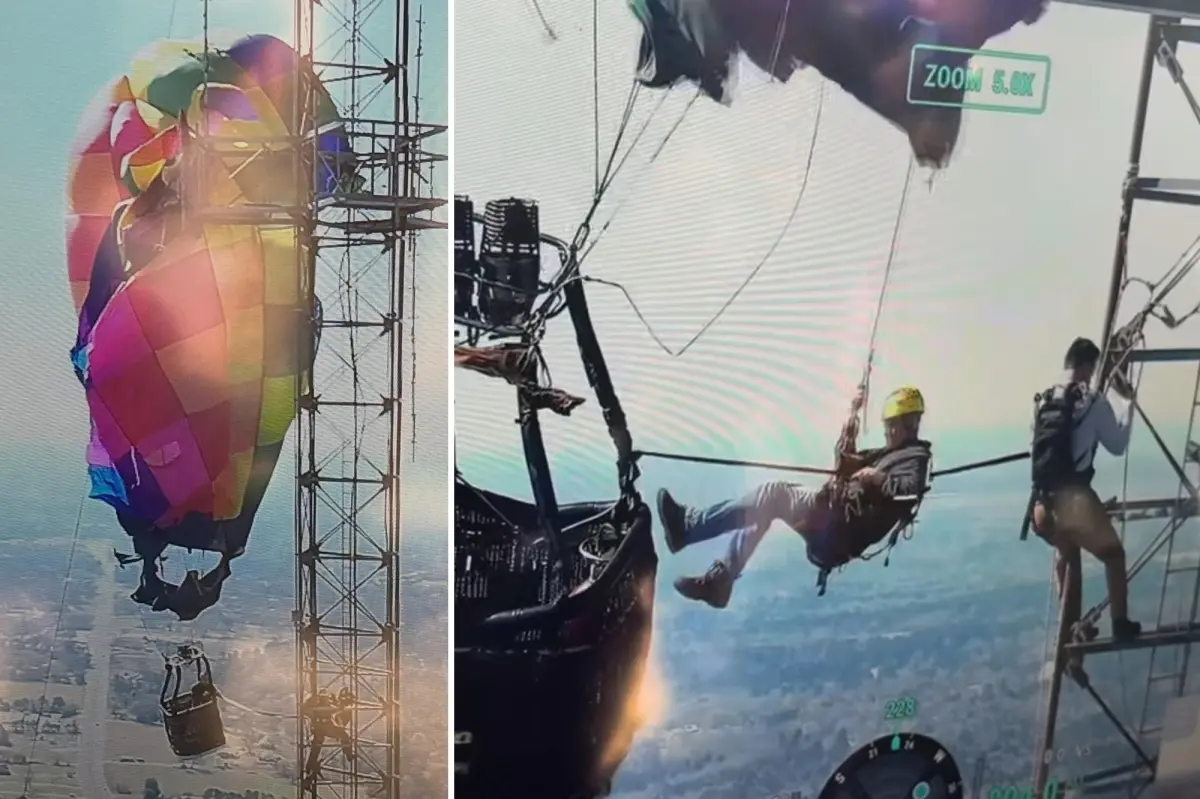
It was a crisp Saturday morning in Longview, Texas, where the sky promised an ordinary day of weekend routines and mild breezes. John and Emily Thompson, a middle-aged couple from a nearby suburb, had decided to indulge in a romantic adventure. John, a retired accountant with a passion for antiquities, and Emily, a school teacher who loved stargazing, had booked a hot air balloon ride through Rainbow Adventures, a local company offering scenic tours over the East Texas landscape. The hot air balloon, painted in vibrant rainbow colors, symbolized their love for life’s colorful moments—John had surprised Emily with the trip to celebrate their 25th wedding anniversary. As the balloon lifted off gently from the launch site just before 8 a.m., they chatted excitedly about the views ahead. The pilot navigated it smoothly, but as they ascended higher, an unforeseen disaster loomed. Unbeknownst to them, a massive 1,100-foot cell tower loomed in the vicinity, its steel bars and antennas standing like silent guardians of the digital age. What started as a peaceful float turned into a nightmare when, perhaps due to a sudden gust or navigational error, the balloon’s envelope collided directly with the tower. The sharp metal edges punctured the fabric, causing the balloon to snag violently. In an instant, the Thompson’s world flipped: the balloon deflated partially, trapping itself in the tower’s lattice, leaving the wicker basket dangling precariously nearly 920 feet above the ground. Stomach-churning images later captured the scene—the tattered rainbow envelope flapping helplessly like a wounded bird, with the basket swinging wildly in the wind, John and Emily clutching the sides for dear life. They were high enough to see the Houston skyline faintly in the distance, but way too high to feel anything other than sheer terror. The basket, designed for cozy ascents, now felt like a fragile cradle in a deadly storm. John, who had always been the steady one in crises, tried to comfort Emily, whispering reassurances, while she fought back tears, her mind racing with thoughts of their two grown children. The couple’s initial excitement morphed into raw survival instinct, their hands sore from gripping, bodies shivering not just from the altitude but from adrenaline. Passersby on the ground began noticing, pointing upward, phones out to capture the bizarre sight. One onlooker later described it as “like something out of a disaster movie,” but for the Thompsons, it was agonizingly real. They remained conscious, miraculously uninjured despite the jolt, but the isolation up there—cut off from the world below—made every minute feel eternal. The wind howled around them, the basket swaying like a pendulum, amplifying their fear. Emily recalled her mind flashing to past vacations, simpler joys now seemed distant. Meanwhile, in the basket, John tried signaling with a scarf, hoping someone would spot them. Their ordeal, dangling in the ether, captured the fragility of human plans against nature’s unpredictability. Soon, reports flooded to emergency services, turning this private fright into a community spectacle.
The Call for Help and Heroic Response
Down below, the Longview Fire Department sprang into action, receiving the distress call just before 9 a.m. from concerned witnesses who had spotted the rainbow balloon ensnared on the imposing cell tower. It was a sight that defied belief—a vibrant symbol of leisure now twisted into a lifeline. The “high angle rescue,” as the department termed it, mobilized swiftly; Chief Marshal was the first on the scene, radioing for reinforcements. With insurance in their expertise, the team knew this was no ordinary save. The tower, owned by a telecommunications giant, stood as a behemoth, its height comparable to the Empire State Building, presenting logistical nightmares from wind resistance to equipment strain. Fourteen brave souls, a mix of on-duty firefighters and off-duty responders, volunteered for the arduous task. Among them was Sean Patel, a 35-year-old dad and veteran rescuer, who thought of his own family’s hot air balloon story—a failed attempt at their backyard barbecue. His wife had joked they’d stick to picnics after that, but now, suiting up in heavy gear, Sean felt the weight of duty. Rope loads, harnesses, and climbing tools were prepared, the asphalt parking lot beneath turning into a crowded staging area. By 9:30 a.m., remote cameras confirmed the basket’s position: swinging wildly, restraining the Thompsons from certain catastrophe. Stephen Winchell, the Special Operations Lieutenant leading the charge, briefed his team. “This is the Super Bowl of rope rescues,” he declared, not for spectacle but emphasizing the risks—the exposure to whipping winds that could claw at skin, the physical toll of climbing over a thousand feet up and down, loaded with ropes weighing as much as a small child. Yet, the team’s camaraderie shined; veterans shared stories of past rescues, like the time they pulled a hiker from a ravine, building morale. Winchell, a devout man, invoked a quiet prayer for protection, acknowledging the “sweat-equity” required—muscles burning, sweat sliding under helmets. As they began the ascent, one by one, rappelling up the tower’s framework, the public gathered below, some setting up lawn chairs as if awaiting a parade. Winchell noted his son had texted, excited to tell school friends his dad was the hero. The climb was methodical, each step deliberate, securing lines to prevent slips. Environmental factors played havoc: gusts battered them, forcing pauses, while distant thunderstorms loomed as a reminder of Mother Nature’s caprice. Passing climbers shared nods of encouragement, their breaths syncopated with the wind’s roar. Reaching the midway point, a sense of isolation hit them; the ground dwindled to specs, birds scattering wide. By 10 a.m., the first responders reached the basket, their faces masks of resolve behind the gear. Contact was made; shouts cut through the din: “We’re here! Hang tight!” The Thompsons’ eyes widened in relief, tears mixing with exhaustion. In that moment, human connection bridged the divide.
Encountering the Victims and Assessing the Damage
Approaching the dangling basket, the rescuers witnessed the raw human drama firsthand. John and Emily Thompson were visibly shaken, their faces pale from hours of uncertainty, yet commendably calm amid the chaos. The basket, a quaint wicker orb meant for leisurely flights, now rocked like a ship in a gale, the hot air balloon’s shredded envelope entangled in the tower’s bars like a kite in a tree. Lieutenant Winchell radioed back initial assessments: both passengers conscious, no apparent injuries—a miracle given the puncture and plummet that shredded the balloon’s fabric. They had clung to the basket’s edges for dear life, avoiding the propane tank’s edges, their knuckles white from grip. Emily, the softer-spoken of the duo, whispered thanks, her voice trembling as she recounted the impact. “It happened so fast—one moment we’re admiring the sunrise, the next, everything’s spinning.” John, steadying her, added they felt the balloon snag, a screeching tear as the envelope burst, filling the air with hydrogen deflated slowly. Rescuers saw beyond the stratum; these were real people with lives—John, a history buff who dreamed of balloon trips after reading Jules Verne, and Emily, an educator whose classroom was now home to worried students per her quick call before ascent. The team empathized deeply; veteran rescuer Lisa Torres thought of her grandma’s near-miss helicopter rescue. “You did amazing staying put,” Torres assured them, offering sips of water from her pack. Probing for details, they learned the Thompsons had signaled wildly post-crash, using jackets as flags, but the height muffled cries. The basket’s contents—propane remnants, picnic baskets—lay scattered, a poignant reminder of shattered serenity. Wind howled, complicating communication, but the pair’s cooperation shone: no panic attacks, only cooperative responses to instructions. Winchell praised their poise, noting how passengers often complicate rescues, but here it was “textbook calm.” Environmental hazards intensified; a sudden squall buffeted the group, ropes straining under invisible forces. One rescuer nearly slipped on condensation, his fall halted by harness—heart-pounding for all. Amidst this, the Thompsons shared fragments of their life: their anniversary passion project, interrupted by fate. Rescuers relayed anecdotes to keep spirits high, turning rescue into rapport. By this point, ground crew monitored via drones, fans tweeting real-time, transforming personal ordeal into public saga.
The Precarious Descent: Rope by Rope to Safety
With trust established, the actual extraction began—a ballet of bravery against gravity. Multiple 300-foot ropes, coiled like serpents, were deployed in a synchronized maneuver. Rescue harnesses were secured around the Thompsons’ waists, snug but not constrictive, ensuring every movement was tethered to safety. The process was meticulous: “Rope by rope,” as Winchell described, inching the couple downward in controlled stages. First Emily, the lighter, lighter, or perhaps prioritizing the vulnerable—her frame cradled by rescuers Patrick and Maria, both parents themselves. As they initiated the rappel, winds gusted unpredictably, swaying the basket anew. Emily’s eyes welled; “Is it safe?” she queried. “Safer than dangling,” Patrick replied, his voice steady yet compassionate. She descended gradually, the rope brake controlling her fall, her descent a hypnotic glide of 300 feet at a time, pausing at rigged anchors on the tower’s midsection. Below, spotters guided, shouting encouragements that echoed upward. John followed, his descent bookended by Winchell and Sean, who shared his fascination with heights. “Ever skydived?” Sean joked mid-lowering, lightening the tension. “Not like this,” John chuckled weakly. The physical demand was immense; muscles ached under gear’s weight—ropes, harnesses, radios totaling 50 pounds each. Sweat-equity poured, as Winchell termed it; ropes chafed skin, breaths labored in thin air. Challenges mounted: a frayed rope necessitated a switch, halting progress for fraught minutes. Environmental exposure added peril—chilling winds numbed fingers, distant rain threatened electrification. Yet, the team’s bond fortified; handoffs at belays evinced trust, veterans mentoring juniors. One rescuer, battling vertigo from a past fall, pushed on, thinking of family. The descent spanned hours, each 300-foot drop a victory over height. Ground crew reclined the Thompsons on ambulances, wrapping blankets against shivers—emotional exhaustion palpable. Curious onlookers cheered, some family members of first responders waving. The Thompsons reunited, embracing amidst tears of relief. “We’re alive,” Emily breathed, a testament to rescue finesse.
The Spectacle of a Community Response
As the Thompsons touched earth, the rescue’s ripple effects unfolded vividly. What began as a private emergency blossomed into a communal event, with spectators numbering in the hundreds, drawn like moths to drama’s flame. Some hauled lawn chairs, coolers, and binoculars, transforming the Tower lots into impromptu viewing parties—families munching popcorn as if at a concert. Winchell recounted a surreal moment: his buddy’s family watched from a gas station across, kids waving imaginary hero banners. Social media erupted; live streams went viral, “hot air balloon miracle” trending locally. Residents, from elderly war vets to schoolkids, shared memes, prayers, and donations for Rainbow Adventures. The evidence of public fascination— photos of the tangled balloon circulating—humanized the ordeal, merging entertainment with empathy. Even distant relatives called, turning isolation’s end into connection. Tower King II, the local dismantlers, geared up heroically. Their commercial outfit, usually for mundane structures, now tackled shreds with reverence. First, the basket and propane tank—still gurgling remnant fuel—were lowered methodically, engineering marvels ensuring no sparks. Enveloped remnants followed, piece by piece, like disassembling a giant puzzle. Operators chatted empathetically, preserving mementos for the Thompsons. The cleanup shone community spirit; locals offered help, volunteers cleared debris. Winchell reflected on operational smoothness amidst chaos, crediting divine providence, his faith grounding the narrative. Post-rescue press conferences highlighted logistics, but human stories emerged—the rescuers’ fatigue, Thompsons’ gratitude. One rescuer’s family reunion dinner was delayed, wives understanding duty’s call. Rainbow Adventures pledged inquiries, sponsoring safety seminars. The event fostered reflection: on life’s unpredictability, human resilience. Hoppers passing by left flowers, symbolic of loss and renewal. In Longview, it birthed legends, school essays on heroes. Spectators’ accounts varied— from awe to horror— yet unified in praise.
Triumph, Reflections, and Kind Gestures
In the rescue’s wake, accolades poured in like a warm Texas sun. The firemen, oft unsung heroes, were hailed as city saviors, their sweat-soaked fatigues trading for local fame. Free pizza deliveries flooded the station— from anonymous donors and chains like Domino’s— a gesture of appreciation that lifted spirits. “Never expected, but always appreciated,” the fire department posted on Facebook, images of grinning responders clutching slices. Winchell, unveiling the story’s depth, admitted the physical toll: climbers treating blisters, chafing, muscle strains with ice packs and camaraderie. “Like running a marathon with ropes,” he likened, crediting persistence. The Thompsons’ recovery mirrored: emotional check-ins revealed lingering dizziness, counseling scheduled, yet optimism prevailed. Emily revisited her classroom, sharing the tale to inspire resilience; John joked of future excursions, perhaps tethered. Rescuers’ families rejoiced— one veteran’s kid drew “Dad the Superhero” portraits. Community emails overflowed, “Thank you for our town’s guardians.” Longview’s bond strengthened, the incident a catalyst for safety drills. Reflection on bravery: not all heroes wear capes, but harnesses. Survivors’ reside encapsulated grace under pressure, a human testament to cooperation. In conversations over pizza, stories flowed— rescues past, hopes future. The balloon’s remnants, disposed responsibly, symbolized closure; Rainbow Adventures rehired pilots, enhancing protocols. Ultimately, this episode wove humanity: predators’ panic transmuted to relief, rescuers’ labor to legend, community’s witness to unity. Returns to normalcy blended gratitude, etching a 2000-foot tale of survival’s humanity.