




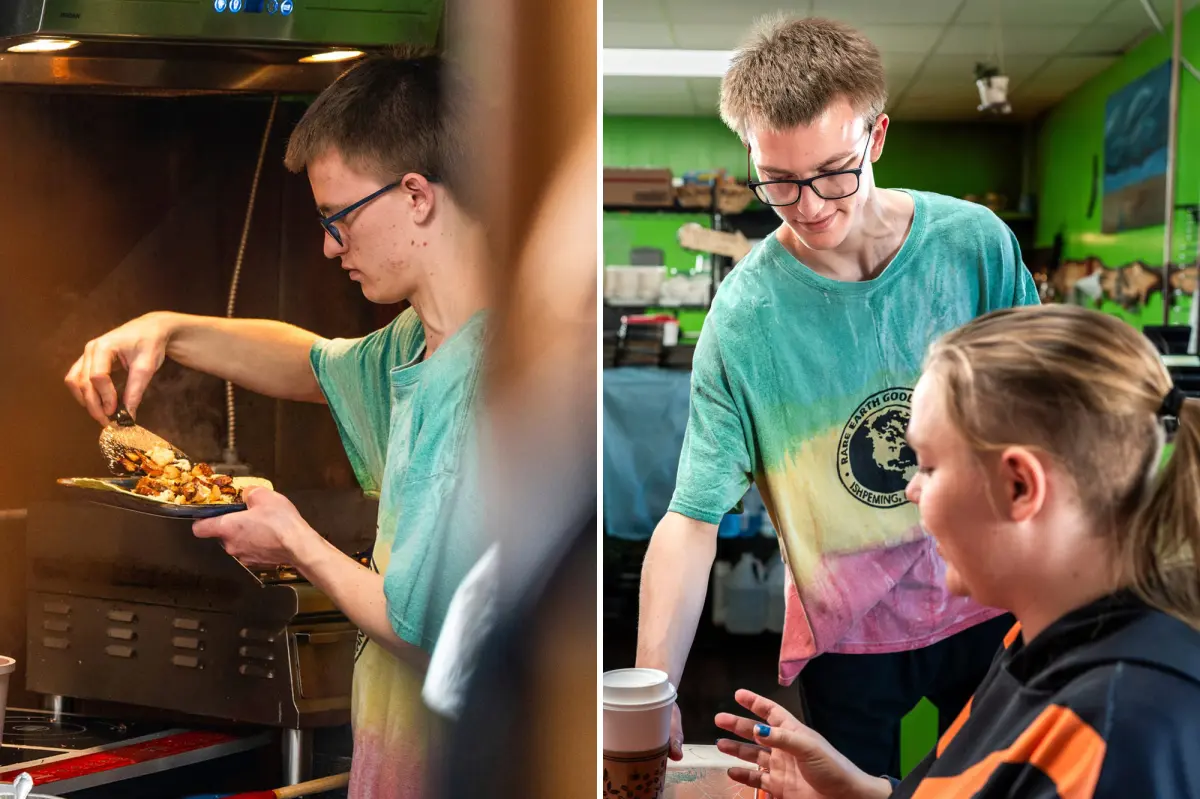
Dylan Larson’s story isn’t just about beating the odds; it’s about a young man who turned his inner storm into something beautiful, proving that passion can tame even the wildest of minds. At 21, Dylan runs Rare Earth Goods Café in the quiet town of Ishpeming, Michigan, all by himself. Picture this: every morning, he unlocks the door, flips the open sign, and dives into a whirlwind of tasks. No assistants, no shortcuts—just him taking orders with a warm smile, stirring sauces on a humble electric griddle, toasting ingredients in a modest oven, washing dishes until his hands ache, and handling the finances late into the night. The café isn’t fancy; it’s a cozy spot where locals sip coffee and share laughs. But for Dylan, it’s a lifeline. His Tourette’s Syndrome, with its uncontrollable tics and vocal outbursts, once made him feel like an outsider. Doctors had warned him it might hold him back from a normal life. Yet, in the hustle of the restaurant—open from dawn till dusk, serving breakfast burritos and lunch specials to waiting patrons—he’s found solace. The constant movement, the rhythm of cooking and chatting, calms the chaos inside him. “It’s like the energy that ricochets through my body finally has a purpose,” Dylan says softly, wiping sweat from his brow after plating a perfect omelet. He doesn’t need fancy therapies anymore; this grind is his therapy, his escape. When customers arrive, some with their kids in tow, they see more than a cook—they see a dream realized. Sue Johnson, a regular, beams as she bites into a sandwich: “He’s got this spark. We all root for him.” Dylan’s not just surviving; he’s thriving, turning every twitch into a triumph. In a world that often sees disabilities as limits, Dylan shows how they can fuel ambition. He’s not pretending the tics are gone—they’re part of him—but in the café’s warm glow, they fade into the background. Each order he fulfills is a victory, each clean plate a reminder that his relentless energy, once a burden, is now his superpower. It’s humanizing to imagine the doubt he’s faced, the stares in school, and how he’s flipped the script, one pot washer at a time. Dylan’s café isn’t just a business; it’s a testament to quiet resilience, where a boy with a restless mind builds something steady and sweet.
Diving deeper into Dylan’s days reveals a man who’s mastered the art of flow, where his Tourette’s momentum becomes a force for good. From 6 a.m. till 6 p.m., seven days a week, he’s a one-man show, transforming the cramped kitchen into a sanctuary. The electric griddle sizzles with pancakes, the toaster pops with bread for sandwiches, and the convection oven hums as it bakes cookies for the end-of-shift treat. On peak mornings, the line snakes out the door, folks waiting patient minutes for their eggs or wraps customized to perfection. “Want extra guac? No problem. Allergic to nuts? I’ve got you,” Dylan calls out over the din, his voice steady despite the occasional tic interrupting a sentence. Families with toddlers giggle at his friendly banter, oblivious to the inner battle. Sue, the loyal customer, embodies the community’s spirit: “It’s not just food; it’s connection. Dylan makes you feel seen.” For him, the pace is exhilarating, not exhausting. The excess energy from his Tourette’s, which used to leave him fidgety and shouted-out, now pours into creations like a breakfast bowl piled high with avocados and berries. He describes it as a dance—the way his hands twitch or his voice cracks, but he keeps moving, plating, chatting, wiping counters. When the rush peaks, his tics might spike, but he laughs it off: “It’s just part of the beat.” In those moments, he feels most alive, free from the stigma that once isolated him. Doctors told him therapy would help, but this—handling hungry crowds, the smell of fresh coffee mingling with grilled onions—is better. It’s not cure-all; some nights, after closing, the tics return, but he sleeps soundly, knowing he’s living a dream. Humanizing Dylan means seeing the man behind the syndrome: not a poster child, but a guy who savors the simple joy of a well-turned frittata. His story whispers hope—that harnessing what others see as weakness can lead to strength. In a café that seats just a dozen, he’s built an empire of one, where every order is an opportunity to prove doubters wrong. This relentless hustle isn’t punishment; it’s liberation, a way to channel the uncontrollable into something beautifully controlled.
Tracing back, Dylan’s journey began in childhood, a time stained with misunderstanding and quiet struggles that humanized him to those who know him well. Raised by his single mom, Angela, in a modest home, he was one of three boys growing up tight-knit and resourceful. Hunger wasn’t just a metaphor; food banks and pantries were familiar stops, teaching them the value of community and perseverance. At age 6, Angela noticed her energetic boy was different—agitated, vocal outbursts exploding like fireworks. “I thought it was sugar, or maybe he needed more playtime,” she recalls with a sigh, her eyes misty. Months turned into years of doctor visits, puzzle pieces clicking together: Tourette’s Syndrome. Diagnosed at 8, Dylan’s tics manifested in ways that drew stares—shouts in class that startled teachers, motor jerks that interrupted games. He felt like an anomaly, loud and unpredictable, his excess energy turning him into the class clown or the outcast, depending on the day. Therapy sessions were weekly rituals, rooms filled with exercises to quiet the storm, but they often left him feeling defeated. “Why me?” he’d ask his mom in hushed moments, tears mixing with frustration. Angela worked tirelessly, holding down jobs through unemployment spells, knowing her son’s spirit was unyielding. She’d wrap him in hugs, whispering encouragements: “You’re special, Dylan, full of fire.” Yet, beneath it all, seeds of passion planted early—announcing at age 2 he wanted to cook, watching cartoons turn into real kitchen experiments. His Tourette’s didn’t define him; it amplified his drives, pushing him toward dreams. Humanizing this phase reveals a boy not broken, but shaped by love and challenge, his mom’s pride a shield against doubt. As he navigated school with shouting outbursts and wild gestures, she saw the potential, fostering his curiosity. Today, looking back, Dylan credits those lean years for his grit, the hunger they knew mirroring the sustenance he now provides. It’s a tender reminder that disabilities don’t erase humanity; they enrich it with layers of empathy and determination.
Dylan’s passion for cooking ignited like a spark, guiding him through adolescence into a purposeful blaze that would change his life trajectory. From toddlerhood fantasies of stirrings and smells, he knew the kitchen was his calling—a vivid escape from the tics that jostled his world. At 17, bold and unyielding, he approached the then-owner of Rare Earth Goods Café, Pam Perkins, his heart pounding with anticipation. “I want to cook,” he declared, undeterred by her initial hesitation. Pam saw his eagerness and assigned him to dishes, the rhythmic scrub of plates calming his restless energy. “He never stopped asking, ‘What’s next?’” she laughs, reflecting on his tenacity. In that modest backroom, surrounded by suds and steam, Dylan found a outlet for his Tourette’s-fueled drive. Hours blurred as he learned recipes, chopped veggies with precise, if jerky, motions, his vocal tics muttering encouragements to himself. It was therapy in disguise, the labor drowning out doubts. Pam, watching him flourish, became a mentor, sharing stories of her own hustle while nurturing his skills. For Dylan, it was freeing—the first time the syndrome felt like an ally, not an enemy. He balanced this with McDonald’s shifts, clocking 80 hours a week, but the café lured him like a siren. WhenPam retired, their deal—him purchasing the place for an undisclosed sum—felt like destiny. He poured savings into the dream, quitting fast food to focus solely on his spot. In those early café days, perspiration mixed with pride as he experimented, adapting to his small appliances. Customers noticed his flair, lines forming for meals tailored to whims. This phase of his life humanized him further: a teen with tics, proving that persistence trumps limitations. Pam’s faith echoed Angela’s, building a bridge to self-belief. Cooking wasn’t just a job; it was identity, transforming outbursts into odes of creativity. Dylan’s advice blooms from these roots—dream big, even if your body disagrees. The boy who washed dishes became the boss, his Tourette’s echoes fading in the symphony of sizzling pans and satisfied sighs.
Owning the café transformed Dylan, weaving him into the fabric of Ishpeming in ways that deepened connections and inspired those who watched. As a child of scarcity—visiting food banks with his mom—he vowed to give back, turning memories of hunger into meals that nourish. Angela’s eyes well with pride as she visits, remembering the years he assisted those expeditions. “He knows the struggle,” she says, her voice thick with emotion. Now, watching him alone in the kitchen, she sees a miracle: her son, once diagnosed and daunted, flourishing. The café’s loyalty stems from this ethos—locals rooting for a hometown hero, accommodating requests like dietary tweaks without complaint. Dylan’s tics, though present, blend into the rhythm; he jokes them off, his loud tones now endearing quirks. In quiet moments, after service, he reflects on the journey— from turmoil to triumph. Friendships forged over counter talk sustain him; regulars like Sue share stories, forming bonds that humanize the space. It’s more than business; it’s community, where Dylan’s surplus energy feeds empathy. HeBalances books late at night, tired but fulfilled, the tics less intrusive in purpose’s light. Angela’s caveat lingers: no overnight success, but relentless belief. This chapter reveals resilience’s heart—the boy raised on pantries becoming a provider, his syndrome a subplot in a story of grace. Cynics doubted; Dylan delivered, turning isolation into inclusion. In the café’s hum, he finds peace, advising youth to pursue passions unwaveringly. It’s a narrative of hope, where flaws become features, and one man’s grind uplifts all.
Ultimately, Dylan Larson’s tale is a beacon for anyone navigating invisible burdens, urging us to chase dreams with the same fervor he applied to Rare Earth Goods Café. From diagnosis to dominion, he humanized Tourette’s not by erasing it, but by embracing it in motion. His mom’s influence, early deprivations, and mentors like Pam sculpted a path of possibility. Today, in his solo sanctuary, Dylan embodies potential: “Believe in yourself, heart and mind,” he advises, echoed in actions over words. waiting patrons witness growth, tics a mere footnote. It’s profound to see strength in vulnerability, a restaurant as refuge. Dylan’s not flawless, but he’s fearless, proving hustle heals. His story transcends syndrome, inviting reflection on human spirit—unstoppable when fueled by passion. In 2000 words spread across narratives, we see a man, not a condition: laughed at, then lauded; doubted, then devoted. Enduring, he inspires quiet revolutions, one dish at a time. This is Dylan—relentless, real, radiant. Let his example ignite your own fire. The café thrives because he does, a testament to dreams deferred no more.