



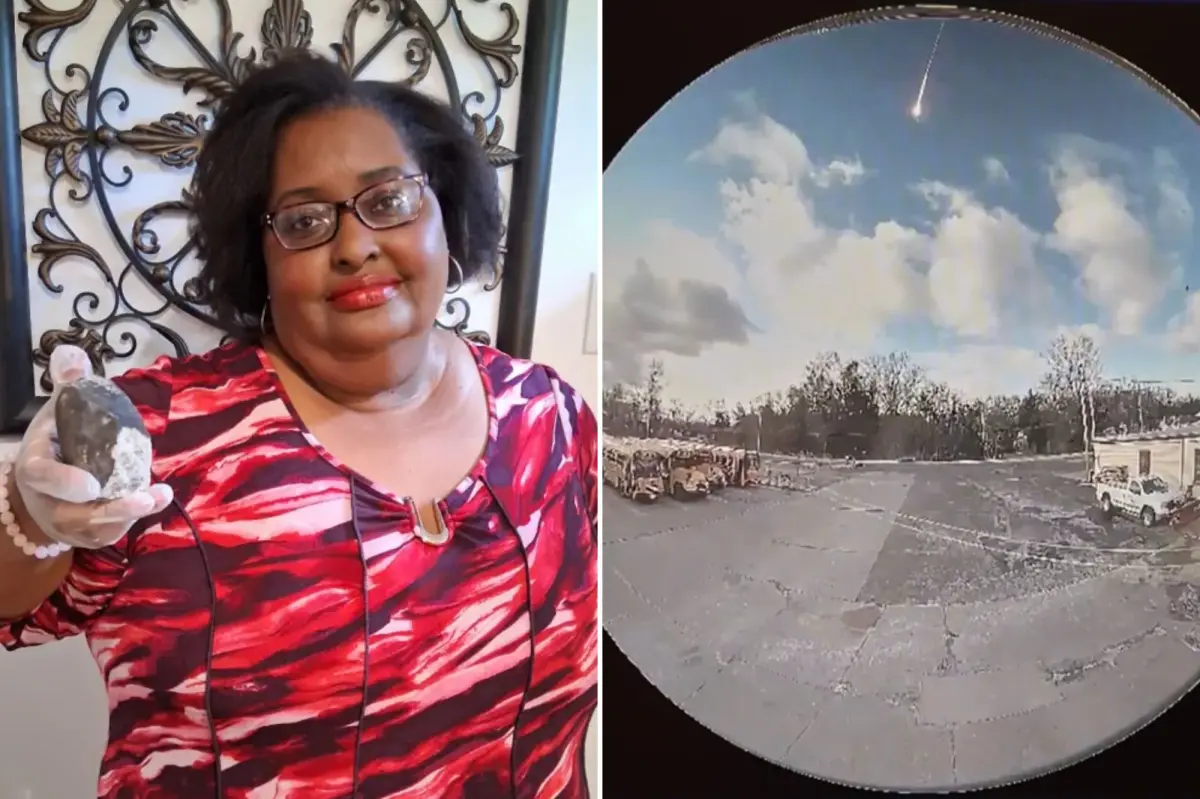
On a quiet Saturday night in Houston, the sky erupted into a momentary spectacle—a brilliant flash followed by a deafening sonic boom that echoed through neighborhoods. What at first seemed like a distant light show turned out to be something extraordinary: a meteor blazing through Earth’s atmosphere. For locals, it was a reminder of the mysteries lurking in space, but for one Houston resident, Sherrie James, it became a life-altering intrusion. The meteor, breaking apart as it descended, sent a fragment hurtling into her home. Shattering through the roof and attic floor, it landed squarely in her 30-year-old daughter’s bedroom—a heavy, black rock weighing about two pounds. As the dust settled and family members gathered around, James couldn’t help but feel a mix of awe and unease. “I’m a big sci-fi nut,” she shared with reporters, her voice tinged with both excitement and trepidation. “I hoped it wasn’t an egg with something growing inside. I stayed back from it at first. I didn’t want to get radiation or be infected by an alien bug or anything.” Her words painted a picture of a woman caught between the thrill of the unknown and the primal fears of the unknown. Now, with a gaping hole in her roof and strangers knocking at her door, James faced the reality of owning a piece of cosmic history, all while her stomach churned in knots. Such encounters aren’t as rare as they used to be, as meteors have been streaking across the sky with surprising frequency lately—Ohio on March 17, Germany earlier that month, and whispers of falls in Georgia, Alabama, and Arkansas over the past year. These celestial visitors, born in the asteroid belt between Mars and Jupiter and dating back some 4.5 billion years, remind us that our planet hurtles through an endless tapestry of space junk.
Delving deeper into these celestial events, experts like meteorite hunter Roberto Vargas offer insights that ground the fantastical in science. He believes the recent flurry can be attributed to Earth’s current path through cosmic debris fields—vast swaths of floating asteroids and fragments that occasionally collide, sending shards toward our atmosphere. “There are things in space that are floating around,” Vargas explained thoughtfully. “They bang into each other and sometimes pieces break off that are big enough to make it to ground. But more often, they are just shooting stars or fireballs that burn out. Sometimes, it really is just a random coincidence.” His perspective humanizes the phenomenon, transforming abstract astronomy into a relatable tale of cosmic traffic jams. Vargas, a man driven by passion for these rare rocks, has turned meteor hunting into a livelihood, selling his finds online. After chasing a meteorite that struck a home in Koblenz, Germany on March 8, he spent days combing the area only to return empty-handed. Yet, when news of Ohio’s landing broke, he didn’t hesitate—jumping in his car for an eight-hour drive from Connecticut. There, amidst muddy fields and hopeful explorers, he joined a community of seekers, all peering at the ground for any sign of extraterrestrial treasure. It’s a world filled with anticipation, but also patience, as Vargas recalled the Germany trip: “I spent four or five days looking, but it was one stone that hit a house and the person living there wasn’t selling. We hunted the area and nobody found anything. So, I came home.” His stories reveal the gritty, adventurous side of chasing stars, where dreams of discovery meet the sting of disappointment.
Joining Vargas in Ohio was fellow hunter Carl Dietrich, who packed up from South Carolina and settled into the hunt like a dedicated prospector. “I’ve been in Ohio since the day after it fell,” Dietrich said, his eyes alight with the thrill of the chase. “So far, I’ve found two pieces. I’m basically looking at the ground trying to find black rocks.” His description evokes images of hunched figures scanning acres of soil, brushes in hand, separating the ordinary from the cosmic. Dietrich, too busy with the search to dwell on market values, noted that these “black rocks” could fetch around $200 per gram—a staggering sum when you consider there are 28 grams in an ounce. Multiply that by the pounds of meteorite strewn across Ohio, and the potential fortune becomes dizzying. Back in Houston, James contemplated a similar future for her fragment. Composed mostly of silicate minerals with scattered metallic iron grains, it’s scientifically unremarkable to experts but potentially lucrative to collectors. She planned to carefully remove the damaged roof section to preserve its value alongside the meteorite. Yet, as a homeowner and mother, the financial promise paled against the intrusion into her personal space. “My stomach has been in knots ever since,” she admitted, describing sleepless nights and the discomfort of uninvited visitors. One can imagine her pacing her living room, the weight of the rock a constant reminder of how the universe had barged into her life uninvited, blurring the lines between science fiction and stark reality.
What makes these meteors so intriguing—and valuable—is their rarity, especially when they interact with human structures. Known as “hammer stones” for their dramatic entry, these meteorites that pierce roofs or walls hold immense appeal for collectors. Dr. Laurence Garvie, director of the Buseck Center for Meteorite Studies at Arizona State University, emphasized their allure: “Hammer stones are the most collectible of any meteorites. It’s a huge deal anytime a meteor goes through somebody’s house.” His enthusiasm comes from a place of pure curiosity, though he downplays the financial frenzy: “From the point of science, we don’t care if it lands in a house or a field.” Statistics back up the drama—worldwide, there are 10 to 20 meteor falls daily, but with 70% of the globe covered by water and another 15% inaccessible, most go unnoticed or uncollected. For James, the hammer stone in her daughter’s room is more than a collectible; it’s a personal ordeal. The physical damage meant roof repairs and emotional upheaval, compounded by the eerie sensation of strangers approaching her home. She recounted going out for dinner the night after the impact, her appetite vanishing amidst the shock. “We went out for dinner last night and I couldn’t eat,” she said, her words capturing the vulnerability of ordinary life intersected by cosmic chance. In a larger sense, these events connect human stories to the vast indifference of space, where a simple rock can upend routines and spark global interest.
Ownership of these celestial artifacts raises intriguing questions, blending legality with adventure. Vargas adheres to the “finders, keepers” mantra for public land, but emphasizes that on private property—like James’ home—the landowner holds automatic rights. His insights reveal a community of hunters bound by ethics and excitement, sharing tips online about sightings and valuations. Despite the recent uptick, Garvie reassures that there’s no apocalyptic pattern: “It just happens that, right now, we have a few in populated regions. It’s purely random.” This randomness weaves threads through people’s lives, as seen in a cautionary tale from Indonesia in 2020. A meteorite piercing a home there weighed 4.6 pounds and was worth an estimated $1.85 million, yet the unsuspecting owner—a coffin maker—was cheated out of a fortune, selling it for a pittance. For James, knowledge is power; she’s educating herself about appraisals to avoid similar pitfalls. Her experience highlights the human element: fear, wonder, and the slow process of adapting to the extraordinary. As she navigates repairs and inquiries, one senses a quiet resilience, the kind that comes from confronting the unknown head-on. In the end, these meteors remind us of our place in the universe—not as passive observers, but as participants in its whims.
Reflecting on these events, it’s clear that meteors bridge the gap between the distant cosmos and everyday human experiences, stirring emotions from terror to triumph. Sherrie James, still reeling from her brush with the stars, represents countless others who find themselves caught in nature’s unpredictability. Her story, alongside those of hunters like Vargas and Dietrich, paints a portrait of awe and adaptation. In Houston, the sky’s flash lingers in memory, a fleeting spark that ignited conversations about space, value, and vulnerability. As Earth continues its journey through debris fields, these moments serve as gentle reminders that we’re all connected to the stars—vulnerable yet capable of enduring their fleeting touch.