



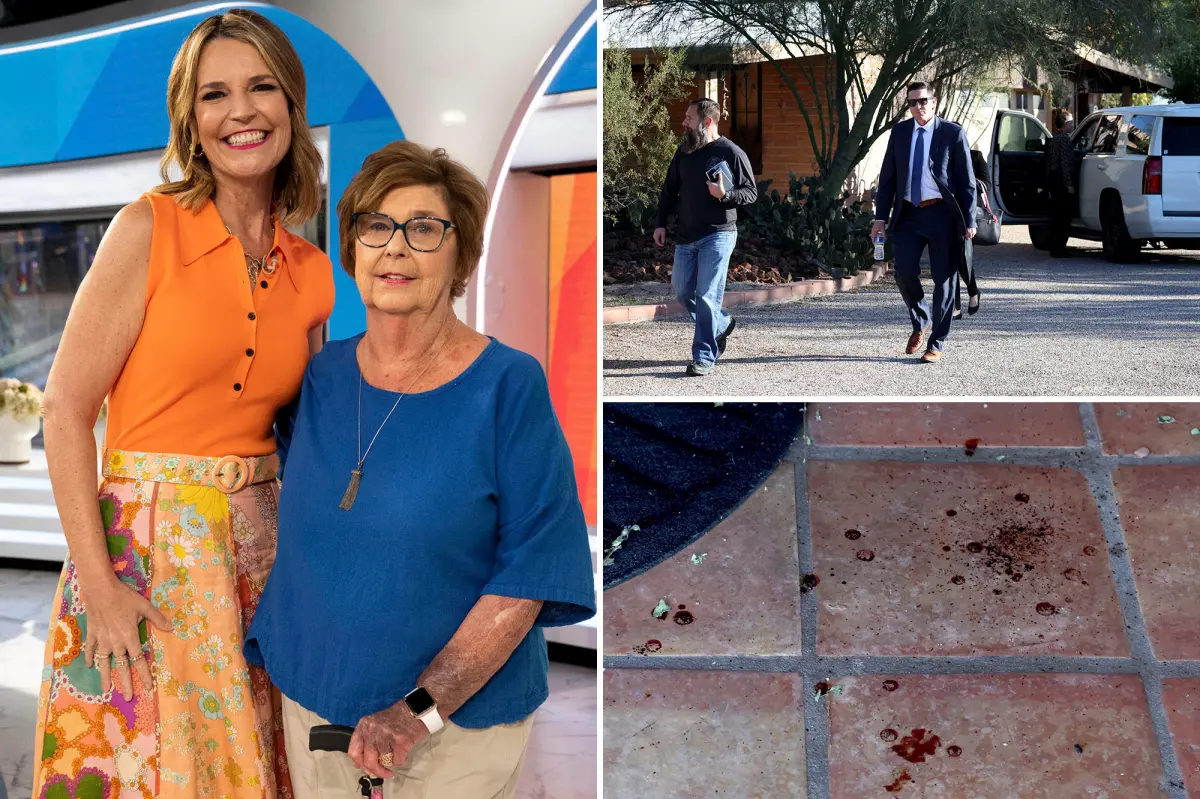
It was a crisp autumn morning in Arizona when the news of Nancy Guthrie’s disappearance first broke, casting a long shadow over her family and the nation at large. Nancy, a devoted mother and grandmother, had vanished under mysterious circumstances from her home in Tucson, leaving behind a community gripped by concern and a prominent daughter, Savannah Guthrie, the beloved host of NBC’s Today Show, struggling to process the unthinkable. For weeks, the story dominated headlines, blending the heartache of a personal tragedy with the public’s fascination drawn from Savannah’s high-profile career. Yet, even as the days turned into a relentless search involving law enforcement, volunteers, and media scrutiny, Arizona police found themselves at a standstill—no suspects had been identified, and the trail only grew colder. As detectives delved deeper into Nancy’s life, her routines, her friendships, and her final moments, the investigation revealed layers of a woman’s quiet existence, far removed from the spotlight her daughter inhabited. Nancy was known for her warmth, her love for gardening, and her tight-knit family bonds, but now, those who knew her feared the worst: what if this wasn’t just a coincidence? The Pima County Sheriff’s Department, tasked with unraveling the puzzle, emphasized that while no credible leads pointed to a targeted attack, the absence of suspects left room for a haunting array of possibilities—from accidental scenarios to deliberate acts clouded in secrecy. In this vulnerable moment, Savannah and her siblings clung to hope, appearing in public appeals that humanized the case, sharing memories of their mother as a beacon of stability in their lives. Savannah, often the composed anchor of millions, revealed in interviews the raw grief of waiting, of imagining her mother’s final thoughts, her last smiles. For the family, this wasn’t just a news story; it was a profound loss that threatened to redefine their world, forcing them to confront the fragility of the mundane—a routine errand or a walk could vanish into oblivion without warning. Volunteers from the community organized search parties, combing through desert landscapes and neighborhood trails, echoing the collective empathy that surges in times like these. Yet, as the sun set on yet another fruitless day, the emptiness lingered, amplified by the digital age where speculations ran wild on social media, fueling unfounded rumors that only added to the family’s anguish.
Detectives with the Pima County Sheriff’s Department, dedicated professionals with years of experience tackling Arizona’s rugged terrain of crime and mystery, continued their painstaking work, methodically interviewing anyone who might have crossed paths with Nancy in her final days. The process was exhaustive, involving door-to-door canvassing, reviewing security footage from nearby stores and homes, and piecing together the mosaic of her interactions. One neighbor recalled seeing Nancy tending to her roses just hours before her disappearance, her laughter carrying on the breeze as she chatted with a passerby about the changing seasons. Another acquaintance shared stories of her volunteer work at a local animal shelter, where her gentle nature shone through in rescuing strays and nurturing them back to health. These glimpses painted a portrait of a woman deeply rooted in her community, someone whose simple joys—family gatherings, Sunday brunches with her grandchildren, or solitary walks in the desert—now served as clues in a larger narrative of loss. The investigators, aware of the emotional weight carried by Nancy’s loved ones, maintained close contact, offering updates that wavered between cautious optimism and grim realism. They understood that each interview stirred memories, reopening wounds for those who mourned prematurely, wondering if they could have done more, noticed something amiss. In the quiet precinct rooms, seasoned detectives shared their own stories of similar cases, the ones that haunted them long after resolution, reminding themselves that behind every missing person report was a human life, a web of relationships now frayed. Savannah, drawing from her own experiences covering major events, expressed public gratitude for the efforts, humanizing the search by speaking of her mother’s kindness—a woman who baked cookies for strangers and offered a listening ear to neighbors in distress. Yet, amidst the interviews, a nagging absence persisted: no one had seen anything overtly suspicious, no strange vehicles idling nearby, no heated arguments overheard. This lack of clear leads underscored the eerie unpredictability of such disappearances, where the ordinary could morph into the extraordinary in an instant, leaving families to grapple with the ‘what ifs’ that keep them awake at night.
As the investigation unfolded, forensic experts played a crucial role, their meticulous analyses forming the backbone of the inquiry. Teams pored over Nancy’s abandoned vehicle, which was found parked neatly in a residential area, its interior untouched except for traces that could hold vital secrets—fingerprint prints, DNA samples, perhaps even digital footprints from her phone. These elements, often overlooked in rushed simple narratives, revealed the intricate dance between science and sorrow. Each swab, each fragmented image, carried the potential to bridge the gap between disappearance and discovery, offering glimpses into Nancy’s last movements. Analysts worked tirelessly in sterile labs, their days blending coffee-fueled sessions with discussions on the human element: how a misplaced glove or a single hair could unravel not just the mystery, but restore dignity to a family’s shattered peace. For Savannah, who had once interviewed forensic specialists during her reporting days, this waiting game evoked a professional respect tinged with personal dread. She imagined the technicians as unsung heroes, painstakingly reconstructing timelines from the mundane—credit card receipts, call logs, surveillance clips—to honor a life cut short. Meanwhile, the emotional toll on the lab teams was palpable; many had faced parental losses of their own, and this case resonated deeply, pushing them to go the extra mile. Community support swelled, with donations for advanced forensic tools, underscoring the public’s investment in justice for one of their own. Yet, even as preliminary reports trickled in—no signs of foul play in initial checks—the anticipation of ‘additional forensic results’ hung like a storm cloud, promising clarity but delivering ambiguity. This slow reveal mirrored the family’s journey through grief: denial giving way to anger, then bargaining with fate, as they clung to every updated scrap, hoping it would end the nightmare.
In the heart of this unfolding drama, the Pima County Sheriff’s Department spokesperson stood as a voice of measured assurance, bridging the gap between authority and vulnerability. They emphasized that despite the passage of time, no suspects had emerged from the shadows, a fact that, while disheartening, kept the door open for breakthroughs. “We are in close contact with the Guthrie family,” the spokesperson shared, a statement that spoke volumes about the human side of law enforcement—not just agents of the state, but compassionate allies in crisis. For the Guthries, this rapport meant regular check-ins, candid discussions on progress, and the reassurance that their mother’s case remained a top priority, not buried under the weight of other investigations. Savannah, in particular, drew strength from these interactions, using her platform to amplify the department’s messages, urging the public to respect privacy while spotlighting leads. The spokesperson’s words—”no credible information indicating this was a targeted incident”—carried a dual-edged comfort, assuaging fears of premeditated harm while leaving room for the possibility that Nancy’s path had intersected with something unforeseen, like a random encounter or a health-related crisis. This phrasing resonated with the family’s experiences, where the unknown bred a peculiar hope mixed with despair—perhaps it was an accident, a misunderstanding, something recoverable. Yet, the absence of suspects highlighted the cold reality of many such cases, where motives remained obscured, identities hidden, and lives paused indefinitely. For investigators, this was a reminder of their oath: to pursue truth relentlessly, treating each case as a story worth telling completely. Volunteers rallied around this ethos, their stories intertwining with the official narrative—retirees sharing warmth over search grids, locals donating meals to keep troops energized. In this tapestry, Nancy Guthrie emerged not just as a statistic, but as a beloved figure whose disappearance united a community in empathy and resolve, turning a personal grief into a shared pursuit of justice.
Savannah Guthrie, the poised journalist whose face greeted millions each morning, found herself thrust into a role far removed from her studio perch—a daughter grappling with the raw, unrelenting pain of uncertainty. In interviews and public pleas, she spoke of her mother with a tenderness that humanized the tragedy, recalling Nancy as the heart of their family, the one who cheered loudest at graduations, who prepared comfort meals during tough times, and who instilled values of resilience in her children. Savannah’s brother and sister stood alongside her, their united front a testament to the Guthrie family’s bond, forged through years of shared laughter and support. Yet, the ordeal peeled back layers, revealing vulnerabilities even a public figure couldn’t shield—the sleepless nights, the what-if scenarios that flooded social media with inquiries, the overwhelming tide of well-wishers offering prayers and advice. For Savannah, accustomed to navigating headlines with grace, this was a personal storm, challenging her composure as she balanced work commitments with emotional upheaval. She used her voice not for spectacle, but to honor her mother, sharing anecdotes that painted Nancy as multifaceted: a retired teacher who inspired young minds, a gardener whose blooms brightened neighborhoods, a grandmother whose storytelling wove magic for grandkids. The public’s response was profound, with letters pouring in from strangers—fans of the Today Show sharing similar heartaches, communities organizing vigils, and quiet acts of kindness like fundraisers for the investigation. This solidarity underscored the ripple effect of such losses, where one family’s sorrow echoed across borders, reminding everyone of life’s unpredictability. Yet, amidst the outpouring, the lack of suspects gnawed at their spirits, turning days into an endurance test. The Guthries leaned on each other, drawing from a reservoir of faith and familial advice, determined to keep Nancy’s memory alive. In Savannah’s reflections, the case transformed from media fodder into a narrative of love’s enduring power, a call for compassion in a world too often defined by haste.
As weeks stretched into months, the disappearance of Nancy Guthrie lingered as a poignant reminder of the mysteries that plague every community, blending the mundane with the profound. The investigation, still active and exhaustive, continued to trawl through leads, interviews, and forensic insights, yet the central question persisted—no suspects, no closure. For the Guthrie family, this limbo was a crucible of emotions, where hope battled with heartbreak, and everyday rituals felt hollow without their matriarch. Savannah and her siblings carried forward, channeling their grief into advocacy, urging awareness for missing persons cases like their mother’s. The Pima County Sheriff’s Department, committed to their promise, vowed persistence, their spokesman’s updates a lifeline in the uncertainty. Volunteers, touched by the human scale of the search, persisted in their efforts, embodying the community’s resolve. Nancy’s story, now etched in the collective consciousness, transcended her disappearance, highlighting themes of resilience, the fragility of connections, and the undying quest for truth. In a world obsessed with quick resolutions, this case invited contemplation—patience in the face of unknown, empathy for those waiting. For Nancy Guthrie, whose legacy lived on in memories of her warmth and wisdom, the hope endured that answers would emerge, reuniting or resolving. Until then, families like hers navigated the depths, buoyed by love and the subtle graces of human kindness, a testament to life’s intricate, unbreakable threads. In reflecting on this ordeal, one couldn’t help but ponder the ordinary heroes—detectives, family members, neighbors—who illuminated the path through darkness, making the obscure less daunting and the unseen profoundly felt. This narrative, humanized by its core of emotion and empathy, served as a mirror, urging society to cherish the present, support the bereaved, and never surrender to the shadows of what might have been.