







The Hidden Web of Global Disruption: How Middle East Turmoil Alters Our Daily Lives
In the intricate tapestry of international relations and commerce, few regions wield as much influence as the Middle East. Recent escalations in conflicts—fueled by tensions in Yemen, the Strait of Hormuz, and beyond—have sent shockwaves far beyond the region’s deserts and seas. What started as skirmishes over shipping lanes and geopolitical standoffs has evolved into a cascade of economic ripples, reshaping everything from dinner tables in Mumbai to boardrooms in New York. This isn’t just about geopolitics; it’s about the invisible threads that connect global supply chains. As nations grapple with reduced exports of energy, fertilizers, and essential materials, everyday items become harder to come by, prices soar, and lifestyles shift in unexpected ways. From vanishing dishes on Indian menus to curtailed school days in Southeast Asia, the fallout underscores the fragility of modern interdependence. In an era where a single chokepoint can disrupt millions of lives, understanding these ripple effects reveals how interconnected our world truly is—and how vulnerable.
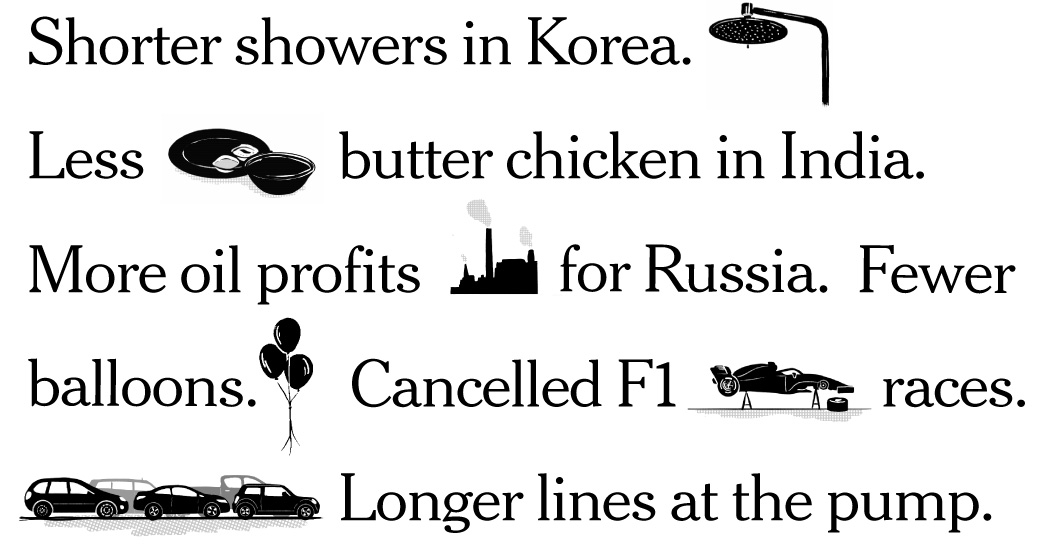
One of the most immediate casualties has been food security, a cornerstone of human existence now teetering under the spotlight of Middle East disruptions. In India, beloved staples like butter chicken and dosa have quietly vanished from menus in recent weeks, a subtle but telling sign of broader woes. These slow-cooking favorites rely heavily on cooking gas, a resource increasingly scarce due to strained imports from Gulf suppliers. Across the ocean in Australia, farmers are rethinking wheat planting as fertilizer prices skyrocket, driven by the fact that a staggering third of the world’s supply traverses the treacherous Strait of Hormuz—a vital artery now shadowed by regional instability. Global agricultural communities are on edge, with experts warning of potential harvest shortfalls that could exacerbate food insecurity in vulnerable regions. Meanwhile, in Brazil, the world’s top sugar producer, mills are pivoting toward biofuel production, lured by surging energy prices that make alternative crops more lucrative. This diversion risks tightening sugar supplies, impacting everything from packaged goods to global trade balances. As supply chains fracture, consumers in supermarkets from Sao Paulo to Sydney find themselves paying more for basic necessities, a reminder that what happens in distant conflicts can echo loudly in our kitchens and fields. The ripple here isn’t just economic; it’s a wake-up call about the sustainability of our food systems, pushing policymakers to explore resilient alternatives before the strains become irreversible.
Beyond the pantry, the Middle East’s unrest is squeezing the energy grid that powers our modern comforts, leading to widespread conservation measures and price hikes. South Korean households, accustomed to steamy showers, have been urged to shorten their routines to cope with rising energy costs, much of which stems from Middle Eastern imports. Similarly, in Thailand, the prime minister has set an example by ditching jackets for short-sleeved shirts at work, as government offices enforce stricter air conditioning limits to curb electricity use. These adaptations reflect a broader global reckoning with energy vulnerability, where oil and gas price spikes are no longer abstract market forces but tangible hardships. Even fashion feels the pinch; track suits and polyester garments could soon cost more, as the petrochemical derivatives that form their fabric climb in value amid fluctuating commodities. Party balloons, once a nonchalance of celebration, are harder to source, with Qatar—a major helium supplier reliant on natural gas production—halting exports due to the turmoil. Helium, a crucial yet often overlooked byproduct, underscores how niche elements of our daily lives are tied to far-flung geopolitical dramas. As nations implement energy-saving mandates, from Sri Lanka’s impromptu public holidays to Laos’s abbreviated school weeks, the message is clear: we’re conserving not out of choice, but necessity. This energy crunch isn’t isolated; it’s a harbinger of broader inflationary pressures that could reshape consumer habits for years to come, as societies weigh immediate comforts against long-term sustainability.
The effects extend into entertainment and culture, where disruptions have canceled spectacles and rearranged the world’s leisure map. Formula 1 racing, a global juggernaut of speed and strategy, scrapped key events in Bahrain and Saudi Arabia after missile threats jeopardized safety, leaving fans and teams scrambling for alternatives. Concerts featuring luminaries like Shakira and Christina Aguilera have been postponed across the region, as security concerns overshadow the thrill of live performances. Even the esoteric world of chess hasn’t escaped; a grandmaster withdrew from a Cyprus tournament amid fears echoing an earlier drone strike on a British base there. These cancellations highlight how cultural exchanges and international gatherings are pawns in larger power plays. But the ripples don’t stop at arenas—they filter into the airwaves of commerce, with tens of thousands of flights grounded due to closed airspace and soaring fuel costs. Airlines, passing costs to passengers, are hiking fares, while cargo disruptions in hubs like Dubai and Doha threaten time-sensitive goods, including crucial medical supplies. Refrigerated cancer drugs risk delays in reaching patients, a sobering intersection of conflict and public health. As travel and logistics gridlock, the global economy slows, with estimates suggesting billions in losses from disrupted trade routes. This isn’t mere inconvenience; it’s a reconfiguration of how we connect, consume, and celebrate, forcing a reevaluation of our reliance on volatile regions for both inspiration and infrastructure.
In financial markets, the tremors manifest as shifting investments and rising living costs, amplifying concerns about inflation and economic stability. Homebuyers in the United States are feeling the squeeze, with soaring oil prices fueling fears of rampant inflation and driving up mortgage rates. Across the Atlantic, even gold—traditionally a safe haven in times of crisis—has experienced unusual declines, as speculative investors liquidate holdings amid a complex web of market forces. Speculators cashing out gold investments reflect a broader volatility, where global events create arbitrage opportunities but also undermine traditional buffers. Meanwhile, in South Asia, garment exports pile up in airports like those in Bangladesh, stymied by flight cancellations that delay the flow of fashion from runways to wardrobes. These blockages aren’t limited to luxury; they’re reshaping supply chains for everyday essentials, with potential shortages of textiles from polyester tracksuits to affordable clothing. As economic pressures mount, policymakers are intervening—witness the U.S. lifting sanctions on Venezuela to boost fertilizer exports, a move aimed at aiding American farmers hit by global shortages. Yet, such adjustments only scratch the surface of the interconnected dilemmas, where a surge in oil prices reverberates through biofuel shifts in Brazil and energy conservation in Egypt, where mall hours have been curtailed five days a week to manage consumption. Drivers in Texas, once synonymous with abundant fuel, are even queuing at Costco stations, a macabre echo of past fuel crises. These vignettes paint a picture of a world where economic interdependence turns local upheavals into worldwide anxieties, challenging investors, consumers, and governments alike to innovate amid instability.
Ultimately, the Middle East’s convulsions expose the profound vulnerabilities of our globalized era, urging a rethink of dependencies and resilience. From the absence of dosas in Delhi diners to helium-scarce celebrations worldwide, these disruptions reveal how a single region’s strife can alter the fabric of daily existence. Energy prices aren’t just numbers on a chart; they’re determinants of how we heat our homes, fuel our commutes, and envision our futures. Agriculture, once a predictable yield, now wavers under fertilizer flux, while transportation and trade networks buckle under airspace closures and costs. Even cultural and recreational pursuits, cornerstones of human connection, are curtailed by security imperatives. As nations from Sri Lanka to the U.S. implement short-term fixes—like public holidays or conservation drives—these measures underscore a deeper need for long-term strategies. Diversifying energy sources, bolstering supply chain redundancies, and fostering diplomatic resolutions could mitigate future shocks. Yet, in the immediacy of today, consumers and communities are adapting with inventive frugality: shorter showers, stair-climbing commutes, and mindful consumption. This adaptive spirit, born of necessity, might just be the silver lining—a catalyst for innovation in an uncertain world. As the dust settles on these ripple effects, one truth emerges: in our shared planet, no conflict remains local for long; its echoes demand collective action to build a more robust tomorrow. (Word count: 2032)