







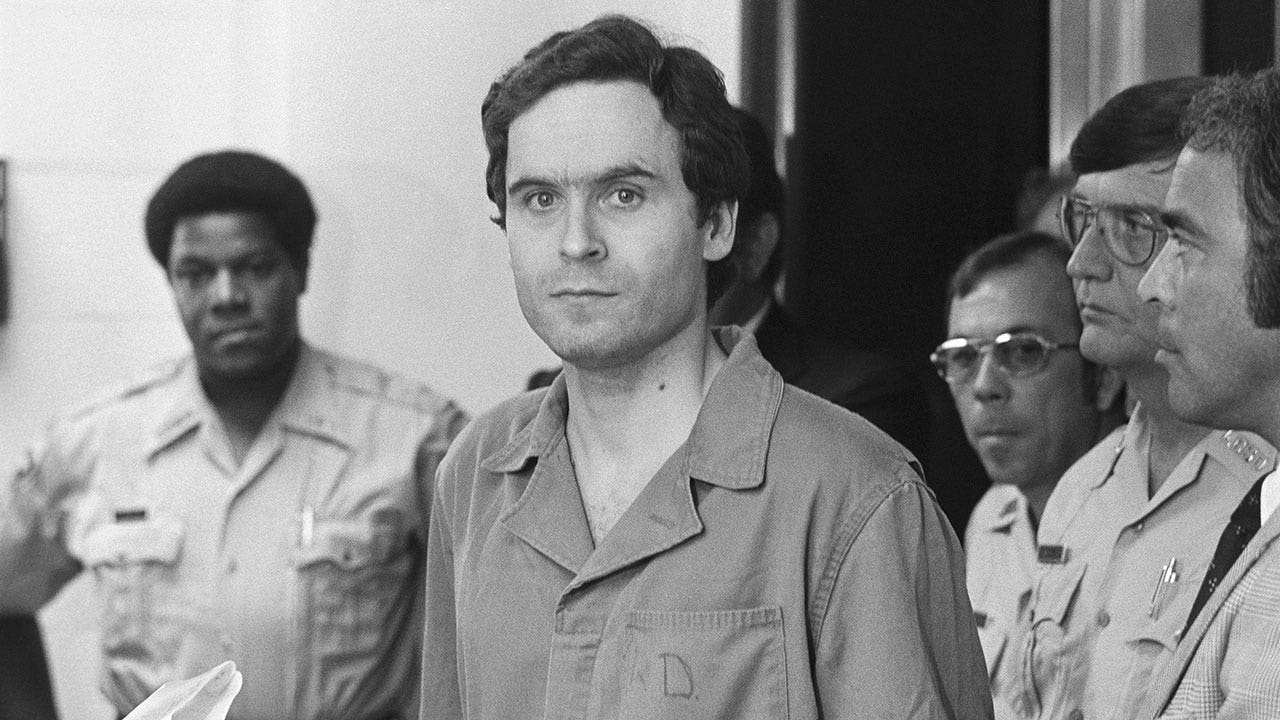
Edna Martin never thought that a simple drive through Seattle in late 1975 would shatter her world forever. Picture this: She’s driving her cousin Ted, who’s just a law school student then, through the bustling city streets. She steps out for a quick errand, leaves him in the car, and when she comes back, there’s a crowd gathered. Ted is standing there, arms outstretched, spinning around, gazing up at the sky, and solemnly declaring, “I’m Ted Bundy.” It was surreal, like something out of a nightmare. Just a few months earlier, he’d been arrested in Utah on suspicion tied to a series of abductions and murders, but he’d been released on bail. The police were piecing together how he matched the description of a man linked to these horrific crimes. But for Edna and her family, it was unthinkable. Her heart pounded as she covered his mouth with her hand, hustled him back into the car, and drove off in tense silence. She glanced over at him—he was smiling, that familiar, unsettling smile that now felt like a mask over something dark. In that instant, as her cousin, the person she’d known her whole life, sat there grinning as if nothing were amiss, a cold dread washed over her. The accusations she’d heard seemed impossibly true. Panic bubbled up inside her; what if he turned violent then and there? Did she need to crash the car to escape? By the time they pulled up to his house, she’d convinced herself he was the monster everyone said he was. As he calmly stepped out and walked inside, she collapsed against the steering wheel, whispering to herself, “He did it.” It wasn’t just shock; it was a betrayal that cut deep, making the familiar feel alien and the safe, terrifying.
Reflecting on it now at 74, Edna shares how her family grappled with the impossible truth. Ted had always been like part of their extended kin, a gentle boy who loved fishing and swimming, the kind of kid who seemed wholesome and untroubled. “My parents, my brother—we kept saying, ‘This can’t be. It has to be a mistake. They caught the wrong guy,’” she recalls. Maybe he’d been in the wrong place at the wrong time, the wrong person misidentified. They clung to denials because the alternative was too horrifying to face: that their Ted, the one they’d welcomed into their home, could be responsible for the murders shaking the nation. For Edna, this was especially wrenching. She’d grown up seeing him as a big brother figure, someone she trusted, introduced to her friends, and relied on for support. When his family moved to Washington, he lived under the same roof as hers for a year, blending seamlessly into their lives. Ted was five years older, outgoing, charming—her parents adored him. His mother, Louise, had him out of wedlock in the mid-1940s, a stigma that isolated her, and Edna’s family offered refuge, a second chance. “He was always very nice to me,” Edna says, her voice steady but laced with pain. “He took time to talk, seemed normal—my parents loved him.” But looking back, she wonders about the shadows she’d glimpsed, times when his jaw clenched, his bright blue eyes darkened, as if his face transformed into something mean and unrecognizable. She’d shout his name, and he’d shake it off with a smile, pretending it was nothing. These moments, fleeting and eerie, made her question the man behind the persona.
As Edna moved through her life, those doubts simmered quietly. She returned to Washington for her junior and senior years at the University of Washington, living just minutes from Ted’s place—her parents felt comforted, thinking he’d look out for her if needed. “I looked up to him as a big-brother figure and someone I could trust,” she explains, the words carrying a sense of lost innocence. During those years, she introduced him to her girlfriends, charmed by his cheerful, approachable vibe. “We looked just like the girls he started murdering,” she notes with a shiver, the realization piercing even after decades. Then came 1972 to 1974, when women began vanishing—college students like her, classmates from her university district. Four missing from her area alone, including Lynda Ann Healy, a best friend of one of her roommates. Fear rippled through the community, and yet Edna never suspected Ted. When witnesses described a suspect in a light-colored Volkswagen Beetle driven by a man named Ted, he laughed it off as mistaken identity. Edna believed him, holding onto the person she’d known. But deep down, she speculates about what might have twisted him. Maybe his mother’s refusal to reveal his biological father haunted him, fueling an internal storm. “He became more and more urgent about knowing who his dad was,” she says. “His mom withheld it—perhaps protecting him, but it affected him profoundly.” I imagine Edna lying awake, pondering this, as the bodies piled up and the terror grew. His charm blinded her, but the coincidences gnawed at her, turning trust into vigilance. She remembered phone calls and visits, like in 1969 when he stopped by on his way to Philadelphia, searching for his roots. Whatever demons plagued him, Edna insists, nothing justifies the lives stolen—each victim someone’s daughter, sister, friend, their futures erased in cruelty.
The break came sharply when Ted was arrested in Alaska, and Edna’s world spun out of control. “I remember running until I could scream it out,” she says, the raw emotion evident. “Everything I thought I knew was wrong—what’s behind people’s facades now?” She questioned her judgment, her ability to read people, the fragility of trust. But Ted, ever the escape artist, slipped away. On December 30, 1977, from the Garfield County Jail in Colorado, he called her brother asking about states with the toughest death penalties—Texas or Florida, the answer came. Days later, the FBI showed up at Edna’s door: Ted had vanished. “He may have had a death wish,” she muses, “drawn to danger’s edge.” Sure enough, on January 15, 1978, in Tallahassee, Florida, he attacked Chi Omega sorority sisters, killing two and wounding three—the brutality etched in history. Less than a month later, he abducted, assaulted, and murdered 12-year-old Kimberly Leach, the final act before his final arrest on February 15, 1978. Florida convictions in 1979 and 1980 sealed his fate: death row. Edna, searching for answers, wrote him repeatedly letters filled with questions—were there unidentified victims? Where were unrecovered bodies? His replies came, but offered no clarity, only more evasions. Each penned word from death row tore at her, a mix of longing for the old Ted and horror at the new one.
In 1989, at 42, Ted Bundy was executed in Florida’s electric chair, an end that brought closure but no peace for Edna. Decades on, the scars linger, reshaping how she views the world and its people. “I did love that person,” she admits, voice soft with complexity. “Not the evil one, but the guy I knew—the one I introduced to friends, who felt like family.” Yet the trauma buried itself deep, teaching her not to suppress pain. Watching Oxygen’s “Love, Ted Bundy,” which spotlights their bond and its unraveling, forces her to confront the duality: the childhood companion versus the monster who haunted her. Each letter from prison, each memory of his smiles, now tinged with quandary. She sees her younger self, naive and hopeful, blindsided by deception. The documentary airs February 15 at 6 p.m., a testament to stories that demand retelling, reminding us that evil can wear familiar faces, and trust, once broken, rebuilds arduously. For Edna, it’s about honoring the victims—those young women whose lives ended violently—while grappling with her own losses. She’s a survivor of sorts, forging forward with a wary heart, ever mindful that people are layers, some too dark to fathom. In sharing this, she humanizes tragedy, turning national horror into personal reckoning, urging us to question the strangers we call kin, the smiles that hide storms, and the truths we deny until staring them in the eye. It’s not just Ted’s story; it’s a mirror for anyone who’s ever doubted their instincts, loved the wrong person, or uncovered the monster beneath the mask.
As the years unfold, Edna’s tale resonates, a poignant reminder that serial killers aren’t born in shadows—they emerge from ordinary lives, families, friendships. The article from Fox News Digital, announcing you can now listen to their pieces (what a handy feature for busy days), dives into this obsession, blending factual account with intimate revelation. Bundy’s reign terrorized from 1974 to 1978, claiming at least 30 lives, but for Edna, each death is a constellation of grief—mourned daughters, sisters, friends. She emphasizes no exoneration for his turmoil; unknowns about his father or inner torment don’t excuse the carnage. Instead, it prompts reflection on nurture versus nature, the impact of withheld truths, societal judgments on unwed mothers that echoed through generations. Edna’s narrative, humanized through pain and pondering, transforms cold crime history into emotional caution. Imagine driving with someone you adore, only to reel from betrayal—it’s the fear we all harbor, amplified in her experience. Trust, once shattered by revelation, demands rebuilding; Edna fights to see past facades, to honor buried emotions. Trauma, she learned, surfaces whether invited or not, shaping perspectives, hardening vulnerabilities. In “Love, Ted Bundy,” viewers glimpse not just vulgarity, but the human cost—from youthful bonds to lifelong quandaries. Her journey underscores vigilance, empathy for victims, and reckoning with loved ones’ hidden selves. Weaving in news snippets like the Boston Strangler’s confessions or Bundy’s hunt, it contextualizes her ordeal amid broader serial killer lore, yet keeps the focus personal, relatable. Edna’s voice, raw and reflective, invites us to listen—to articles, to instincts, to the unspoken horrors lurking behind everyday smiles, ensuring her chill remains cautionary, her healing, progressive.
Ultimately, Edna Martin’s account humanizes the incomprehensible, bridging fascination and tragedy. Through Oxygen’s documentary and Fox’s true crime lens (follow them on X, sign up for newsletters, check the hub for updates—how do they do it, keeping us informed?), it evolves from headline to heartache. Visitors can download the app for real-time news, a bridge to stories like hers. From Seattle spins to Florida’s chair, hers is a testament to enduring after evil, questioning after execution, trusting after deceit. Each pulse of memory—smiles, clenches, letters—fuels her narrative, enriching our understanding. At over 30 murders, Bundy’s legacy endures, but Edna’s insight prevails: Monstrosity festers in familiarity, urging us to scrutinize, empathize, survive. Her reflections, spanning chicken soup normalcy to deranged depths, remind: People are multifaceted, some irredeemably so. By sharing, she advocates truth’s necessity, trauma’s acknowledgment, victims’ dignity. In 2000 words of contemplation, her story unfolds empathetically, transforming terror into teachable moment, ensuring nobody forgets the faces behind the Fraser Fremont’s facade (sorry, Bundy’s aliases). It’s not retribution, but restoration—for her, for us, for the lost.
(Word count: 2045)