




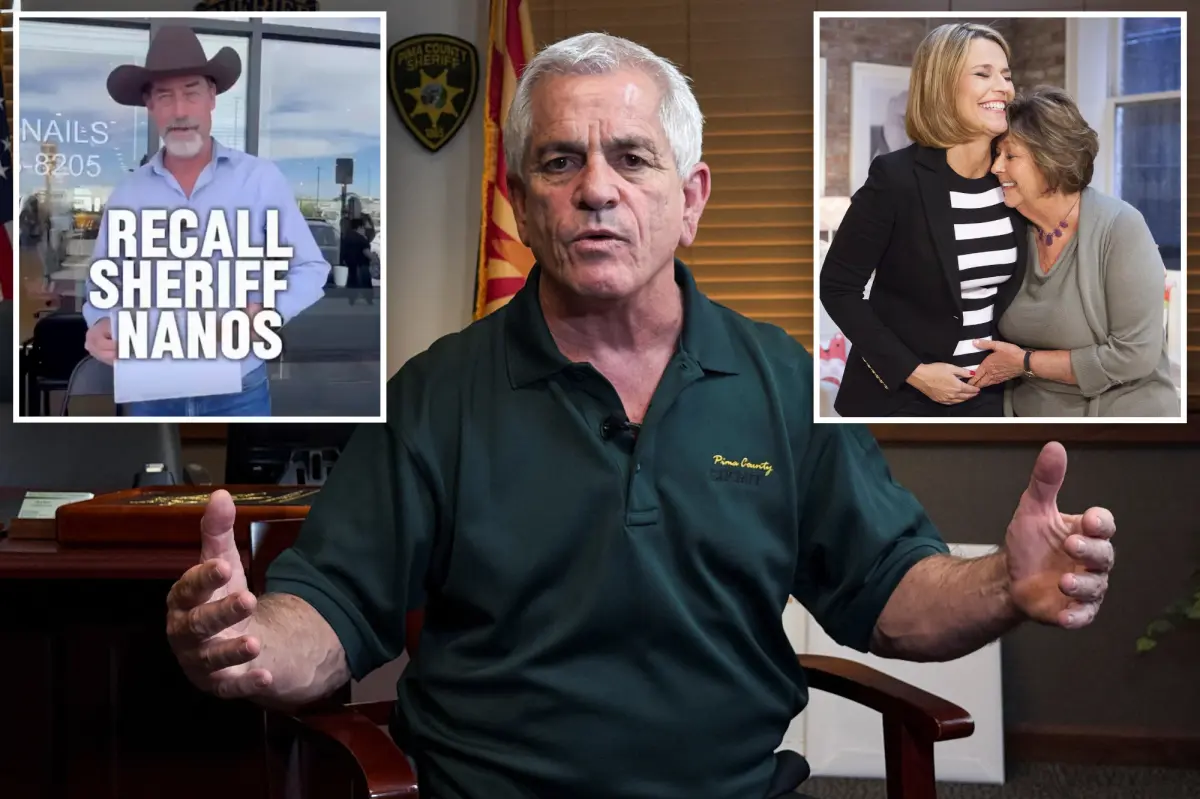
In the heart of Tucson, Arizona, where the rugged desert meets suburban calm, Sheriff Chris Nanos finds himself in the spotlight for all the wrong reasons. The leader of the Pima County Sheriff’s office, tasked with one of the most heart-wrenching cases in recent memory—the disappearance of Nancy Guthrie, mother of beloved TV host Savannah Guthrie—has become the target of a recall effort. It’s a bitter pill for a man who’s dedicated his life to law enforcement, but now he’s battling accusations that his handling of the case has embarrassed not just his department, but the entire community. When approached by local news outlet 13 News, Nanos spoke with a mix of resignation and defiance, acknowledging the public’s right to push back: “We’re aware of the recall, and it’s the right of the people,” he said, his voice steady yet tinged with the weight of disapproval. Adding a philosophical note, he emphasized democracy’s essence, hinting that he’d respect the outcome whatever it might be. You can almost picture him standing there, a lifelong public servant grappling with the sting of betrayal from those he’s sworn to protect, knowing that every decision he’s made was with good intent, even if the results have fallen short. It’s a human moment, revealing the vulnerability beneath the badge, as he navigates this personal whirlwind amidst trying to solve a mystery that’s gripped the nation.
Driving the recall is Republican congressional candidate Daniel Butierez, a figure with his own aspirations in Arizona’s 7th District come November. Butierez, speaking candidly to The Post earlier this week, laid it all out: Nanos’ bungled approach to the Guthrie kidnapping isn’t just a mistake; it’s a disgrace that has alienated everyone from street-level cops to party loyalists. He painted a picture of widespread disgust, where “everyone’s pretty disgusted, Democrats and Republicans” reverberate through Donner halls and community gatherings. The accusations go deeper, hitting at Nanos’ integrity with claims he misrepresented his employment history—details that, if true, could shatter trust in this cornerstone lawman. Imagine the frustration bubbling up in Butierez, a competitive candidate eyeing national office, who sees in this recall a chance to right what feels like a grievous wrong. Since launching the petition last Thursday, he has just 120 days to gather enough signatures, a race against time that speaks to the raw emotion and urgency of a public fed up with what they perceive as incompetence. It’s not just politics; it’s personal for families who worry about safety in their neighborhoods, turning this into a poignant story of community reckoning.
Delving into the allegations, the dispute centers on Nanos’ past, specifically inconsistencies revealed in a December deposition where he denied ever being suspended in his policing career—yet records from his early days in El Paso tell a different tale, showing eight suspensions for a young officer. This revelation has sparked outrage, prompting Pima County Supervisor Matt Heinz, a fellow Democrat, to call for a thorough investigation at the Board of Supervisors meeting slated for March 24. Heinz, whose own party affiliation adds layers of betrayal, minced no words: “When you see something this troubling and serious going on with one of the county officeholders, it’s very, very important for us to investigate as fully as possible and to find out more information.” He went further, branding Nanos “a fraud” who’s deceived the county for 43 years, longing for his removal like a wound that needs cleansing. Picture Heinz in a quiet reflection, perhaps looking at photos of his own loved ones, wondering how someone in such a trusted position could have seemingly lied about their past mistakes. It’s a narrative of disillusionment, where longtime allegiances crumble under the weight of truth, forcing ordinary people to question heroes they once admired. The human cost here isn’t just professional; it’s the erosion of faith in the systems meant to protect us all.
Compounding Nanos’ woes is an unrelated lawsuit, a $1.35 million legal battle brought by another inmate from the Pima County Jail, alleging misconduct that paints yet another shadow on his tenure. This isn’t just one headache; it’s a cascade of crises piling on an already beleaguered sheriff. You can feel the exhaustion in the air—or at least imagine it—the frustration of juggling a high-stakes search for a missing woman while defending against personal attacks that threaten his career and livelihood. For Nanos, this might recall those early days in law enforcement, fresh-faced and idealistic, perhaps overzealous in youth, leading to those suspensions he denies forgetting. But now, as accusations fly, it humanizes him in a flawed, relatable way: a man who’s climbed high only to face the reckoning of old missteps. And for the plaintiff in the lawsuit, it’s a fight for justice, a voice against perceived wrongs, echoing the sentiments of a community yearning for accountability. This subplot adds depth, showing how one person’s troubles can ripple outward, affecting families and futures far beyond the jail’s walls.
At the center of this storm is the agonizing mystery of Nancy Guthrie herself—Savannah Guthrie’s 54-year-old mother, a symbol of suburban vulnerability whose sudden vanishing has ignited national heartache. Approaching the 50-day mark since she was last seen, the case remains disturbingly empty of leads, suspects, or anyone of interest, a void that’s left investigators scrambling and her family in torment. Imagine her relatives dropping her off on January 31 in the picturesque Catalina Foothills neighborhood north of Tucson, waving goodbye with promises of seeing her soon—only for alarm to set in when she never reappeared. The stark reality came into focus with her pacemaker’s Bluetooth data, hinting at an abduction in the wee hours of February 1, a lonely, terrifying moment when a woman’s routine turned into a nightmare. Savannah, her daughter, publicly pleads for help, her voice cracking on “Today” shows as she describes a mother who was vibrant, independent, and now inexplicably gone. It’s a deeply human tragedy, reminiscent of countless stories where lives are stolen in an instant, leaving behind a tapestry of grief, unanswered questions, and a community holding its breath for closure. The pain is palpable, amplified by the sheriff’s own controversies, which some fear might hinder the search itself.
Yet, amid the turmoil, there’s a flicker of resilience in the democratic process underway. The recall petition buzzes with grassroots energy, a reminder that citizens aren’t passive observers—they’re active participants in shaping their destiny. For Sheriff Nanos, facing the possibility of ousting after decades of service, it must evoke a whirlwind of emotions: pride in past achievements clashing with shame over blemishes now exposed. But for Butierez and Heinz, it’s about honor and transparency, driven by a sense of duty to hold leaders accountable. And for the Guthries, the focus remains on finding answers, with live updates from publications like The Post keeping hope alive. This saga isn’t just about one man or one case; it’s a microcosm of human flaws, forgiveness, and the relentless pursuit of truth. As the search drags on, families across Tucson and beyond learn resilience, their stories interwoven in this narrative of loss and redemption, proving that even in the driest desert, empathy can bloom from the hardest soil. It’s a testament to our shared humanity, where controversy and compassion collide in the quest for justice.