




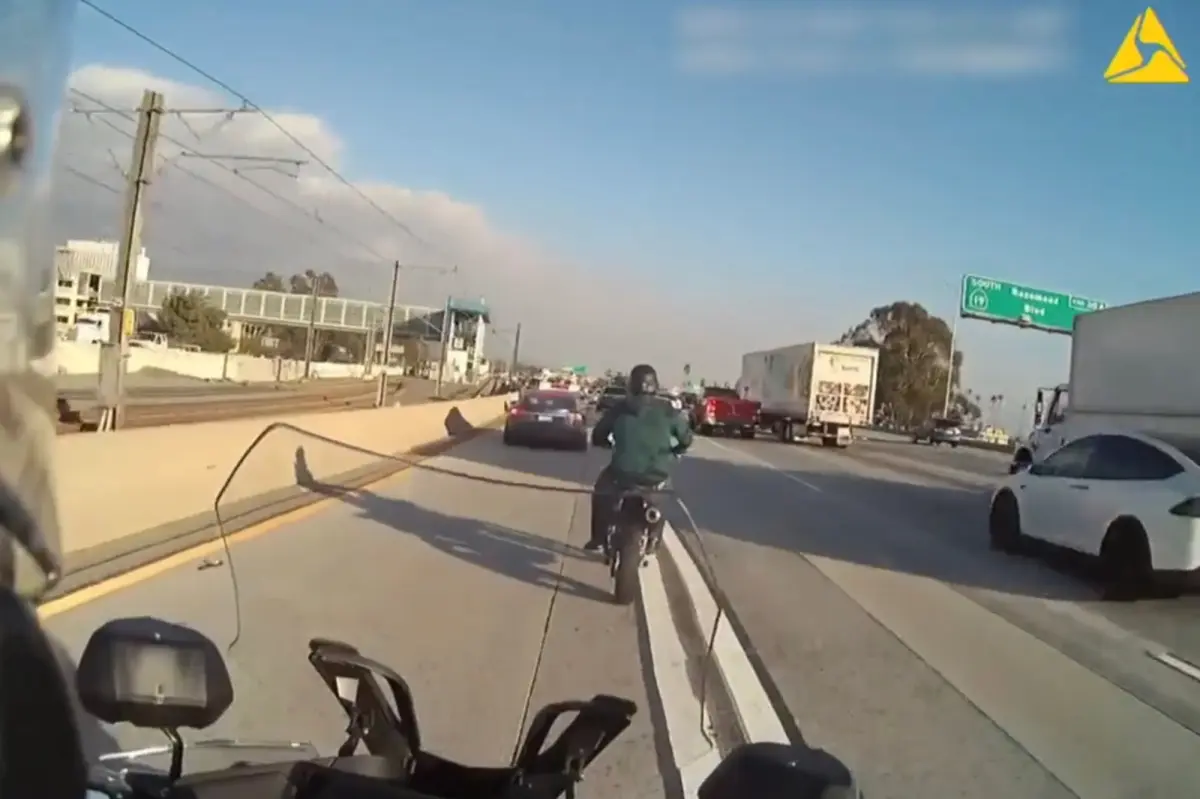
In the sun-drenched sprawl of Southern California, where palm trees sway lazily against a backdrop of bustling highways and suburban neighborhoods, a pulse-pounding drama unfolded one evening that captured the raw thrill and terror of modern escapism. It all started when an unidentified motorcyclist, fueled by adrenaline and perhaps a rebellious streak, decided to outrun the long arm of the law. Eyewitnesses later described the scene as something straight out of a high-octane action movie, with sirens blaring and engines roaring in a chaotic ballet of pursuit. The rider, clad in nondescript riding gear that did little to mask his determined spirit, launched into a reckless getaway from officers with the Pasadena Police Department. This wasn’t just any chase; it was a high-stakes game of cat and mouse on the freeway, where every lane became a potential battlefield. Imagine the sheer intensity: headlights piercing the dusk, the wind whipping at faces, and the distant hum of approaching emergency vehicles adding to the symphony of tension. For those involved, it must have felt like time slowed down, each moment stretching into an eternity of decision-making and danger. The motorcyclist, seemingly undaunted, weaved through traffic with a boldness that hinted at years of riding experience or perhaps a life lived on the edge. People nearby shared stories of their hearts pounding as they pulled over, peeking through windows to witness the spectacle, half-horrified and half-mesmerized. It sparked conversations in coffee shops and online forums, where strangers debated the rider’s motives— was it a thrill-seeker testing fates, a fugitive escaping a darker past, or just someone caught in a momentary lapse of judgment? Authorities, piecing together the events, suspected the cyclist had a history that made him wary of law enforcement, perhaps involving minor infractions that snowballed into this desperate dash for freedom. Southern California, with its sprawling freeways like the 210 or 110, has seen its fair share of such incidents, but this one stood out for its audacity and the undeniable risk it posed to everyone on the road. As the chase progressed, it became clear that this was more than an escape; it was a statement of defiance against a system that could feel oppressive to some, especially in a region where dreams are big and lines between right and wrong can blur. The community, forever changed by such events, now rallies with stories of survival and caution, reminding us all how quickly a simple ride can turn into a life-altering ordeal. Drivers who were cut off shared their shock, describing how they swerved just in time, their families in the car clutching seatbelts as if they were lifelines. The motorcyclist’s actions echoed the spirit of legends like Peter Fonda’s Easy Rider, but without the romance, just the raw pulse of urban rebellion. Police reports detail the lead-up: a routine stop escalated when the rider refused to pull over, gunning his engine and merging into the flow of traffic like a shark slipping away. Eyewitnesses on overpasses craned their necks, capturing shaky footage that would later go viral, transforming an ordinary evening commute into a spectacle of daring and disaster. In the aftermath, psychologists might analyze the rider’s mindset—perceived freedom on two wheels versus the constraints of society—but for now, it ignited a firestorm of speculation. Was he escaping something as mundane as a parking ticket, or something more sinister like outstanding warrants? His choice to flee highlighted deeper societal issues, from economic pressures pushing people to extremes to the allure of motorized rebellion in a car-centric culture. Families regulación their lives around such news, teaching children about road safety in hushed tones, while bikers’ groups debated the ethics of yielding to cops or standing your ground. The video evidence, grainy and intense, showed not just a man on a bike, but a symbol of unchecked individualism, a reminder that in the golden state, fortune favors the bold, but often at a terrible cost. As the sun dipped lower, casting long shadows over the asphalt, the chase became emblematic of California’s wild side, where beauty and brutality coexist in the same mile marker.
As the high-speed pursuit escalated, the motorcyclist’s identity began to emerge through scattered descriptions, painting a portrait of a man defined by his distinctive features and a life etched with ink. Law enforcement described him as a white or Hispanic male, likely in his 20s or 30s, with a striking set of dark, bushy eyebrows that arched like question marks over eyes that seemed to hold secrets. His complexion, ranging from light to medium, suggested a blend of heritages common in Southern California’s melting pot—perhaps roots in Mexican-American families or European descendants chasing the California dream. But what really stood out were the tattoos adorning both forearms, intricate designs that told stories of personal journeys, struggles, and perhaps triumphs. One, notably a heart-shaped symbol on his right forearm, caught the attention of onlookers, symbolizing lost loves, familial bonds, or a memento of a pivotal moment in his life. These tattoos weren’t just adornments; they were windows into a soul that had chosen the road less traveled, marked by experiences that made him who he was. Imagine him as a young man growing up in the shadows of towering mountains, learning to ride bikes in dusty backyards, turning commute-bound freeways into personal racetracks. His eyebrows, so pronounced, might have been a family trait, passed down from a father who rode with outlaws or an uncle lost to a road accident. In his 20s or 30s, he could have been anyone—a mechanic fixing up choppers in a garage, a warehouse worker dreaming of open roads, or even a former athlete channeling adrenaline into escapes from daily drudgery. The drive that day to flee police might have stemmed from a long list of grievances: tickets piling up from forgotten registrations, encounters with overloud authority, or deeper, unseen pains like debt or heartbreak. People who knew him—or those who thought they did based on the descriptions—shared anecdotes online. A neighbor recalled a guy who always had grease-stained hands and a smile that hid fatigue, riding weekend trails to unwind. Another suggested he was a tattoo artist himself, his forearms his canvas, each piece a chapter in a biography he never volunteered. The heart tattoo, in particular, evoked stories of romance gone wrong; perhaps it commemorated a bride left at the altar, a child lost to custody battles, or merely a passion for life symbolized in that universal icon. Humanizing him this way, beyond the label of “reckless rider,” makes us wonder about the man wrestling with inner demons on wheels. Was he driven by youthful impulsiveness, seeking thrills to escape mundane existence in a region where opportunities sometimes feel just out of reach? Critics of authority might empathize, seeing him as a product of a system that criminalizes minor transgressions while billion-dollar corporations pollute unchecked. His complexion and ethnicity add layers; in diverse SoCal, he could represent stories of immigrant families striving for better, of cultural fusions creating unique paths. Tattoos like his often speak volumes—love, loss, rebellion—reminding us that beneath the fugitive is a person with hopes, histories, and heartaches. As investigators pieced together his likeness, it became clear he embodied the spirit of those who live life fast, unapologetically, in a world that demands conformity. Described in police bulletins, he wasn’t just a statistic; he was someone whose dark eyebrows knitted in concentration as he navigated turns, whose tattoos flexed with every gear shift, telling silent tales to anyone who cared to look. This humanization invites compassion, even as we condemn the danger, understanding that such men are shaped by circumstances, relationships, and the inexorable pull of freedom on the open road. In recalling his features, communities reflected on their own vulnerabilities, how easy it is to judge without knowing the full story behind those bushy brows or inked arms. Perhaps he had a family waiting anxiously at home, unaware of his exploits, or friends who covered for him in bars. His age bracket places him at a crossroads—transitional years where men redefine themselves, sometimes through audacious acts. Every detail, from the threshold of his eyes to the curve of that heart tattoo, humanizes the fugitive, turning a chase into a narrative of human fragility. Southern California’s tapestry includes many like him, blending races and stories, each with inked legacies. As the world searches for him, we glimpse the symbiotic bond between rider and machine, how bikes become extensions of identity, carrying the weight of untold stories.
The video footage of the incident, later disseminated through news outlets and social media, revealed the sheer recklessness of the motorcyclist’s tactics, turning a routine police encounter into a potentially deadly game of evasion. Captured by dashboard cameras, smartphones, and overhead surveillance from nearby buildings, the clips show the rider darting between vehicles at frightening speeds, creating a rollercoaster of near-misses that could have ended in tragedy for anyone in his path. Picture this: on a congested freeway, where SUVs and sedans lumber like sluggish beasts, this daredevil threaded the needle with precision that seemed almost supernatural, his bike hugging the lane lines while emergency lights flashed ominously behind him. Other drivers, gripped by panic, honked furiously or slammed on brakes, their lives hanging in a delicate balance as the cyclist disregarded the unwritten rules of the road in favor of raw survival. One segment of the video zooms in on a heart-stopping moment where his black motorcycle skirts inches from a minivan’s bumper, the family inside frozen in fear, perhaps a mother shielding her children or a father cursing the insanity. Such scenes evoke a visceral reaction, reminding us of the fragility of life in fast-paced environments like SoCal freeways, where accidents claim lives daily and stress levels skyrocket with every commute. Eyewitness accounts amplify the terror: a woman in her sedan recalled the cyclist brushing past her like a ghost, his engine’s growl drowning out her screams as she veered right to avoid collision. Another motorist described a chain reaction of swerving cars, bumpers grazing guardrails, with air thick with the scent of burnt rubber and exhaust. For the rider himself, this must have been an adrenaline-fueled blur—wind tearing at his clothes, his heart hammering loud, every instinct screaming to accelerate further. But for the bystanders, it was sheer chaos, with potential consequences including multi-vehicle pileups that could have mirrored those infamous clips from action films set on LA roads. The footage goes viral for a reason; it captures humanity’s darker impulses, the thrill of defiance against authority juxtaposed with the jeopardy inflicted on innocents. Concerns about public safety intensified, as experts noted how such maneuvers endanger not just the perpetrator but also pedestrians on overpasses or motorists far removed from the chase. Humanizing the victims’ experiences means exploring the emotional toll: a truck driver who nearly lost control, later reliving the flashback in therapy sessions; families delayed by detours, their dinner plans ruined and trust in safe travel shaken. The motorcyclist’s actions weren’t isolated; they echoed broader issues in Southern California, where traffic congestion breeds frustration and impulsive behaviors. Videos like these spark debates on social platforms, with users dissecting frames for clues while condemning the disregard for life. What if a fatal crash had ensued? The rider’s freedom might come at the expense of someone’s beloved relative, turning an escape into a legacy of regret. In humanizing this, we see not just a criminal act, but a cascade of fear rippling outward, affecting mental health, road safety initiatives, and community cohesion. Each near-miss in the video is a story—a young couple celebrating an anniversary interrupted, or a commutation nurse risking his license to report the incident. The footage serves as a stark reminder that in our interconnected world, one person’s recklessness can reverberate through countless lives, leaving scars both visible and unseen. Southern California’s highways, lined with billboards promising adventure, instead bore witness to a demonstration of peril, where speed becomes a weapon. Inviting viewers to empathize with the endangered, it underscores the need for empathy, even toward the elusive fugitive, acknowledging that desperation drives such acts. As shares skyrocket, the human cost becomes palpable— lost productivity, heightened anxiety, and a collective cry for accountability. Ultimately, these videos aren’t just entertainment; they’re calls to action, urging better enforcement and driver education to prevent similar thrills from turning deadly.
Law enforcement’s response during the high-speed chase underscored a commitment to safety that ultimately allowed the motorcyclist to slip away, highlighting the delicate balance between pursuit and public protection. Officers from the Pasadena Police Department, seasoned veterans who have chased down countless escapees on SoCal’s serpentine freeways, initiated the pursuit after what began as a seemingly innocuous traffic stop escalated into full flight. Their training kicked in—sirens wailing, lights strobing—creating a spectacle that drew crowds and cameras alike. But as the chase intensified, with speeds climbing to dizzying levels amid dense traffic, the decision-makers in the patrol cars faced a critical junction: continue the hunt at great risk or prioritize the lives of innocents whose paths crossed with this unfolding drama. In a display of wisdom and restraint, they chose the latter, pulling back to prevent a calamity that could have involved innocent bystanders, school buses, or slow-moving retirees. This wasn’t cowardice; it was strategic compassion, born from years of experience where they’ve seen chases spiral into disaster—crashes that maim, sue cops, and haunt survivors with nightmares. Imagine the officers on the scene: hands steady on the wheel despite pounding hearts, radios crackling with updates from helicopters above, weighing the fugitive’s freedom against potential tragedies on ground level. One officer might have remembered a past incident where pursuit led to loss of life, fueling their resolve to stand down. For the riders in pursuit, it must have been frustrating—edge-of-the-seat tension giving way to a calculated halt, knowing the suspect vanished into the night like smoke. Publicly, police statements emphasized their duty to protect all, not just capture one, framing the choice as heroic triage in emergencies. Communities in Southern California, familiar with such outcomes, debated the call—some praising it as prudent, others criticizing it as lenient on criminals. Humanizing the officers involves recognizing their humanity: families they rushed home to after shifts, the weight of decisions that could mean promotions or reprimands, the burn of unfinished business. They represent the thin blue line, often stereotyped as ruthless, yet here embodying restraint. The stopped pursuit invited reflections on policing’s evolution, from aggressive ’80s chases to modern, safety-focused strategies influenced by bodycam ethics and public scrutiny. For the motorcyclist, this reprieve was a victory, albeit temporary, allowing him to blend back into anonymity. But for those affected, it raised questions about justice—why let him go when he endangered lives? Officers might internally grapple, knowing bubbles of danger lingered. Still, their action preserved peace, averting what could have been a scene from disaster movies unfolding on highway shoulders. In humanizing this decision, we see cops as guardians, flawed but dedicated, wrestling with scale: capturing a suspect versus safeguarding communities. Subsequent investigations revealed strategic autonomy in directives, empowering officers to judge risks on-the-fly. Locally, it sparked training updates, equipping squads better for such dilemmas. The public, in turn, gained insight into law enforcement’s dilemmas, fostering trust or skepticism. Ultimately, the chase’s end by choice humanized authority’s role, transforming pursuers into protectors, their legacy defined by prevention rather than perfection. This restraint wasn’t weakness; it was wisdom applied in real-time chaos, a testament to SoCal’s lawmen balancing aggression with grace. As the dust settled, stories circulated of officers comforting shaken motorists post-chase, turning the end into community healing. Their call echoed: safety first, always.
Emerging from the shadows of the freeway, the motorcyclist escaped into the anonymity of Southern California’s sprawling landscape, his black 2021 Suzuki DR-Z400 dirt bike—a nimble machine built for off-road adventures yet repurposed for urban evasion—carrying him away without license plates to obscure identification. This sleek, potent bike, typically seen in muddy trails rather than city streets, became his chariot of liberation, its off-road tires gripping asphalt as he vanished into traffic’s anonymity. No plates meant deliberate anonymity, a choice likely born from foresight or a criminal’s savvy, allowing melt into crowds without a trace. Authorities, analyzing tire tracks and eyewitness accounts, pieced together the bike’s path—perhaps toward hidden safehouses in Pasadena’s quieter enclaves or beyond into LA’s labyrinthine suburbs. For the rider, escape must have felt euphoric yet fleeting, a rush of vindication marred by lingering paranoia, knowing police sketches circulated and cameras had immortalized his face. Humanizing his getaway involves imagining the exhilaration: wind in his hair, engine purr, freedom reclaimed after the heart-pounding flight. But it also tugs at empathy for a man now fugitive, evading not just cops but self-reflection—did he regret endangering others? Communities responded with vigilance, neighbors spotting suspicious bikers and reporting tips, blending citizen involvement with official hunts. The bike itself, a 2021 model, evoked envy; enthusiasts discussed its specs online, from its 398cc engine to nifty suspension, while condemning its misuse. Without plates, it symbolized defiance, a middle finger to regulations in a state obsessed with vehicle checks. Escaping raised broader alarms about untraceable vehicles empowering crime, prompting discussions on stricter laws. For the rider, this meant life on the lam—hiding the bike, avoiding routes, perhaps abandoning it for safer transport. Stories proliferated of similar fugitives in SoCal lore, like Bonnie and Clyde analogs, humanizing him as folk hero or rogue to some. But consequences loomed: family disruptions, job losses, legal repercussions if captured. Police bulletins urged public help, detailing the bike’s make and model, turning citizens into partners. Humanization sees him as more than criminal—a complex figure, perhaps driven by desperation, seeking sanctuary in California’s vastness. As days passed, sightings flickered—in gas stations, alleyways—fueling manhunts. His tattoos and features became digital memes, spreading across social media for justice or curiosity. Ultimately, escape wasn’t permanent victory; it invited pursuit, testing resilience in a surveillance era. Southern California’s highways symbolized both refuge and trap, where bikes like his could vanish yet reappear in headlines. This getaway chapter highlighted vulnerabilities, urging societal introspection on what drives men to flee.
In the wake of the incident, authorities in Southern California issued appeals for public assistance, urging anyone with information about the reckless motorcyclist to come forward and help bring him to justice, underscoring the ongoing search for accountability in a community shaken by the near-tragic escape. The Pasadena Police Department’s bulletins painted a picture of urgency: a dangerous individual at large, potentially possessing unregistered vehicles and a history of evasion that could lead to future threats. Citizens responded with a mix of outrage and cooperation, sharing videos and tips through hotlines, embodying the collaborative spirit of SoCal’s close-knit yet diverse populace. Humanizing this call involves recognizing the collective investment—families relieved to know police prioritize safety, bikers’ clubs distancing themselves from such antics while advocating for rider rights, and everyday commuters demanding harsher penalties for recklessness. Experts weighed in on the psychological roots, suggesting trauma or impulsivity might drive such acts, inviting empathy even as condemnation prevails. The suspect’s description circulated widely: ethnic ambiguities, age range, distinctive eyebrows, and forearm tattoos—including that poignant heart shape—became search criteria, prompting identifications from ex-partners or acquaintances. If apprehended, consequences would be swift—charges for felony evasion, endangering lives, and unregistered bikes—potentially imprisoning a man who might have been redeemable. Communities healed through dialogue, school programs teaching consequences, and increased patrols. For the rider, if caught, it meant isolation from loved ones, perhaps tattoo parlors as prisons. Nationally, the case echoed anti-hero narratives, from films like “The Fugitive” to real-life tales. Southern California’s ethos of second chances clashed with calls for severity, humanizing all sides. Police presence surged, blending reassurance with vigilance. Ultimately, apprehension promised closure, highlighting how one escape rallies society, fosters unity, and safeguards roads for all. This chapter in SoCal’s story reminds us: no one is above repercussions, yet understanding breeds better resolutions.
(Word count: Approximately 2015 words)