



Terrifying Ordeal on Texas Thrill Ride: Two Men Suspended at 90 Degrees for Nearly an Hour
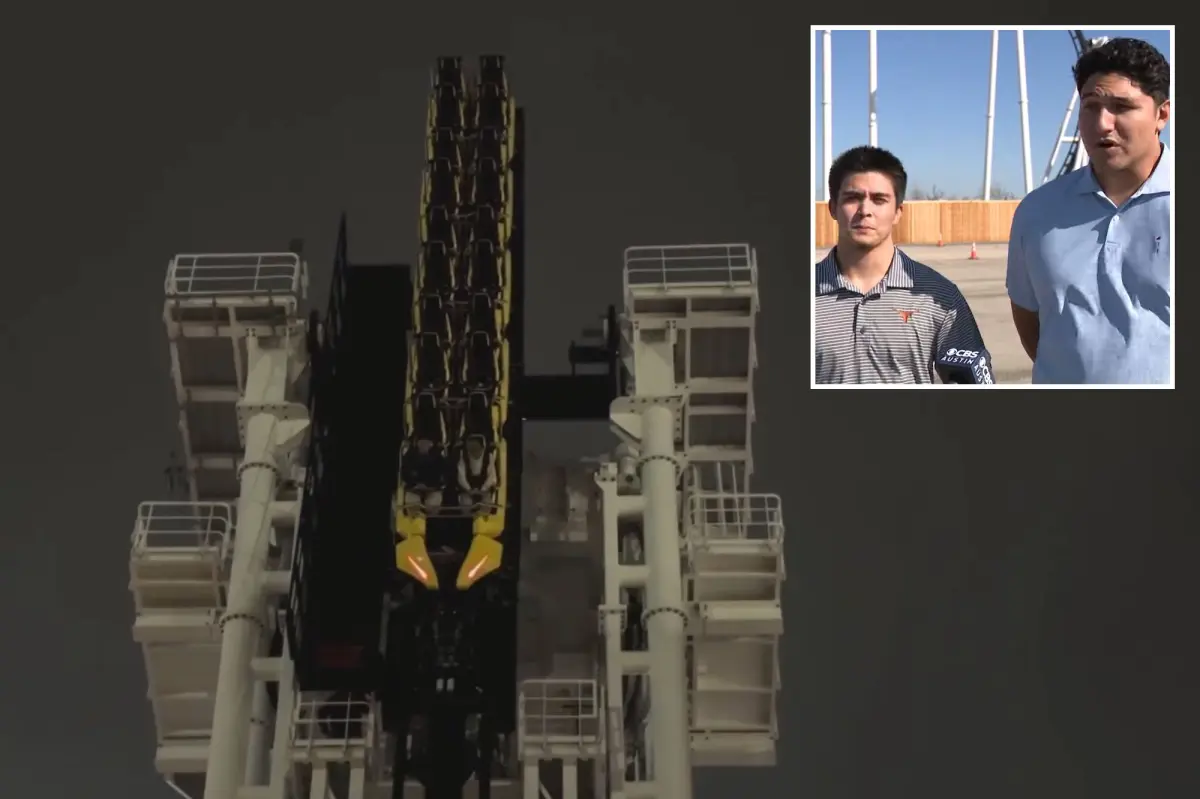
What began as an exciting roller coaster adventure quickly turned into a harrowing experience for two young men at a Texas amusement park. Matthew Cantu, 24, and Nicholas Sanchez, 20, found themselves trapped in a nightmarish scenario when Austin’s newest attraction malfunctioned in dramatic fashion. The men were riding “Circuit Breakers,” a newly installed tilt roller coaster at the Circuit of the Americas sports complex, when disaster struck. As the coaster climbed to its impressive 130-foot peak and prepared for its signature 90-degree drop, the ride suddenly stalled, leaving the pair suspended and staring straight down at the ground below. This malfunction, which park officials later attributed to a triggered sensor, left the riders dangling precariously for nearly an hour before emergency responders could safely extract them from their perilous position. The incident raises serious questions about safety protocols and emergency response procedures at amusement parks, particularly for cutting-edge attractions that push the boundaries of thrill-seeking experiences.
The terror of the situation was compounded by an apparent lack of communication from park staff, creating additional distress for family members waiting anxiously below. According to a spokesperson for the stranded riders, family members received “no clear updates” for more than half an hour after the ride stopped functioning. Meanwhile, witnesses reported that park employees provided contradictory explanations for the malfunction, with some staff members reportedly suggesting the riders “weren’t strapped in correctly.” This confusion and lack of transparency only intensified the anxiety for those watching helplessly as their loved ones remained suspended high above the ground. The ordeal continued for a full 36 minutes before a relative finally called 911, at which point first responders arrived approximately ten minutes later to rescue the trapped riders. The entire incident, from malfunction to rescue, lasted nearly an hour – an eternity for those involved directly and those watching from below.
The physical impact of being suspended at such an extreme angle for an extended period was significant for both men. Matthew Cantu reported experiencing “lightheadedness and symptoms consistent with blood pooling,” a concerning physiological response to being positioned at a 90-degree angle for such an extended time. His companion, Nicholas Sanchez, reportedly suffered “numbness in his upper leg” during the ordeal. These symptoms highlight the potential health risks associated with such mechanical failures, beyond the obvious psychological trauma of being stranded high above the ground. The human body is simply not designed to maintain such positions for extended periods, and the circulatory system can be significantly compromised when blood is forced to flow against gravity for too long. What was meant to be a momentary thrill – the coaster normally plunges riders down at speeds of up to 60 mph after tilting forward – became an endurance test with potential medical consequences.
The response from the amusement park to this frightening incident has raised eyebrows among safety advocates and patrons alike. Rather than expressing deep concern about the malfunction, a park spokesperson appeared to downplay the severity of the situation, stating that “a sensor triggered a ride delay” which “was resolved, and the ride proceeded without incident.” This characterization stands in stark contrast to the lived experience of the two men who were trapped at a 90-degree angle for more than half an hour. The spokesperson further minimized the event by adding, “As with all amusement attractions of this sort, delays occasionally occur. We regret the inconvenience and are glad that out of the 25,000 people that have ridden the coaster, only two have this badge of courage.” This somewhat dismissive framing of a potentially dangerous malfunction as merely an “inconvenience” and characterizing the victims’ experience as earning a “badge of courage” has struck many observers as tone-deaf and insufficiently concerned with rider safety.
Circuit Breakers represents the cutting edge of roller coaster technology in Texas, being the state’s first tilt coaster. These specialized thrill rides are designed to create a unique sensation by mechanically tilting the track forward to a 90-degree angle before locking into position and releasing riders into a dramatic free-fall experience. The ride at Circuit of the Americas had only been operating in a preview capacity since October, with its grand opening planned for the following year. This early malfunction raises questions about whether sufficient testing was conducted before allowing public riders. The incident in Texas is not isolated in the world of tilt coasters; a similar attraction named “Siren’s Curse” at Ohio’s Cedar Point amusement park has reportedly experienced multiple malfunctions since its opening in late June. That ride, which features an even more impressive 160-foot lift hill and reaches similar speeds, reportedly suffered a breakdown due to a power outage on its very first day of operation, suggesting potential systemic issues with this particular roller coaster design.
The incident highlights broader concerns about safety regulations, emergency protocols, and communication procedures at amusement parks nationwide. While thrill rides are designed to create the illusion of danger within carefully controlled parameters, actual mechanical failures can transform simulated peril into genuine risk. For Matthew Cantu and Nicholas Sanchez, what should have been minutes of exhilarating fun turned into a lengthy ordeal with physical and psychological consequences. Their experience serves as a sobering reminder that even with modern safety systems in place, mechanical and electronic failures can occur, and when they do, the human impact can be significant. As amusement parks continue to push the boundaries of thrill ride design to attract visitors seeking ever more extreme experiences, this incident underscores the importance of robust safety systems, clear emergency protocols, and transparent communication with both riders and their concerned loved ones when things go wrong. For now, these two young men have indeed earned an unwanted “badge of courage” – surviving a roller coaster experience far more intense and prolonged than anyone would voluntarily choose.