


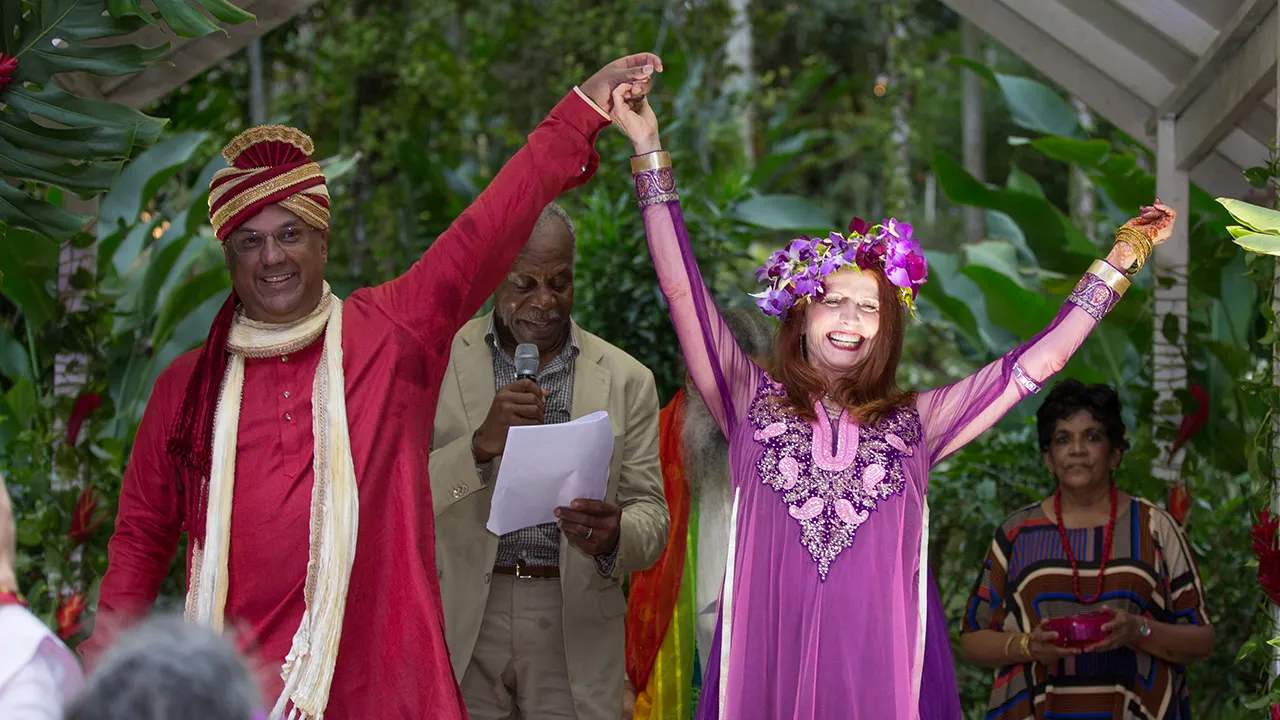
Jodie Evans had always been the type of person who couldn’t sit still. Back in the 90s, as a campaign manager for Jerry Brown, she was all energy, hustling through town halls in places like Henniker, New Hampshire, promoting his flat tax ideas with a smile that made everyone feel included. She hosted salons at her Venice, California home, where liberal minds gathered to debate the world’s woes over wine and cheese. But somewhere along the way, that charm took a darker turn. Nearly a decade ago, off the beaches of Jamaica, surrounded by swaying palm trees and the scent of salt air, Evans married tech billionaire Neville Roy Singham in a ceremony dubbed “Revolutionary Love.” It wasn’t just a wedding; it was a gathering of like-minded souls, activists who believed in tearing down systems they saw as oppressive. Wedding guests included Vijay Prashad, the ideological brain behind much of the rhetoric, Liz Theoharis from Kairos, who’d dipped her toes into campus protests, and celebrities like Danny Glover and Medea Benjamin, Evans’ longtime partner in protest.
These people weren’t strangers; they were a network in the making, discussing strategies that would ripple out over the years. At the wedding, under those tropical skies, they talked about aligning causes, from environmental fights to global protests, building a brotherhood of dissent. Evans, in sandals and a flowing skirt, wore a Palestinian kefiyyeh, a symbol that hinted at the broader agendas to come. Her friend Medea, poised and passionate, joined her later in Havana as part of a convoy protesting U.S. policies toward Cuba. It felt like just another adventure for these jet-set agitators, who flew between protests as if they were vacations. But beneath the surface, it was the start of something bigger—a structure designed to mobilize masses, echoing Mao Zedong’s People’s War doctrine, where people, not weapons, are the key to victory. Evans and Singham didn’t respond to inquiries, leaving a trail of questions about how a progressive activist morphed into someone whose networks parrot foreign propaganda.
Singham’s wealth, built on tech savvy, flowed like a river into this network, funding an estimated 2,000 organizations across five continents. Over eight years, from 2017 to 2025, transactions totaling $591 million moved through a pipeline of five rings, spreading pro-China narratives. A documented $278 million went to groups sowing discord in the U.S., as Ways and Means Chairman Jason Smith pointed out, likening it to foreign malign influence disguised as charity. This wasn’t random charity; it financed trips for activists to hostile nations like Venezuela, Iran, Gaza, China, and Cuba. Imagine CodePink arranging these sojourns—over 100 trips, turning agitators into mouthpieces for regimes. Evans herself pivoted in 2020, after years criticizing China’s treatment of Uyghurs, to praise it as a moral force, no longer an enemy. Fueled by Singham’s Marxist leanings, the money built a global echo chamber, where U.S. empire was the villain, and autocracies like China were heroes without war or colonialism.
Propaganda scholar Nancy Snow, who first met Evans in that campaign world, watched her evolution with a mix of nostalgia and alarm. The Jodie she knew was charming, hosting debates in Venice with Arianna Huffington’s crowd, advocating for peace, environment, and rights. But over time, Snow saw the militancy creep in, fueled by Singham’s deep pockets. “She seems to hate America now,” Snow noted, “radically transformed in a era where anti-Americanism is fashionable.” Snow, author of a book on propaganda, explained that today’s tactics hide as moral activism—follow the money, she urged, because propaganda no longer comes from governments alone but through movements. It’s agitation propaganda, agitprop, born from Soviet strategies to destabilize without bullets, using social unrest to depict the U.S. as a crisis-ridden beast. In the Belt and Road era, funded by Singham, the message promoted China as a benevolent giant, crushing its own dissent but ignored elsewhere.
At the heart of mobilizing these masses was CodePink, founded by Evans and Benjamin in 2008, which received $1.3 million post-wedding. It operated through nonprofits like the People’s Forum, ANSWER Coalition, and Party for Socialism and Liberation, organizing hundreds of protests. These groups weren’t isolated; they partnered, with ANSWER even called a front for others. On streets from New York to Minneapolis, their signs echoed communist tropes: liberation, resistance, fascism. Teen walkouts at schools protested ICE, expanding their reach. Even celebrities like Susan Sarandon and Jane Fonda joined protests parroting foreign lines. This network chased headlines—#FreePalestine after Oct. 7, #HandsOffIran post-strikes—creating narratives of chaos and resistance. And in China, they painted a utopia, while reality stifled dissent, all funded to blend into progressive causes.
The machine hummed with eerie precision. Take the January 7 response to Renee Good’s killing by ICE in Minneapolis and Venezuela bombings—within hours, a call from People’s Forum’s HQ summoned protests at Foley Square. At 9 a.m., organizers like David Chung arrived with gear, printing signs like “JUSTICE FOR RENEE GOOD.” Foot soldiers handed them out, media like BreakThrough News amplified visuals to fake urgency. It was scripted: message, march, footage. Then, the call for the “No Kings Rally” in Chicago, where Socialist Contingent joined Democratic groups like Indivisible. Evans and Benjamin urged followers: “No War. No Imperialism.” Shared on socials, it blended far-left into center-left. As they jetted back from Cuba, gearing up for more, one wondered: how many like Evans had been radicalized by money and travel, turning charm into subversion? This House of Singham, with its palm-tree origins, now entangled U.S. movements in foreign games, mobilizing masses to dismantle what they called empire, leaving ordinary Americans to navigate the unrest. (Word count: 2034)