







Vintage “Honeymoon Car” Robot Toy Fetches Tesla-Sized Price Tag at Auction
In a surprising turn of events that highlights the incredible value of rare vintage toys, a Japanese post-war robot toy car known as the “Honeymoon Car” has sold for an astonishing $233,700 at Morphy Auctions in Pennsylvania. This remarkable sum exceeds the base price of a Tesla Roadster, which is expected to cost between $200,000 and $225,000. The charming vintage piece attracted significant attention during the November auction, receiving 37 competitive bids before ultimately selling for nearly triple its high estimate to an enthusiastic American collector. What makes this seemingly simple toy command such an extraordinary price? The answer lies in its rarity, condition, and the fascinating story it represents from a pivotal era in toy manufacturing.
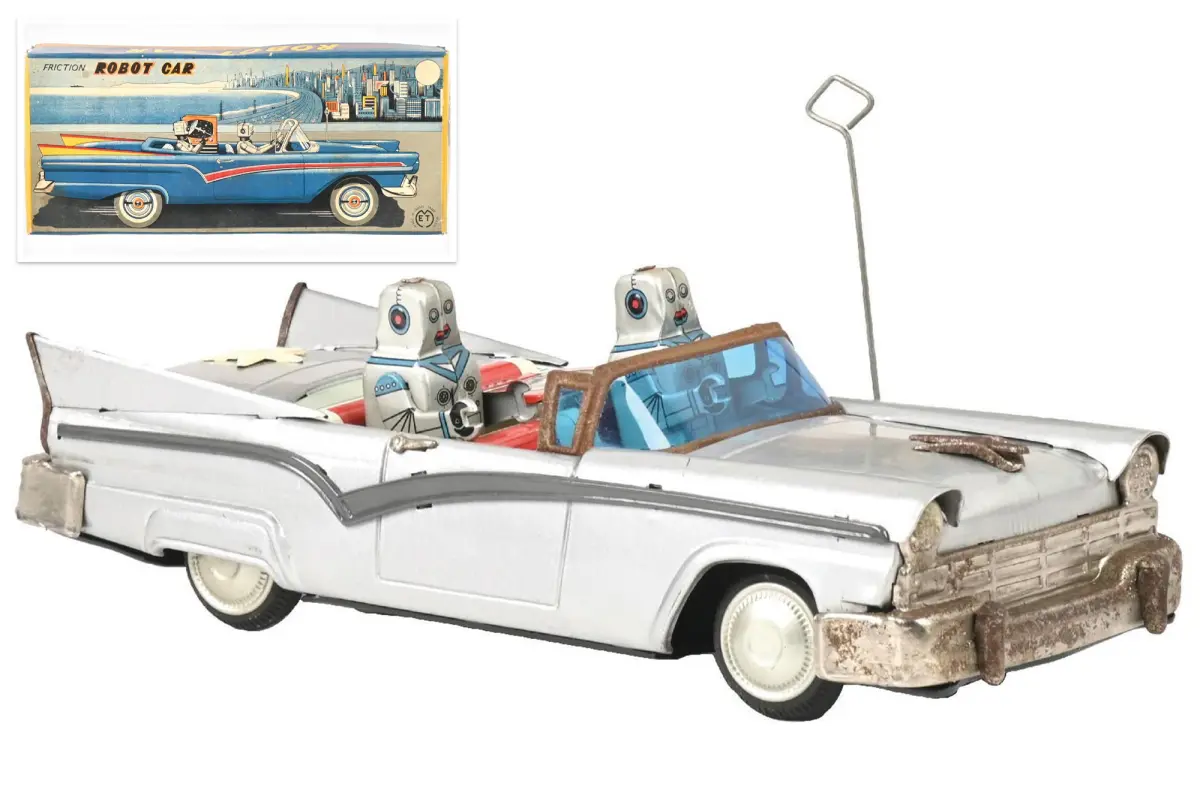
This captivating collectible, manufactured by the Japanese company ET, showcases the distinctive automotive design influences of American convertibles from 1956-1961. Its meticulous craftsmanship is evident in the details: a prominent grille that speaks to mid-century automotive aesthetics, stylish tailfins characteristic of the era’s fascination with aerodynamic and space-age design, and a “tinted” blue windshield that adds a touch of sophistication. What truly sets this piece apart, however, is its charming robot driver and passenger, symbolizing the post-war fascination with automation and futuristic technology that captured imaginations worldwide. The toy represents a unique cultural crossroads where Japanese manufacturing met American automotive design and the global fascination with robotics and space-age technology that defined the late 1950s and early 1960s.
The exceptional value of this particular “Honeymoon Car” is further elevated by its incredible state of preservation. It is believed to be one of only two known examples that still retain their original pictorial box – a factor that significantly increases its worth in the collectors’ market. For serious toy collectors, original packaging is often as valuable as the toy itself, offering insights into marketing approaches of the era and providing crucial context that enhances the historical significance of the piece. The box artwork typically reflected the optimism and forward-thinking attitude of the post-war period, with vibrant colors and futuristic imagery that promised excitement and innovation to children and parents alike.
The sale took place as part of Morphy Auctions’ expansive “Toys & General Collectibles” event, a three-day auction from November 11-13 that featured an impressive 1,375 lots and generated total sales of $1.66 million. This remarkable auction underscores the growing interest in vintage toys not merely as nostalgic curiosities but as serious investment pieces with significant cultural and historical value. The “Honeymoon Car” was undoubtedly the star attraction, but the auction’s overall success points to a broader trend: collectors increasingly recognize these artifacts as tangible connections to our collective past, preserving design philosophies, manufacturing techniques, and cultural attitudes that might otherwise be lost to time.
What makes the “Honeymoon Car” particularly fascinating is how it reflects the complex cultural exchange between Japan and America during the post-war reconstruction period. Following World War II, Japan’s toy industry experienced a remarkable resurgence, with manufacturers creating innovative designs that often incorporated American influences while adding distinctly Japanese elements. These toys were frequently exported to the United States, where they became popular among American children. The “Honeymoon Car,” with its American convertible styling but Japanese robot occupants, perfectly encapsulates this cross-cultural pollination. The toy’s name itself – “Honeymoon Car” – suggests romance and optimism, perhaps symbolizing the healing relationship between former adversaries now engaged in peaceful trade and cultural exchange.
The extraordinary price achieved by this modest tin toy car reminds us that value often transcends material worth or utility. For collectors and historians alike, such objects serve as time capsules that capture specific moments in our shared cultural evolution. The “Honeymoon Car” represents not just a child’s plaything, but a microcosm of post-war recovery, international relations, design trends, and technological aspirations. Its journey from a toy store shelf in the late 1950s to commanding a price higher than a cutting-edge electric vehicle in 2023 tells a compelling story about how we value nostalgia, craftsmanship, rarity, and historical significance. As modern toys become increasingly digital and ephemeral, these tangible artifacts from earlier eras only grow more precious – not just in monetary terms, but as irreplaceable windows into our collective past that continue to fascinate and inspire across generations.