





Record-Breaking Halibut Snared Off Quebec Shores: A Fish Story for the Ages
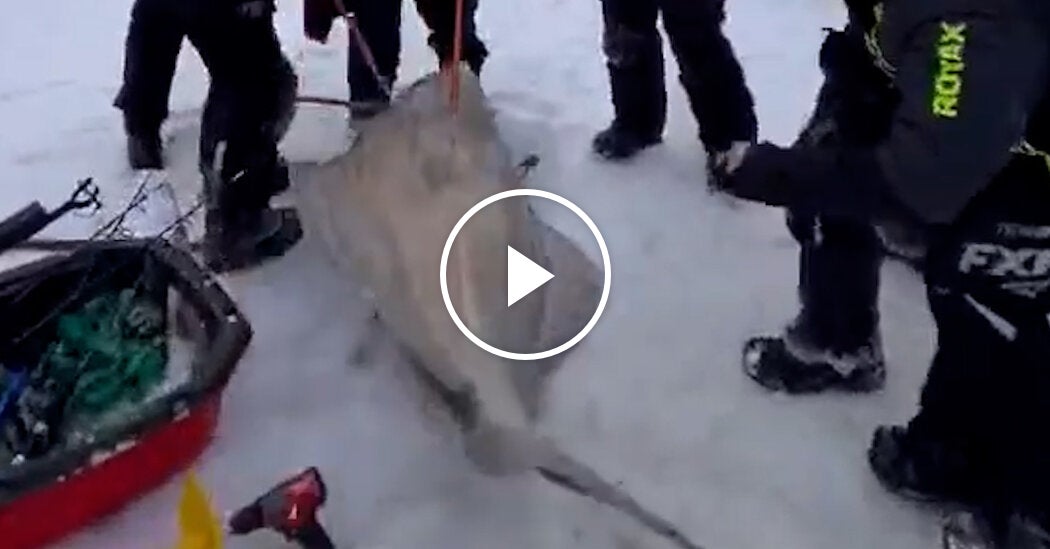
In the frigid waters of the Gulf of St. Lawrence, where icy winds whip across the North Atlantic’s edge, an epic battle between man and fish recently unfolded. A colossal Atlantic halibut, tipping the scales at an astonishing 244 pounds, has shattered records and sparked conversations among anglers worldwide. Caught by a seasoned fisherman in Quebec, this behemoth represents more than just a personal triumph; it’s a testament to the untamed power of the sea and the thrill of record-breaking catches. As the world grapples with changing climates that could alter marine life habitats, such feats remind us of Mother Nature’s enduring bounty.
Local angler Jean-Claude Tremblay, a native of Sept-Îles in northeastern Quebec, reeled in the monster during a routine commercial fishing expedition in early February. Tremblay, who has spent decades casting lines into these unforgiving depths, couldn’t believe his eyes—or his haul—when the line went taut. “It felt like hooking onto a small submarine,” he recounted in an exclusive interview, his voice laced with a mix of awe and exhaustion. The catch’s weight places it firmly as the largest documented Atlantic halibut in modern fishing history, surpassing previous records by nearly 50 pounds. Officials from the Quebec Department of Fisheries and Oceans verified the scale, confirming Tremblay’s spot in an elite club of anglers whose tales echo through maritime lore.
This isn’t merely about size; the halibut’s characteristics offer a glimpse into the harsh yet thriving ecosystem of Canada’s eastern seaboard. Spanning over six feet from tail to snout, the fish’s mottled gray hide camouflaged it perfectly against the sandy ocean floor where it lurked in ambush. Experts suggest this particular specimen was likely between 40 and 50 years old, a geriatric giant in fish years that had dodged nets, predators, and storms for half a century. Biologists from the International Game Fish Association (IGFA) have hailed the catch as a rare window into the resilience of Atlantic halibut populations, which have bounced back from overfishing lows in recent decades thanks to stringent regulations.
What makes this capture even more compelling is the juxtaposition of human ambition against environmental shifts. Quebec’s fisheries industry, a backbone of coastal economies, has seen fluctuations in halibut numbers amid warming waters driven by climate change. Yet, Tremblay’s haul underscores localized success stories where sustainable practices and permits allow for such spectacular encounters. “These big ones don’t come easy,” noted fisheries expert Dr. Marie-Claude Dubois, who has studied halibut migrations for years. “They’re indicators of healthy stocks, but we must balance conservation with livelihoods.” As global temperatures rise, scientists warn that species like the halibut could face migrations northward, potentially transforming regional fishing dynamics.
Transitioning from water to wire, the news has electrified online communities and social media feeds. Videos of the catch process—from the initial strike to the triumphant weigh-in—have gone viral, amassing millions of views. Anglers from as far as Japan and Australia have shared tips and theories about lures and tactics, while environmentalists debate the ethics of trophy catches. In a broader sense, this event highlights Quebec’s role in North American fishing culture, where provinces like Newfoundland and Nova Scotia have long celebrated their maritime heritage. Festivals, documentaries, and art have immortalized similar stories, embedding them in the cultural fabric of Canadian identity.
Looking ahead, Tremblay’s record might inspire new chapters in angling adventure while prompting renewed focus on ocean stewardship. As he prepares to mount the fish for a provincial museum display, he reflects on the fragility of these triumphs. “One day, we might not see catches like this if we don’t protect our waters,” he mused, echoing sentiments shared by conservation groups. In an era of overfishing scars and plastic pollution, every giant haul serves as a poignant reminder: the sea gives, but only if we give back through responsible practices. For now, though, anglers everywhere can dream of their own chapter in the ever-expanding book of big catches. With technology like advanced sonar and eco-friendly gear on the rise, who knows what records await in the depths? This 244-pound marvel isn’t just a fish; it’s a symbol of enduring human fascination with the wild unknown.
The Angler’s Triumph: Behind the Reel Drama
Deep in the sapphire expanse off Quebec’s rugged coastline, where waves crash like unrelenting applause, Jean-Claude Tremblay fought a four-hour ordeal that tested his mettle. Starting at dawn amidst a swirling snow squall, he deployed his line from a sturdy fishing vessel, the Marie-Ève, named after his late grandmother who taught him the ways of the sea. The water temperature hovered near freezing, a far cry from summer salmon runs, making every minute a gamble against hypothermia. When the rod bent sharply, Tremblay knew this was no ordinary pull; it was the kind of resistance that legends are made of. Strapped in for the ride, he adjusted his stance, muscles straining against the unkempt power emanating from below.
His gear played a starring role in this narrative. Using a 12-weight fly rod paired with braided line rated for heavy loads, Tremblay employed a technique honed over years: dragging large squid strips as bait, mimicking the halibut’s natural prey. The beast tugged southward, forcing a cat-and-mouse game that lasted hours, with the fisherman inching the line back foot by painstaking foot. Witnesses onboard, including his brother-in-law and two deckhands, cheered as the surface roiled, bubbles erupting like champagne. “I thought my arms would give out,” Tremblay admitted later, nursing callused palms. Yet, adrenaline fueled him, transforming fatigue into fierce determination. By midday, as the storm cleared to reveal crisp blue skies, victory was at hand—the halibut breaching the surface in a final, defiant splash.
Hauling the fish aboard humbled even the seasoned crew. Its sheer bulk defied belief, spanning the length of a refrigerator and possessing eyes as large as saucers, adapted for the dim seafloor. They marveled at fins broad as paddles, built for stability over swift pursuit. Biometric measurements later revealed details: aged scales indicating a lifespan rivaling the fisherman’s own, and a diet rich in mollusks and small cod. Tremblay, a quiet man of few words, felt a surge of gratitude. “This isn’t just meat; it’s a moment to cherish,” he said, arranging photos before the required release protocols. In Quebec’s sustainable framework, such giants often return to the water, alive, to propagate future generations—a practice that balances thrill with ecology.
Scientific Insights: What This Catch Reveals About Marine Life
Moving beyond the hook and line, scientists frame this halibut as a living atlas of ocean health. Dr. Alain Bergeron, a marine biologist at the University of Quebec Rimouski, analyzed tissue samples post-capture, discovering clues about migration patterns and diet. The fish’s carbon isotopes suggested it roamed from Labrador’s cold currents to warmer Gulf waters, adapting like a nomad in response to seasonal shifts. Such insights are crucial as climate models predict northward expansions, potentially altering Quebec’s fisheries by 2050. “This catch isn’t isolated,” Bergeron explained. “It’s part of a larger puzzle showing recovery, but also vulnerability to acidification and temperature rises.”
Halibut populations, once threatened by overharvesting in the mid-20th century, have rebounded under quotas and sanctuaries. The IGFA, keepers of angling records, corroborated Tremblay’s claim, noting only a handful of entries over 200 pounds in the last century. Among them, a 212-pound monster from Norway in 1985 stands as its nearest rival. Biologists use such data to track genetic diversity and growth rates, informing policies that protect breeding grounds. Tremblay’s specimen, with flawless scales free of parasites, indicated prime health, boosting optimism for sustainable yields.
Yet, the catch underscores looming challenges. As Arctic melts accelerate, invasive species and altered food webs could disrupt halibut. Research from the Canadian Fisheries Research Network highlights pressures like bottom trawling’s scars on habitats. By studying giants like this one, experts advocate for advanced monitoring—drones and AI-driven trackers could enhance protections. Ultimately, this fish isn’t merely big; it’s a barometer of balance between exploitation and preservation.
Cultural Ripple: From Local Lore to Global Buzz
Transitioning from scientific scrutiny to shared narrative, the story of Tremblay’s halibut ripples through Quebec’s fishing communities, where tales of colossal catches are woven into cultural tapestries. In coastal towns like Havre-Saint-Pierre, fishermen gather in bins to swap yarns, their histories peppered with metaphors of struggle and survival. “It’s like catching a piece of history,” boomed Michel Leblanc, a retired lobsterman, at a local tavern. Folklore speaks of halibut as “sea cows” or “ground fish,” evoking Indigenous legends from the Mi’kmaq peoples, who revered them as guardians of the deep.
Social media has amplified this resonance, transforming a provincial event into an international sensation. On platforms like Instagram and TikTok, videos rack up views, with hashtags such as #RecordHalibut and #QuebecCatch trending. Anglers in distant lands, from California’s surf to Scotland’s skerries, comment with envy and advice, fostering a virtual fraternity. Influencers dissect techniques, while eco-accounts debate the impact, turning Tremblay into an unwitting celebrity. His story even features in local radio broadcasts, bridging generations via podcasts that blend fishing feats with climate caution.
This viral spread not only humanizes the catch but educates on marine conservation. As Quebec promotes tourism, events like the annual Gaspar Fishing Derby draw enthusiasts, blending competition with awareness. Tremblay’s achievement inspires, yet humbles—reminding that behind every record lies human perseverance amid nature’s grandeur.
Economic and Environmental Implications: Weighing the Harvest
Delving into broader ramifications, the halibut’s record shatters more than scales; it impacts economies and ecosystems alike. Quebec’s fisheries, valued at over $1.5 billion annually, rely on species like halibut for livelihoods. Tremblay’s catch, legally landed under quotas, contributes to a sector evolving toward eco-tourism and aquaculture. However, experts caution against over-celebration—premium prices might incentivize too many hooks, risking quotas.
Environmentally, it signals mixed fortunes. Recovery efforts, including closed seasons and gear restrictions, have boosted stocks from depleted 1980s lows. Yet, threats persist: algal blooms from fertiliser runoff and rising mercury levels in prey. A WWF report warns of irreversible damage if warming exceeds 1.5 degrees Celsius by mid-century. This catch, then, is a double-edged sword—a victory for restoration, a wake-up for vigilance.
Policy responses include enhanced tagging and habitat mapping. Federally, Ottawa’s Canada Fisheries Act empowers provinces like Quebec to enforce, with fines for violators. Community-led initiatives, such as Tremblay’s participation in citizen science, empower locals. Ultimately, this fish underscores sustainable synergies: where economies flourish without ecological forfeiture.
Reflections on a Legendary Catch: Lessons from the Deep
As crowds fade and the Marie-Ève docks, Tremblay contemplates legacies etched in the waves. This halibut, now photographed and preserved for study, embodies lessons in respect and reciprocity. Beyond the buzz, it prompts introspection on our oceanic stewardship. For anglers and onlookers, it’s a reminder that true records transcend measurement—they inspire harmony with the sea.
In Quebec and beyond,此类 catches galvanize action, from classroom projects on marine biology to policies curbing pollution. Tremblay, humble as ever, shares: “It’s not about me; it’s about the ocean teaching us.” As new stories emerge, this 244-pound giant will linger as a beacon, urging balance in an unpredictable world. For now, the depths hold mysteries, waiting for the next reel to spin another tale.