





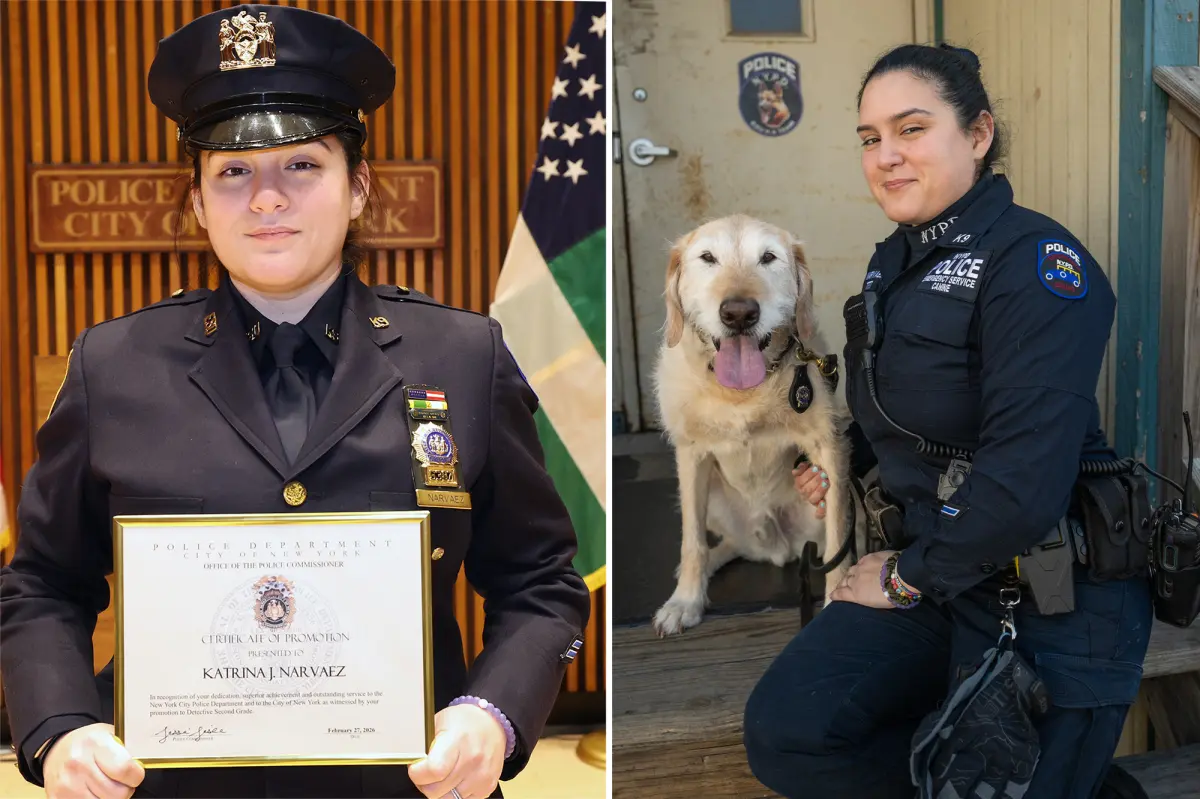
Katrina J. Narvaez stood there in the grand auditorium of One Police Plaza, her heart swelling with a blend of pride and sorrow as Commissioner Jessica Tisch pinned the detective second-grade badge onto her uniform. At just 9 years old, Katrina had lost her father, Lt. Frederico Narvaez, in a tragic shooting while he responded to a domestic incident in Flatbush on October 18, 1996. For nearly three decades, that loss had shaped her, like a quiet storm brewing inside, pushing her toward a path she never fully imagined. She named her K9 partner after her dad—Freddy—and now, at 38, Katrina felt his presence in every wag of the dog’s tail and every alert bark. “My dad would be proud,” she told The Post afterward, her voice steady but laced with emotion. Being promoted alongside ten others in New York’s Finest wasn’t just a career milestone; it was a full-circle moment, honoring the man who had instilled in her the values of protection and service. As a married woman expecting her first child, Katrina couldn’t help but wonder what kind of legacy she was building for her own family. The ceremony was more than brass and badges; it was a tapestry of memories, woven from grief into gratitude, reminding her that sorrow could bloom into strength when rooted in love. In that room, surrounded by colleagues who understood the weight of the badge, Katrina felt seen—not just as a detective, but as the daughter of a fallen hero whose spirit lived on through her unwavering dedication.
Growing up in the shadow of her father’s death, Katrina had always felt a void, but it was the NYPD family who filled it, transforming her understanding of what it meant to be a police officer. Before his passing, she hadn’t really known the depth of the job—cops were just her dad’s world, distant and serious. But after the shooting, the brotherhood and sisterhood of blue enveloped her, sharing stories that painted her father as a man of integrity, someone who thrived not just on the adrenaline of the job but on the genuine care for his fellow officers and the community. Lt. Narvaez had been proud of his role, taking care of others in ways that went beyond the uniform, and those tales ignited something in young Katrina. She listened intently to their reminiscences, about how he’d rush into danger not for glory, but to ensure families like hers stayed safe. It was these connections that forged her resolve. No longer was policing abstract; it was about nurturing neighborhoods, helping people in crisis, and being there when the world felt chaotic. Katrina emerged from those interactions with a burning desire to join the ranks, to honor his memory by embodying the same compassion he showed. This wasn’t just about becoming a cop—it was about becoming part of a lineage of guardians, where every call echoed with the echoes of his sacrifices. In her mind, walking in his footsteps wasn’t a burden but a blessing, a way to keep his light alive in a city that never stopped needing heroes.
Her journey into the NYPD began in earnest in January 2013, when Katrina entered the police academy, her body buzzing with a mix of excitement and nerves as she pushed through rigorous training. The academy wasn’t forgiving—long hours of physical drills, legal lectures, and scenarios that tested her resolve under pressure. Yet, amidst the sweat and exhaustion, she found camaraderie in her classmates, many of whom shared stories of personal motivations, making her feel less alone. Graduating and joining Brooklyn’s 70th Precinct as a patrol officer was surreal; the streets of Brooklyn were alive and unpredictable, from bustling markets to quiet residential corners. As a rookie, she patrolled with wide eyes, learning the rhythms of the neighborhood, intervening in minor disputes, and occasionally facing the heart-pounding intensity of real calls. It was eye-opening, showing her the humanity behind the headlines—people struggling with addiction, domestic woes, or simply needing a listening ear. Later, she transitioned to the domestic violence unit, a assignment that hit close to home given her father’s fate. Handling those cases wasn’t just procedural; it was deeply emotional, as she comforted victims and faced abusers, channeling her inner strength to protect the vulnerable. Through it all, Katrina grew, her compassion deepening, mirroring her dad’s legacy. She realized policing was about empathy as much as enforcement, turning every shift into a chance to make a difference. This phase of her career laid the groundwork, proving to her that she belonged, that the badge fit not just on her shoulder but in her soul.
What truly transformed Katrina’s world, though, was her unexpected path to the K9 unit, fueled by a lifelong love for animals that she had cherished since childhood. Before joining the NYPD, she’d dreamed of working with pets—volunteering at shelters, caring for strays, and feeling an innate connection to creatures that saw beyond words. Her passion didn’t go unnoticed, and the opportunity to join the elite Emergency Service Unit as a handler for a Vapor Wake K9, trained to sniff out guns and explosives, felt like destiny calling. In February 2019, she embarked on a two-month training stint in Alabama, away from the familiar buzz of New York, where she bonded with her new partner, a sleek wire-haired pointer/Labrador mix. Those weeks were grueling yet exhilarating—early mornings in the dew-soaked fields, practicing commands, teaching the dog to obey amidst distractions like sudden noises or crowds. Katrina threw herself into it, her heart syncing with the animal’s instincts. The training wasn’t just about discipline; it was about trust, learning each other’s cues, and confronting fears together. Nights in her temporary quarters, she’d reflect on how this role amplified her sense of purpose, merging her human calling with something feral and pure. Returning to the city, partnered with her K9, she faced high-stakes situations—sweeping for threats in subways or crowds, where a single well-trained nose could prevent catastrophe. It was amazing, changing her life in ways she hadn’t foreseen, turning every deployment into an adrenaline-fueled dance of protection.
The pinnacle of that transformation came when she named her K9 after her father, enshrining his memory in her working life. Freddy, as she called him, became more than a partner; he was her confidant, her best friend in a job that demanded isolation. At 9 years old—the age of retirement for NYPD K9s—Freddy had served loyally, detecting hazards with uncanny precision, his keen sense of smell a extension of Katrina’s vigilance. Naming him after Lt. Frederico Narvaez was a heartfelt tribute, a way to carry her dad’s essence into daily patrols. “I’m with him more than anyone,” she often mused, whether during late-night stakeouts or quiet drives back to the precinct. Freddy’s boundless energy, playful antics, and unwavering loyalty mirrored the traits she’d heard about her father—dependable, spirited, and deeply caring. Yet, as retirement loomed, a bittersweet shadow crept in. Soon, she’d pair with a new dog, carrying Freddy’s lessons forward while bidding farewell to this chapter. For now, though, their bond was ironclad, a living library of memories from backyard play sessions to high-intensity missions. In Freddy, Katrina found solace, a furry reminder that heroism came in all forms, bridging her past losses with present triumphs. This partnership humanized her work, turning professional duties into personal stories of perseverance and love.
Celebrating her promotion now feels like a harmonious crescendo to a life symphony defined by resilience and community support. Katrina, with her growing belly and dreams of motherhood, reflects on how far she’s come—from a grieving child to a decorated detective. The ceremony at One Police Plaza wasn’t just applause; it was a collective cheer from a network that had sustained her. Her husband, a steadfast partner through late shifts and emotional nights, celebrated privately, while her mom, who had raised her post-loss, beamed with pride. Friends in and out of the force offered hugs, reminding her that success wasn’t solo. “I couldn’t do this without them,” Katrina expressed, her gratitude overflowing. As Freddy nears retirement, she contemplates the future—parenting a child in the shadow of two generations of service, perhaps inspiring the next cop or caregiver. Yet, in this moment, it’s about savoring the joy, the hard-earned badge, and the legacy unfolding. Her dad’s spirit, once a distant echo, now fuels her own story, proving that from tragedy can emerge champions who protect and serve with unyielding heart. As she looks ahead, Katrina knows the city will always need heroes like Freddy—and like her.