




New York vs. Florida: The Battle for America’s Historic Ocean Liner
In a high-stakes maritime tug-of-war, New York City officials are making a passionate last-ditch effort to save the SS United States—a legendary 1950s ocean liner—from being deliberately sunk off Florida’s coast. This clash represents more than just a dispute over an old ship; it’s a battle between preserving American maritime heritage and creating a new underwater tourist attraction.
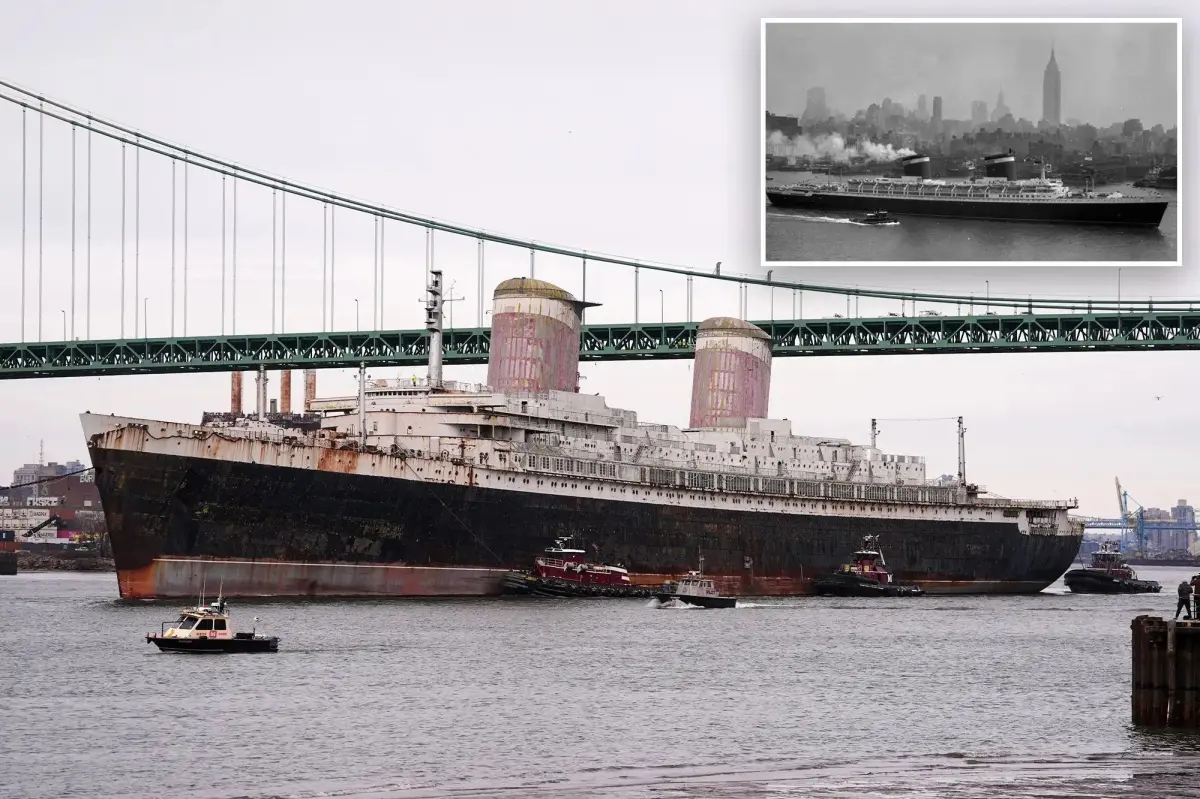
The SS United States isn’t just any vessel—it’s a symbol of American engineering prowess and mid-century elegance. Built in the 1950s and retired in 1969, this ocean liner still holds the transatlantic speed record of 44 mph. During its heyday, it ferried passengers between New York and Europe with unmatched speed and luxury. The ship’s profile is striking—described by admirers as “sleek, iconic and nearly as long as the Chrysler Building is tall.” Now docked in Mobile, Alabama, workers are stripping the once-magnificent vessel in preparation for what Florida officials describe as its transformation into “the World’s Largest Artificial Reef.” The ship found itself in this predicament following a dispute between its longtime owner, the SS United States Conservancy, and the company that owns the Philadelphia dock where it had been moored since the 1990s. Last year, Florida’s Okaloosa County purchased the nationally landmarked vessel for $1 million, with clear intentions for its future beneath the waves.
New York City Councilwoman Gale Brewer is leading the effort to bring the ship to the Big Apple, having proposed a resolution urging Congress and the President to declare the liner a historic location, reclaim it from Florida, and fund its restoration in New York. “I’m not going to sugar-coat anything, but I’d love to see that ship not become a coral reef,” Brewer told The Post, emphasizing that using the vessel as a diving attraction doesn’t honor its “complete stature.” Her vision includes transforming the ship into a waterfront museum and possibly a restaurant—a living monument rather than an underwater wreck. The New York Coalition to Save the SS United States has gathered more than 15,000 signatures for their petition, and has even identified a potential berth at the Gowanus GBX terminal through a board member who owns the property. However, time is running out, with the final chance for a City Council vote on the resolution coming on December 18.
Florida officials, meanwhile, remain firmly committed to their plans. Okaloosa County representatives have stated bluntly: “We fully intend to deploy the SS United States as the World’s Largest Artificial Reef.” Their vision would see the historic liner sink approximately 180 feet underwater to join roughly a dozen other shipwrecks that serve as diving attractions in the Gulf of Mexico. Tourism leaders in the region see tremendous potential in the project, with Darien Schaefer, president and CEO of Visit Pensacola, calling it “a rare opportunity to elevate our entire region on the global stage.” From Florida’s perspective, the ship will find new purpose as an underwater attraction, boosting local tourism while creating a new marine habitat—a pragmatic approach to a vessel that has languished at dockside for decades.
The battle has ignited passion among maritime history enthusiasts across America and beyond. At a November 20 New York City Council hearing, supporters from as far away as Arizona and England submitted testimony in favor of saving the ship. Retired education administrator David Di Gregorio spoke of “an extraordinary opportunity to transform this national treasure into a stationary, dynamic cultural and economic asset.” The emotional connection to the vessel runs deep for many, including Gilma Fields of the SS United States Ocean Liner Preservation Foundation, whose father worked on building the ship as a new immigrant. “It grieves me to think that our beloved country, that normally treasures our maritime history of excellence and exceptionalism, could stand by and watch the purposeful destruction of our historic ship,” Fields testified, calling the potential sinking “an unthinkable catastrophe.”
Even as New York officials fight for the vessel’s preservation, they acknowledge the uphill battle they face. Councilwoman Brewer has been forthright about the symbolic nature of her proposed resolution and the difficulty of convincing Florida’s ownership to change course. The resolution, if passed, would represent New York’s official position but would lack enforcement power. Still, advocates hope that public pressure, combined with appeals to national heritage, might sway decision-makers. For those who see the SS United States as more than metal and machinery—as a floating piece of American history—the thought of the vessel disappearing beneath the waves represents not just the loss of a ship but the erasure of a tangible connection to America’s maritime golden age. As the clock ticks toward Florida’s planned 2025 sinking, the ship’s supporters continue their campaign to ensure this icon remains above water for future generations to appreciate.