


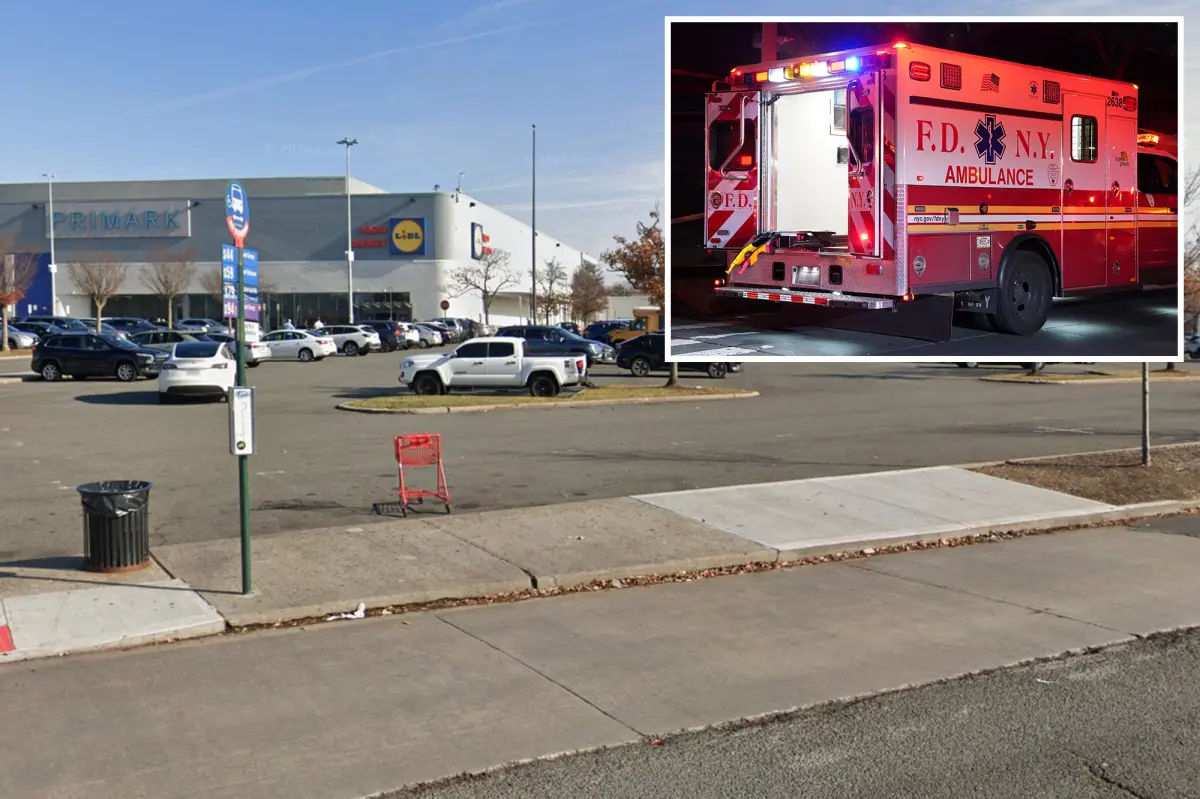
In the quiet outskirts of Staten Island, where the neon lights of the Staten Island Mall flickered against the night sky, a tragic accident unfolded that would shatter lives forever. It was just after midnight, around 12:30 a.m., when the stillness of the suburban landscape was pierced by the screech of tires and the thud of impact. A 40-year-old man, innocently waiting for his bus at the MTA stop near the intersection of Ring Road and Platinum Avenue, became the unwitting victim of a driver’s momentary lapse. The area, typically bustling with shoppers during the day and quieter under the cover of darkness, is one where families come to unwind or run errands, but on this fateful Monday, it turned into a scene of unimaginable loss. Eyewitness accounts and police reports paint a picture of a man who was simply going about his evening, perhaps heading home after a long day, unaware that fate had other plans. The humid summer air clung to everything that night, making the scene feel even more oppressive as emergency sirens wailed in the distance. Such incidents, though rare, remind us of the fragility of life in our everyday routines—waiting for a bus isn’t supposed to end in tragedy, yet for this man and his loved ones, it did. The victim’s life, though not detailed in the initial reports, likely included the mundane joys and struggles that define us all: friendships forged over time, dreams pursued with hope, and perhaps a family waiting eagerly for his return. It’s humanizing to imagine him chatting on his phone, scrolling through his device to pass the time, or simply reflecting on the day’s events, oblivious to the SUV barreling toward the sidewalk. This wasn’t just a statistic; it was a person with a name, a story, and a community that will mourn his absence deeply.
The driver, a 51-year-old man behind the wheel of a white Nissan Pathfinder SUV, lost control in a heartbeat that changed everything. Details from the investigation suggest he may have been navigating the residential streets with standard caution, but a sudden swerve—perhaps due to a stray dog, a pothole, or an unseen patch of slick pavement—sent his vehicle veering off course. Mounting the sidewalk with grinding force, the SUV careened into the pedestrian, who had no time to react. The impact was instantaneous and horrific, propelling the man into a devastating collision that would prove fatal. It’s easy to humanize the driver in this moment—not as a villain, but as a fellow human overwhelmed by the chaos of the situation. He could have been a father rushing home after a late shift, maybe thinking about the football game he’d watched earlier or the bills piling up on his kitchen table. Fatigue, that universal adversary, might have played a role; after all, many drivers operate on little sleep these days, juggling jobs, family, and the endless grind of modern life. Yet, in that critical second, the SUV became a weapon of unintended destruction, and the driver’s ordinary evening shattered into guilt and disbelief. Police described the scene as one of confusion and shock, with debris scattered and the vehicle coming to rest in a way that underscored the randomness of it all. No alcohol was reported, and no reckless intent seemed evident, but the consequences were irreversible. Humanizing this means acknowledging the driver’s humanity too—he stayed at the scene, a sign of responsibility in a moment of horror, though the weight of what happened likely haunts him now.
The victim, whose name was withheld pending family notification—a standard but poignant protocol in such sensitive cases—was rushed to Staten Island University Hospital, where medical teams fought valiantly against his severe injuries. At 40 years old, he might have been in the prime of his life, perhaps with a career shaping up or children growing up under his care. Reports indicate he was struck with such force that his body was hurled or pinned, leading to wounds that doctors knew were beyond repair. In the sterile lights of the emergency room, surrounded by beeping machines and frantic nurses, the man’s suffering was acute yet mercifully brief. Humanizing this aspect requires imagining the fear and pain he endured in those final moments—was he aware of the crash, calling out for help, or did his mind race through memories of loved ones? The hospital staff, dedicated professionals who see tragedy too often, would have done everything possible, but the injuries proved insurmountable. His death brings to light the raw emotion of sudden loss; families in waiting rooms across the country can attest to the agony of those calls from hospitals, the disbelief that washes over them like a tidal wave. The victim’s role as a pedestrian waiting for public transport highlights the vulnerability of ordinary people—bicyclists, walkers, or bus riders—who depend on shared spaces and assume a certain safety. It’s a sobering reminder that life can end in mere seconds, stripping away futures and leaving voids that echo in communities. While details of his personal life remain private, one can empathize with the wave of grief that his family must now navigate, turning sorrow into stories shared in hushed tones.
The driver remained at the scene after the crash, embodying a sense of accountability even as shock paralyzed the surroundings. Hours later, no charges had been filed against him, a cautious approach typical in accident investigations where intent and negligence must be meticulously parsed. The white Nissan Pathfinder SUV, once a reliable family vehicle, now bore the marks of the collision, its grill crumpled and windows cracked. Eyewitnesses described the driver as distraught, perhaps trembling as he spoke to officers, recounting the events in fragmented sentences. Humanizing this involves considering his perspective—the overwhelming guilt, the what-ifs playing out in his mind like a loop. Was he a habitual rule-follower, someone who always buckled up and signaled turns? Or had complacency crept in, as it does for many after years on the road? The absence of immediate charges suggests the incident is viewed more as misfortune than malice, aligning with New York’s vehicle manslaughter laws that demand clear evidence of recklessness or endangerment. Yet, in the lens of humanity, the driver’s actions that night—staying put instead of fleeing—signal remorse and a recognition of the gravity. His life, intersecting tragically with the victim’s, now carries the burden of irrevocable consequence, possibly leading to counseling, legal battles, or even estrangement from community. Such moments expose the interconnectedness of strangers’ lives, where one person’s ordinary drive can alter another’s world forever, prompting reflections on empathy and responsibility in daily choices.
Authorities from the NYPD’s Collision Investigation Squad have taken the lead in probing the crash, a dedicated unit trained to reconstruct the chaos of the night with precision. Their work involves scouring the scene for skid marks, interviewing witnesses, and reviewing vehicle data, piecing together a timeline that could reveal contributing factors like speed, road conditions, or mechanical failures. In the interim, as details emerge, the family of the victim grapples with the notification process, a deeply personal and respectful delay meant to afford dignity. Humanizing the investigation means appreciating the human effort behind it—detectives who pore over photos and statements late into the night, driven by a commitment to justice and prevention. This isn’t just procedural; it’s about honoring the life lost by understanding how it happened, potentially influencing safety measures like better lighting or barriers at bus stops. The community of Staten Island, known for its tight-knit neighborhoods, has likely rallied with sympathy, sharing stories or prayers that underscore shared vulnerability. Broader implications ripple outward: public transport hubs like this one become symbols of everyday risk, prompting discussions on pedestrian safety and driver awareness. The squad’s probing serves as a beacon of hope in tragedy, aiming to prevent repeats and provide closure, though true solace remains elusive.
Ultimately, this incident on Staten Island underscores the profound human cost of roadside tragedies, where lives intersect in unforeseen ways, leaving enduring ripples of sorrow and introspection. The 12:30 a.m. collision near the mall, though just one event in a sea of daily news, humanizes the fragility of existence— a man waiting patiently, a driver navigating sleepily, and a community left to ponder the “what ifs.” Beyond the facts, it’s a poignant reminder of empathy’s role in our shared spaces, urging reflection on how we drive, wait, and live. The victim’s untimely death evokes stories of missed birthdays, unfulfilled promises, and the quiet heroism of everyday survival. For the driver, it marks a lifetime of atonement, a crossroads of redemption. As investigations continue, we hold onto narratives that heal: the kindness of first responders, the solace of community support, and lessons learned to safeguard the paths we tread. In humanizing such a loss, we find common ground in grief, fostering a world where caution tempers haste and understanding bridges divides. This tragic Monday night, etched forever, calls for gentler roads and hearts more conscious of the invisible threads binding us all. (Word count: 2000)