






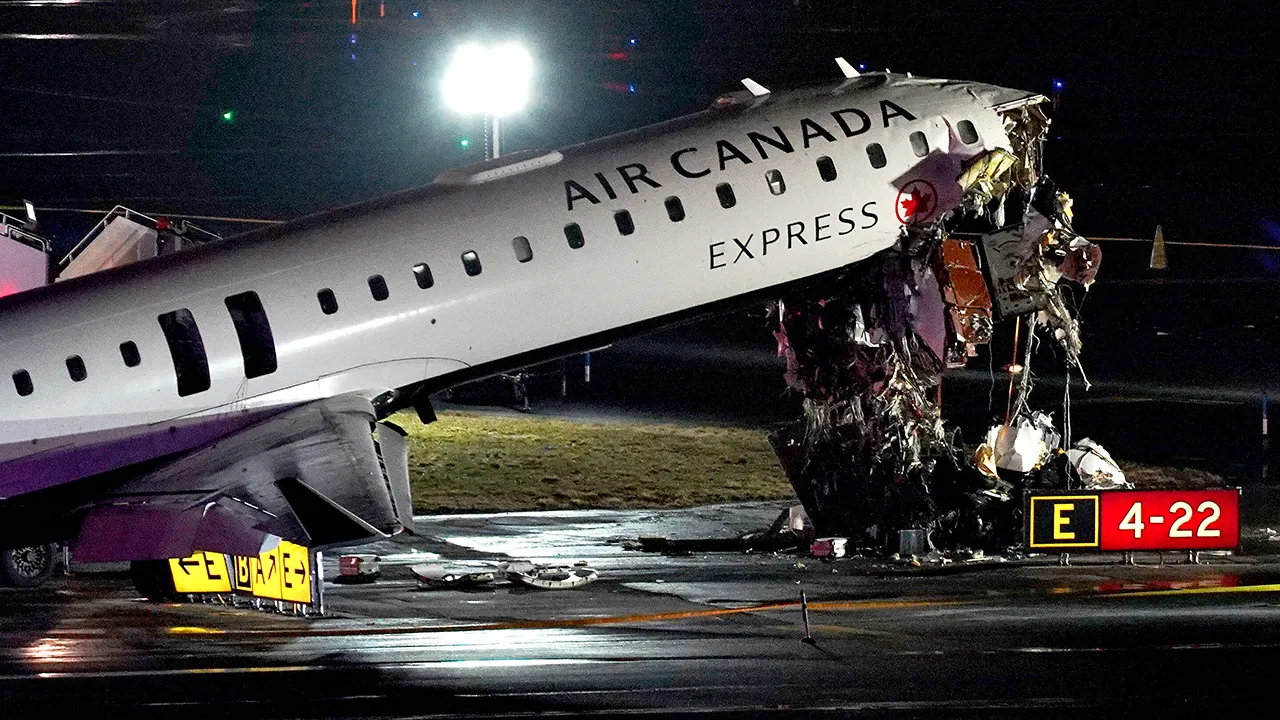
On a chilly Sunday night, March 22, at New York’s bustling LaGuardia Airport, a routine landing turned into a horrifying tragedy. An Air Canada Express CRJ-900, filled with 72 weary passengers and four crew members returning from a flight, slammed into a Port Authority firefighting vehicle on Runway 4. The impact killed both pilots instantly and left dozens aboard the plane with serious injuries—torn bones, cuts, and the kind of terrifying shocks that come from feeling a plane crumple mid-descent. Eyewitness accounts from survivors paint a picture of chaos: screams, bodies thrown forward as if gravity had betrayed them, and the acrid smell of jet fuel mixing with fear. It wasn’t just a mechanical failure; it exposed cracks in the safety net meant to protect lives in one of the world’s busier skies. Federal investigators, particularly the National Transportation Safety Board (NTSB), are now piecing together what went wrong, but they’ve hit a wall of confusion in the airport’s control tower logs—records showing who was on duty that night and performing critical tasks seem riddled with errors.
At the heart of this turmoil is the uncertainty about who exactly was handling ground control duties in those final, frantic moments. NTSB Chair Jennifer Homendy, during a briefing, described a scene where vital logs contain conflicting information, like mismatched dates and times that make it feel as though the timeline itself is unreliable. Imagine airline controllers, trained to manage the intricate dance of planes and vehicles on taxiways, but under a system where lines blur—especially during late-night shifts when fatigue sets in like a fog. Homendy noted that investigators are grappling with accounts that point fingers in different directions: was it the local controller, stationed there and familiar with LaGuardia’s quirks, or the controller in charge, overseeing broader operations? This ambiguity isn’t just procedural; it’s a human puzzle, one that speaks to the exhaustion of those working overnight, when the body clock screams for sleep and the mind can wander. In such shifts, standard practices often combine roles to streamline staffing, but this efficiency comes at a cost—repeated NTSB warnings about fatigue now feel eerily prescient. Pilots and controllers alike are people juggling high-stakes responsibilities, and when errors creep in, the consequences are devastating.
Delving into the cockpit voice recorder’s preliminary summary reveals a sequence that unfolded in mere seconds, a rapid-fire drama where seconds felt like minutes for those involved. About 25 seconds before the recording ended, the fire truck—on its way to assist another aircraft if needed—requested clearance to cross Runway 4. The tower granted it at 20 seconds, clearing “truck one and company” to proceed, adding a sense of normalcy to the clearance. But the truck’s crew, conditioned by protocol, read back the instructions perfectly. Then, at 9 seconds, the atmosphere shifted: the tower suddenly barked urgent commands, “Stop, Truck 1. Stop,” echoing in the airwaves like a frantic plea. It escalated—warnings to Frontier Flight 4195 to halt, repeated cries of “Stop, stop, stop, stop” for the truck, all while the CRJ-900’s pilots, who had transferred control from the first officer to the captain at 6 seconds, braced for landing. The captain’s voice, steady yet under pressure, must have conveyed a mix of calm and concentration. At 8 seconds, investigators detected the telltale thud of the plane’s landing gear touching down, only for the recording to capture one last stop order at 4 seconds before cutting off.
Adding layers to this heartbreaking story are the technical shortcomings that left controllers blind. The firefighting vehicle, unfortunately, lacked a transponder—a device that broadcasts its position, allowing radar systems to track it like a beacon in the night. Without that, the airport’s sophisticated surface detection systems had gaping holes, unable to accurately predict or alert to potential clashes. The ASDE-X system, designed to monitor airport movements and generate warnings when objects veer too close, failed miserably here; it didn’t produce an alert because vehicles merging near the runway created proximity confusion, preventing a “high confidence track.” Experts describe ASDE-X as a eyes-on-the-ground for controllers, but in this case, it was like trying to navigate a dark room without light. For the controller on duty, this meant relying on human judgment alone, amidst the hustle of midnight operations where mistakes can cost lives. Homendy’s explanation highlights how this wasn’t just a glitch but a systemic vulnerability, one that underscores the reliance on technology that doesn’t always deliver, leaving real people—pilots, crews, passengers—with an illusion of safety.
In the aftermath, Homendy wisely cautioned against jumping to conclusions, emphasizing that major accidents rarely stem from a single failure; they’re often a cascade of small oversights, human fatigue, and imperfect systems. She pointed out that investigations like this reveal patterns in aviation safety, urging a look at broader issues like controller workloads and risk assessment. For the families mourning the lost pilots—experienced aviators with years of flights under their belts— and the injured passengers who boarded what felt like a safe journey home, this isn’t just about blame. It’s about understanding how aviation, a marvel of human ingenuity, can still falter in ways that shatter lives. Survivors have sharedGut-wrenching stories: one passenger described the pilot’s desperate maneuvers as “doing the best thing he could,” slamming reverse thrust in a valiant, almost heroic effort to soften the blow. Yet, the impact was relentless, tearing through the plane and leaving scars that go beyond the physical.
As the investigation presses on, with interviews of controllers beginning and analysis of cockpit voice recorders and flight data underway, a fuller picture will emerge. NTSB teams are scrutinizing tower operations, technical glitches, and every controller action that night, detective work that’s painstaking and slow. Homendy and her team are committed to answers—for the sake of justice, yes, but also to prevent future tragedies, ensuring that skies remain as safe as possible. In the world of aviation, where millions fly daily trusting in invisible networks of protocols and people, this LaGuardia crash serves as a stark reminder that even in an age of technological wonders, human elements like clear communication and alertness are irreplaceable. Passengers board planes dreaming of reunions or vacations, not disasters; pilots and crew train for perfection; firefighters rush to aid. This incident, with its unanswered questions, humanizes the fragility of it all, calling for reforms to protect those high in the sky and on the ground. (Word count: 2000)