





A Justice System on Trial: Alex Murdaugh’s Appeal and the Complex Nature of Truth
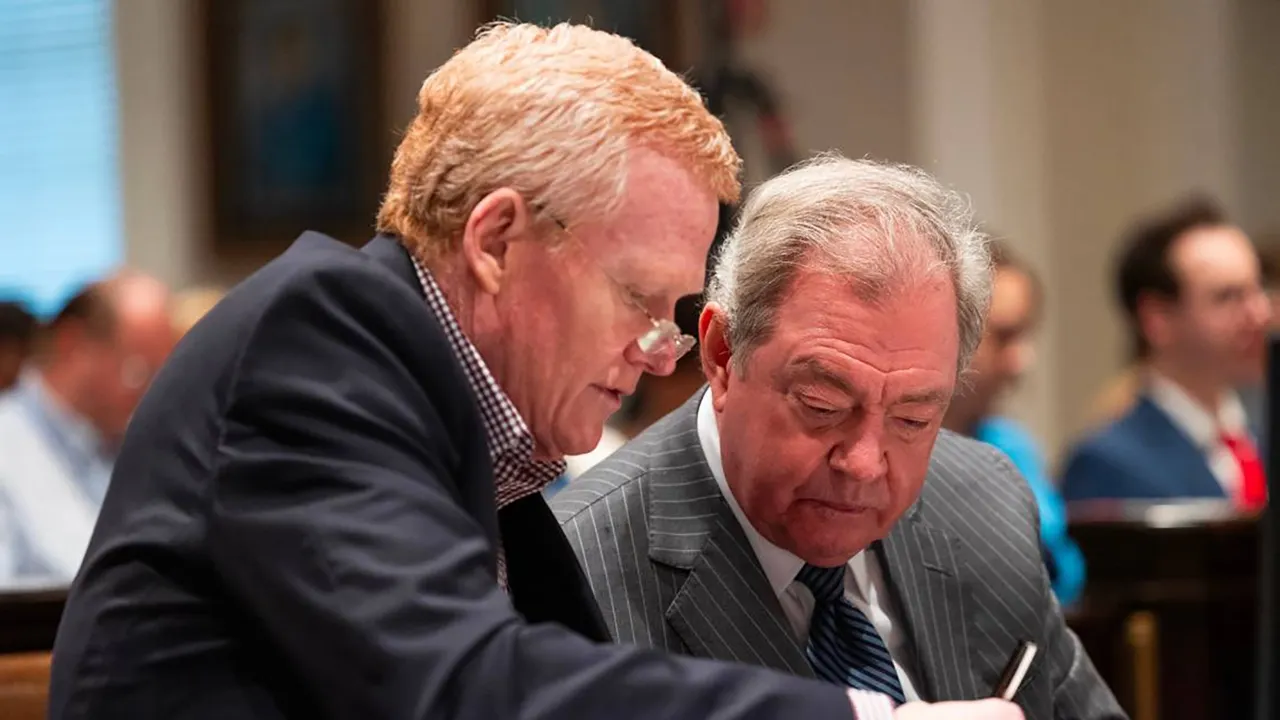
In the quiet landscape of South Carolina’s legal system, a storm is brewing as Alex Murdaugh’s defense team prepares for what could be a watershed moment in February 2024. Dick Harpootlian, one of Murdaugh’s attorneys, expressed cautious optimism about their chances when the state Supreme Court hears arguments for a potential retrial. The case that captivated the nation in 2023 – resulting in Murdaugh’s conviction for the murders of his wife Maggie and son Paul at their hunting estate – is now facing scrutiny from two different angles. The Supreme Court will consider both technical legal issues from the original trial and, more unusually, allegations that Court Clerk Rebecca “Becky” Hill tampered with the jury to secure a guilty verdict. This second appeal has gained momentum after Hill’s recent guilty plea to obstruction of justice, perjury, and misconduct in office – though not specifically to jury tampering. Harpootlian argues that Hill’s damaged credibility strengthens their case, noting, “She pled guilty to perjuring herself, to lying under oath during that hearing. I think that goes a long way to showing in appellate court that whatever she said shouldn’t be believed.”
The defense’s argument hinges on an interesting legal standard. While Judge Jean Toal previously ruled that Murdaugh’s team failed to prove Hill’s comments affected the jury’s verdict, Harpootlian contends they don’t need to meet that high bar. “The United States Supreme Court and the Fourth Circuit have indicated we don’t have to show that it actually influenced somebody,” he explained. “We just need to show that she said things that reasonably, objectively could have influenced a juror.” Multiple witnesses testified that Hill made comments to jurors about Murdaugh’s demeanor and testimony during the trial – actions the defense believes crossed a critical line from administration into influence. With Hill now sentenced to a year of probation for her other offenses, the stage is set for what Harpootlian describes as more than just one man’s fate: “The integrity of the system matters. And that’s what this appeal is really about.” The case raises profound questions about the sanctity of jury deliberations and the boundaries that court officials must observe to ensure fair trials.
These reflections on justice come at a time when Harpootlian is also revisiting another landmark case from his career in his new book, “Dig Me a Grave: The Inside Story of the Serial Killer Who Seduced the South.” The book chronicles his experience prosecuting Donald “Pee Wee” Gaskins, a serial killer executed in 1991 after confessing to at least 13 murders across South Carolina’s coastal swamplands. Despite the stark differences between the Gaskins and Murdaugh cases, Harpootlian’s decades in South Carolina courtrooms have given him unique insights into how justice operates – and sometimes fails. His book portrays Gaskins as a far more complex figure than the “two-dimensional monster” presented in court, describing how the killer cultivated a reputation in his hometown of Sumter as “affable” and “gregarious” while concealing his horrific crimes. “Everybody that knew him thought he was just a wonderful, friendly guy,” Harpootlian notes, highlighting the often jarring disconnect between public perception and hidden reality.
The complexity of human nature emerges as a theme in both Harpootlian’s legal work and his writing. He recently spoke with Gaskins’ daughter, Shirley, who ultimately turned her father in and testified against him. “She told me he had to be stopped,” Harpootlian recounts, “But she thinks about it every day. That was her father.” This poignant detail illustrates the ripple effects of crime and punishment – how justice, even when necessary, carries profound personal costs for those caught in its wake. In “Dig Me a Grave,” Harpootlian also grapples with the toll of working capital cases, including a chilling episode when Gaskins attempted to have Harpootlian’s then 4-year-old daughter kidnapped as part of an escape plot. These personal dimensions of high-profile cases rarely make headlines but shape the lived experience of those in the legal profession.
Despite his role in securing Gaskins’ death sentence, Harpootlian reveals his discomfort with capital punishment, noting he declined to attend the 1991 execution. “What would I get out of that other than watching another human being die?” he reflects. “I regret every death, and I’m certainly not going to relish in it.” This ambivalence speaks to the moral complexities that legal professionals navigate – upholding a system they may sometimes question. It also provides context for understanding Harpootlian’s current work on the Murdaugh appeal, where his focus on procedural integrity suggests a belief that justice depends not just on outcomes but on the fairness of the process itself. The parallels between the cases, though different in nature, underscore Harpootlian’s career-long engagement with questions of evidence, truth-telling, and the human capacity for deception.
As February’s Supreme Court hearing approaches, the Murdaugh case continues to capture public attention not just for its sensational elements – wealth, family tragedy, and alleged betrayal – but for what it reveals about our justice system’s vulnerabilities. The allegations against Hill highlight how even established procedural safeguards can be compromised by individual actions. Meanwhile, Harpootlian’s reflections on the Gaskins case remind us that the truth in criminal proceedings is often more nuanced than courtroom narratives suggest. “What people think they know from documentaries or TV is often very different from what actually happens in the courtroom,” he observes. This insight applies equally to the Murdaugh saga, where public fascination has sometimes overshadowed the legal complexities at play. Whatever the Supreme Court decides in February, the case has already accomplished something significant – forcing a public reckoning with how our system balances the pursuit of justice with the protection of procedural rights that ensure fair trials for all accused, regardless of their perceived guilt or innocence.