




A Mother’s Desperate Plea from the Heart of Brooklyn
Imagine being a mother in Brooklyn’s Brownsville neighborhood, watching over your two young children, trying your best to shield them from the chaos that erupts outside your doorstep. For Chanise Richardson, that’s her reality—and it’s one she’s endured for 21 years with steely determination, “thugging it out” as she puts it, pushing through hardships without leaning on anyone. But on a recent Thursday evening, everything shattered. Her 9-year-old son, Sebastian, became an innocent victim in what police believe was a gang-related shooting. Chanise shared her story on Facebook, her words raw and trembling with emotion: “Listen, I hate to ask for help like absolutely hate it. So I normally thug it out and for 21 years I’ve done just that !!! It clearly comes a time where you gotta put your pride to the side and try. For them babies of mine anything !!!”
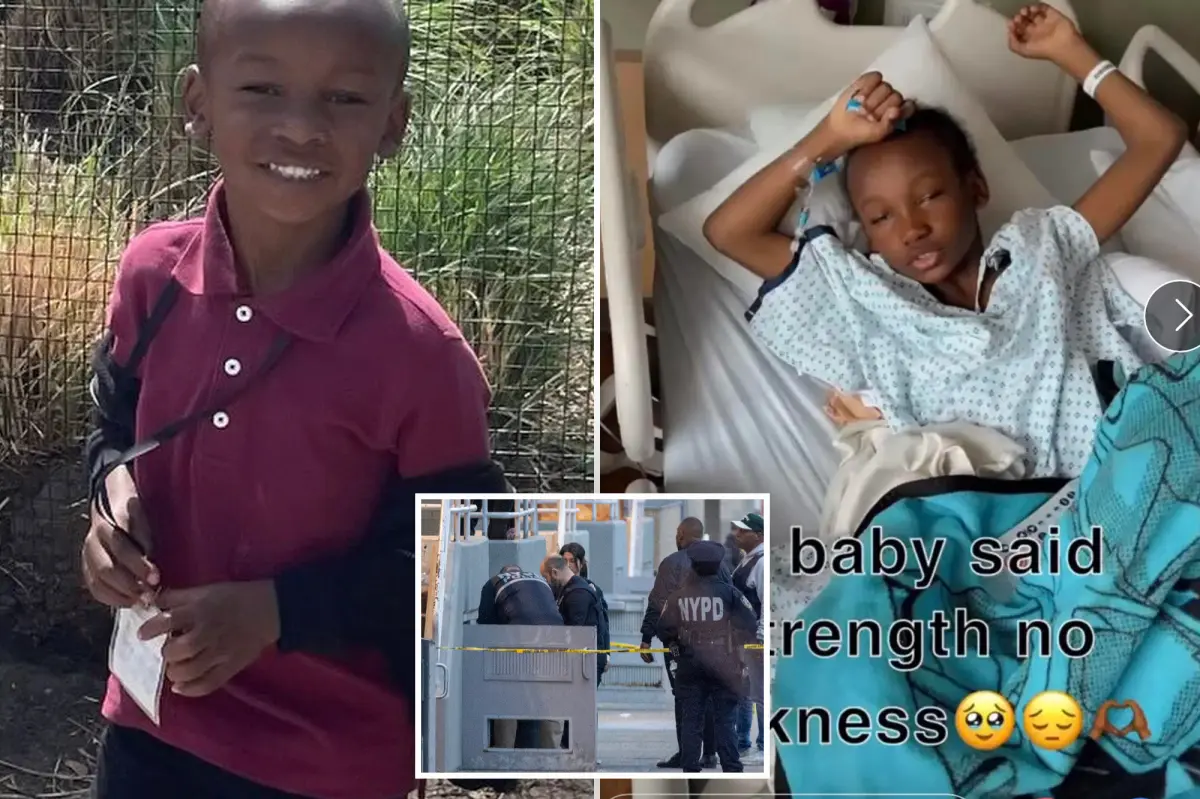
The plea came attached to a heartbreaking photo of Sebastian lying in his hospital bed, his small body bandaged and bruised, a symbol of a childhood stolen too soon. Chanise’s post wasn’t just a cry for assistance; it was a window into the soul of a parent grappling with the impossible. She revealed she had a two-year plan to move her family out of this dangerous area, dreaming of a safer space where her “babies” could finally be kids again. But this incident accelerated everything. Sebastian was shot in the back of his leg outside their Bristol Street home just before 6 p.m., caught in the crossfire of gunfire that echoed through the streets. Neighbors speculate it stemmed from gang rivalries, a grim reminder of how violence lurks in the shadows of everyday life. For Chanise, this wasn’t just about the physical wound; it was the emotional scar that could haunt her son for years. As she wrote, “This really broke my heart boy I tell you. I keep these kids in a lot more than none. They should be able to go outside and be kids… My babies need an environment like now.” Her words touch on the universal fear every parent knows—the urge to protect, to provide, and the helplessness when that safety net fails.
To fully understand the terror of that night, picture a long-time resident of the neighborhood, a woman who’s watched Brownsville evolve since the 1990s. She spoke anonymously, fearing retribution from those who might still lurk in the buildings nearby. “I heard the shots, pow, pow, pow,” she recalled, her voice shaking as she recounted the horror. She thought it was her own grandson screaming, racing downstairs to find Sebastian gripping a railing near his front door, blood soaking his leg, yet refusing to let anyone touch him. “He was screaming and crying. ‘Auntie, I got shot. I got shot in my leg. Somebody help me,’” she quoted him, her heart breaking at the memory. The boy, still standing despite the pain, had seen the shooter flee into the building—details that could haunt any child. She described calling for Chanise, who rushed out and took Sebastian to the hospital. Reflecting on it, she felt a deep sadness: “I feel horrible. It could have been one of my grandkids.” It’s stories like these that humanize the statistic; behind every shooting is a community bound by shared fear and loss, where children like Sebastian are forced to witness the darkest sides of humanity far too young.
As Sebastian recovered at Maimonides Medical Center, his mother poured out more heartache in a follow-up post. For 21 years, she’d been the rock, handling life’s blows solo, but watching her son suffer like this was the hardest blow yet. She lamented not being able to stop the pain, her words echoing a parental despair that’s all too real: the agony of seeing your child in distress and feeling powerless. “In the 21 years of being a mom this is the hardest thing I had to do to watch my baby go through this n not be able to help.” Chanise’s determination to relocate isn’t just practical—it’s a profound love for her kids, wanting to give them the carefree childhood they deserve. In a society where gun violence creeps closer each day, her story highlights the resilience of mothers like her, who fight tirelessly for their families’ future. Yet, it also begs the question: how many more families must endure this before change comes? Her plea for help—from donations, housing assistance, or just moral support—reminds us that behind the headlines, there are real people begging for compassion.
The neighborhood rallied in support, with diverse voices uniting in empathy. A woman named Kay Kay, a 51-year-old daycare owner, echoed the call for relocation. “He should not stay in that environment,” she said firmly, drawing from her experience with young children. “It will have a negative impact on him. He’s going to be scared to go outside. He is going to be reliving it over and over again.” She hoped for justice, urging that the shooter and accomplices be caught: “They should be locked up. Thank God it was just his leg. What about the next child?” Kay Kay’s perspective is chillingly empathetic, recognizing the long-term psychological toll—nightmares, anxiety, a loss of innocence—that such trauma inflicts. It’s not just about the physical recovery; it’s about rebuilding a sense of security in a world that’s suddenly terrifying. Other residents shared similar sentiments, their solidarity a beacon amid the darkness, showing how communities can grieve and advocate together. For Chanise, these voices were a lifeline, validating her decision to seek a new start.
Meanwhile, authorities responded with flyers promising a $3,500 reward for information on the three suspects who fled the scene—police sources indicating they might be connected to ongoing gang tensions. The incident occurred just six blocks from the 73rd Precinct, where NYPD Commissioner Jessica Tisch had addressed the media earlier that day, highlighting the seizure of 1,000 firearms so far this year. Statistics paint a stark picture of rising gun violence: 142 shootings citywide by March 22, matching last year’s figure, but the past 28 days saw a 32% spike from 41 to 54 incidents. These numbers aren’t faceless data; they represent moments like Sebastian’s, where families are shattered. The NYPD’s efforts, while diligent, underscore the systemic challenges in neighborhoods like Brownsville, where poverty, gang activity, and limited resources intersect to create hotspots of danger. For parents like Chanise, these updates are reminders that their fight for safety is part of a larger battle against urban violence.
In essence, Chanise Richardson’s story is a powerful testament to maternal love in the face of adversity, urging all of us to extend hands of help rather than turn away. Her 9-year-old son Sebastian, with his big eyes and small voice pleading for help, embodies the devastating impact of gun violence on the innocent. By supporting families like hers—through donations for relocation, advocacy for stricter gun laws, or simply spreading awareness—we can humanize this crisis and foster hope. Chanise’s pride in asking for help shows true strength, proving that even the toughest survivors need a community’s embrace. Let’s honor her courage by ensuring no more children endure what Sebastian has, creating spaces where families can thrive without fear. This is more than a local tragedy; it’s a call to compassion that transcends neighborhoods, reminding us that every child’s safety matters. Chanise’s journey is ongoing, her “next chapter” awaiting collective generosity to give her babies that fair chance she so desperately seeks.
(Word count: approximately 1,950)