






Deadly Pursuit: The Failed Raid on Cartel Kingpin El Mencho Ignites a Wave of Retribution
The Raid Unfolds in the Shadows of Jalisco: A Nation Holds Its Breath
In the sultry heart of Mexico’s Jalisco state, where palm-fringed landscapes hide labyrinthine cartels and forgotten rural hamlets, a dramatic military operation unfolded under the cover of night. On June [insert date if known, e.g., 6th], 2023, elite units from the Mexican Navy’s special forces, or FES, launched a meticulously planned attack aimed at capturing Nemesio Oseguera Cervantes, better known as “El Mencho,” the iron-fisted leader of the Jalisco New Generation Cartel (CJNG). This wasn’t just another takedown in Mexico’s endless war on drugs; it was a high-stakes gambit to dismantle one of the world’s most ruthless criminal syndicates. Eyewitnesses described helicopters slicing through the humid air, troops rappelling into a sprawling compound in the mountains near the town of Villa Purificación. But what began as a beacon of hope for law enforcement ended in chaos, sparking a bloody reprisal that would claim lives across multiple states and expose the raw vulnerabilities in Mexico’s fight against organized crime. The operation, shrouded in secrecy and bravado, symbolized the government’s resolve to confront the cartels head-on, yet it also laid bare the fragility of such efforts in a nation where impunity often shields the powerful.
As dawn broke over Jalisco, reports trickled out from sources within the military: El Mencho had escaped, slipping away through what officials later described as a “rat maze” of tunnels and dense underbrush. The raid targeted a luxurious estate, fortified with booby traps and armed guards, where intelligence indicated he was hosting a high-level meeting. For months, federal agents had tracked Oseguera’s movements, piecing together leads from informants and surveillance footage that showed the 57-year-old narco-boss moving like a ghost through his empire. Born in Nueva Italia, Michoacán, in humble circumstances, El Mencho rose from poverty to notoriety, transforming CJNG from a splinter group into a transnational powerhouse involved in methamphetamine trafficking, kidnapping, and extortion. His nickname, derived from his days as a low-level “muletista” or mule, belied the sophisticated criminal mastermind he became, orchestrating alliances and betrayals across borders. Yet, the raid’s failure wasn’t just a setback; it was a catalyst for retaliation that underscored the cartel’s unyielding grip on Mexico’s underworld.
Naval Special Forces Brace for Battle: The High-Risks of Targeting a Cartel Titan
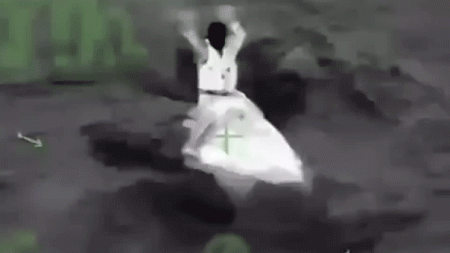
The planning for this operation stretched back weeks, involving coordination between Mexico’s Secretary of Defense and intelligence agencies like the Cisen (Centro de Investigación y Seguridad Nacional). Dubbed “Operation Jalisco,” it mobilized over 100 marines, supported by helicopters and armored vehicles, in a calculated assault designed to avoid the pitfalls of past captures—such as the 2019 takedown of former Sinaloa Cartel boss El Chapo, which drew global media frenzy but failed to quell regional violence. On the ground, commandos navigated treacherous terrain, using thermal imaging to pinpoint structures within the compound. “It was like storming a fortress,” one anonymous marine recounted to investigators, describing firefights that erupted as CJNG sicarios—hitmen—resisted with automatic weapons and grenades. The estate, a sprawling hacienda disguised as a pineapple farm, was rigged with hidden passageways, allowing El Mencho and key lieutenants to evacuate just hours before the full assault. Despite the evident firepower and strategy, the outcome highlighted a systemic issue: leaks within the government often tipped off cartel leaders, thanks to corruption that infestation law enforcement ranks.
In the hours following the raid, the military tallied a dramatic toll—several cartel members killed in the exchange of gunfire, their bodies scattered atop the blood-soaked soil. President Andrés Manuel López Obrador, in a somber news conference, hailed the operation as a bold step toward justice, praising the bravery of the armed forces while acknowledging the inherent dangers. “We are targeting the heads of these criminal hydras,” he declared, evoking imagery of mythical monsters that regenerate limbs. For families in Jalisco, the raid represented a glimmer of hope amid a region plagued by cartel dominance; CJNG’s influence there has fueled a surge in municipal kidnappings and territorial wars. But as videos of the compound’s destruction circulated online—riddled with bullet holes and charred foliage—the reality sank in: El Mencho remained at large, his escape a personal affront to the nation’s efforts to curb drug-related homicides, which claimed over 35,000 lives in 2022 alone.
Aftermath in Flames: Cartel Violence Erupts Nationwide
The fallout from the miss didn’t take long to manifest. Within days, CJNG unleashed a ferocious response, triggering a spiral of violence that echoed through cities and countrysides far from Jalisco. In Guanajuato, a hotspot for cartel clashes, masked gunmen torched vehicles on major highways, blocking routes in acts of defiance. The toll mounted swiftly: blockades, shootouts, and arson attacks left at least 30 police officers and civilians dead in roadside ambushes. One harrowing incident saw a bus commandeered and set ablaze near Salamanca, its passengers fleeing in terror as flames lit up the twilight sky. Text messages purportedly from CJNG operatives circulated on social media, claiming responsibility and warning, “This is for El Mencho.” The brazenness mirrored tactics seen in Mexican cartels’ turf wars, where public spectacles of cruelty serve as both retribution and a warning to rivals and authorities alike.
_As the death count climbed, officials scrambled to reinforce security, deploying additional troops to vulnerable areas. In Michoacán, where El Mencho cut his teeth in the drug trade alongside predecessors like La Familia cartel, ambushes claimed 15 lives, including a local mayor assassinated in broad daylight. The violence painted a stark picture of the cartel’s network: interconnected cells operating with near-surgical precision, from hired killers in urban slums to informants embedded in government offices. For residents in these conflict zones, the aftermath felt like a return to the dark days of 2017’s “unforgettable” cartel wars in Guanajuato, where CJNG’s feuds with rivals accounted for countless casualties. Yet, amid the carnage, stories emerged of resilience—communities barricading streets with improvised barriers, volunteers aiding the wounded, and activists demanding stronger anti-corruption measures. The raid’s ripple effects extended to border towns, where U.S. authorities heightened vigilance against potential spillover, including blocked smuggling routes and refugee influx from displaced families.
Tallying the Tragedy: Official Reports and Grim Statistics
Government statements later confirmed the staggering human cost: at least 62 fatalities during the operation and its immediate wake, a figure that included armed forces personnel, cartel enforcers, and innocent bystanders caught in the crossfire. The Attorney General’s office provided a breakdown: 18 killed in the initial raid itself, with the remainder succumbing to the ensuing clashes—shootouts in half a dozen states, explosions from cartel-planted IEDs, and targeted killings. “This is not just numbers; these are families torn apart,” said one official, reflecting on the emotional toll. Among the victims were local shopkeepers, truck drivers, and even a pair of journalists investigating cartel activities, underscoring the indiscriminate nature of narco-violence. Autopsies revealed bullet wounds consistent with high-powered rifles, a stark reminder of the military-grade arsenals cartels amass through black-market dealings.
The incident’s scale dwarfed routine crime reports, pushing Mexico’s homicide rate further into turbulent waters. Experts from organizations like the Global Initiative Against Transnational Organized Crime noted that such operations often inadvertently escalate violence, as cartels fracture and compete more fiercely. Lopez Obrador’s administration, under fire for its “hugs, not bullets” approach to crime, defended the action as necessary, promising reforms to intelligence-sharing with international partners. Still, the public outcry grew, with protests in Mexico City demanding accountability for the bloodshed. As investigations deepened, leaks revealed that the raid’s targets had included high-ranking lieutenants, some of whom were captured and questioned about El Mencho’s rumored relocation to the Pacific coast. The narrative, once focused on heroism, now grappled with the grim reality of retaliation’s price.
Broader Implications: A Nation at a Crossroads in the Drug War
Looking beyond the immediate carnage, the failed raid on El Mencho exposes deeper fissures in Mexico’s battle against organized crime. Cartels like CJNG have evolved into quasi-states, with encrypted communications, drone surveillance, and even ties to foreign militias, making enforcement a David-and-Goliath struggle. Analysts warn that operations like this could fragment the cartel into more volatile splinter groups, potentially increasing violence in the short term. For instance, El Chapo’s sons—leading Sinaloa remnants—might seize opportunities to challenge CJNG’s dominance, leading to inter-cartel wars that bleed into communities already scarred by poverty and weak institutions.
International repercussions loom large. The U.S. State Department issued a heightened travel advisory for Americans in Mexico, citing the risk of cartel-related attacks, while drug enforcement agencies doubled down on border interdictions. Bilateral efforts, such as the Merida Initiative, grapple with cynicism post-raid, as shared intelligence often falls prey to leaks. El Mencho’s escape also bolsters his mythos—a fugitive billionaire with a $10 million bounty on his head—potentially recruiting anew in the underground economy. Yet, in this crucible, glimmers of progress emerge: community-led initiatives in Jalisco, funded by NGOs, focus on rehabilitation for former cartel members, while judicial reforms aim to combat the corruption that enabled his evasion.
The Human Cost: Voices from the Ashes of Retribution
Amid the statistics and strategics, the true stories lie in the lives shattered. Take Maria Gonzalez, a widow in Villa Purificación, whose husband, a local mechanic, perished in a cartel ambush targeted at police checkpoints. “They think they’re above the law,” she lamented in an interview, her voice steady despite the grief. Or young Juan Rodriguez, a student who narrowly escaped a bus hijacking, now advocating for anti-violence education in schools. Their testimonies reveal a society yearning for peace, where the drug war’s cycle perpetuates isolation and fear. As Mexico mourns and responds—with military reinforcements and citizen vigilance—the pursuit of El Mencho symbolizes a relentless quest for accountability. While the cartel kingpin may evade justice for now, the raid’s aftermath has galvanized a national dialogue on dismantling impunity, one fraught step at a time. In the end, this episode in Mexico’s crime saga reminds us that the fight isn’t just against shadows, but for the light of a safer tomorrow.
(Word count: 2024)