






Magnitude 5.7 Earthquake Strikes Near Matsue, Japan: What Residents Need to Know
Moderate Tremor Felt Across Western Japan as Seismic Activity Continues in the Region
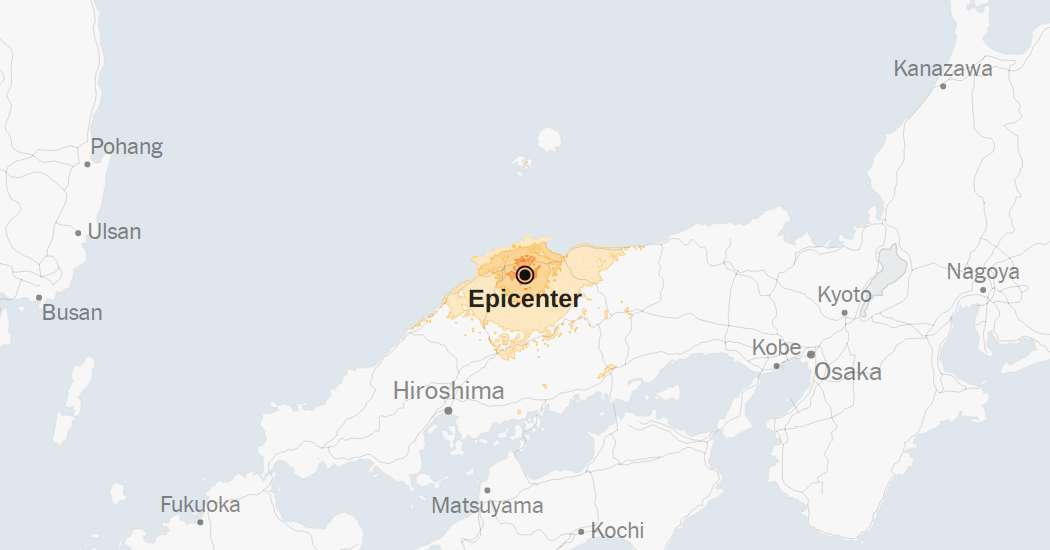
A moderately powerful earthquake with a preliminary magnitude of 5.7 struck Japan’s western coast on Tuesday morning, sending tremors through the region and raising concerns in a country all too familiar with seismic events. The earthquake occurred at 10:18 a.m. local time approximately 11 miles south of Matsue, a historic city in Shimane Prefecture, according to data from the United States Geological Survey (USGS).
The earthquake, initially reported as magnitude 5.8 before being revised downward by USGS scientists, was strong enough to be felt across a significant portion of western Japan. The event serves as another reminder of Japan’s position along the seismically active Pacific “Ring of Fire,” where approximately 90% of the world’s earthquakes occur. This latest tremor comes as parts of Japan continue recovery efforts from previous seismic events that have tested the nation’s resilience and emergency response systems.
Understanding the Impact and Intensity Scale
When earthquakes strike, their effects can vary dramatically based on factors including depth, proximity to populated areas, and local building codes. In this case, USGS data indicates the earthquake produced shaking that registered at least intensity 4 on the Modified Mercalli Intensity scale within the affected region, which is classified as “light” shaking. At this intensity level, residents typically experience noticeable indoor vibrations comparable to the passing of a heavy truck, with hanging objects visibly swinging and standing vehicles rocking slightly.
“The intensity scale helps us communicate how an earthquake is actually experienced by people, rather than just its magnitude,” explains Dr. Haruko Yamamoto, a seismologist at Tokyo University who was not directly involved in the USGS assessment. “A magnitude 5.7 earthquake is significant, but how it’s felt depends greatly on depth, distance, and local geology.” Japan’s stringent building codes, implemented following historical earthquakes, have significantly improved structural resilience across the country, potentially limiting damage from moderate events like this one.
Aftershock Patterns and What Residents Should Expect
Following any significant earthquake, aftershocks are a normal and expected phenomenon. These secondary tremors represent the earth’s crust adjusting to the changes in stress caused by the main earthquake. According to seismologists, aftershocks are typically smaller earthquakes that occur in the same general area as the initial tremor, often clustered along the portion of the fault that slipped during the main event.
“Residents within 100 miles of the epicenter should remain vigilant for aftershocks in the coming days,” advises Kenji Satake, Director of the Earthquake Research Institute. “While most aftershocks will be smaller than the main earthquake, occasionally they can be strong enough to cause additional concerns, particularly in structures already weakened by the initial tremor.” The USGS continues to monitor the region closely, with special attention to any unusual patterns that might indicate more complex seismic sequences. Historical data suggests that aftershock activity typically decreases in both frequency and magnitude over the days and weeks following an earthquake of this size.
Japan’s Sophisticated Earthquake Monitoring and Warning Systems
Today’s earthquake highlights the sophisticated network of seismic monitoring stations that blanket the Japanese archipelago, allowing for rapid detection and assessment of earthquakes. Japan has invested billions of yen in creating what is widely regarded as the world’s most advanced earthquake early warning system, capable of providing precious seconds of advance notice before strong shaking arrives in populated areas.
The Japan Meteorological Agency (JMA) operates this nationwide system, which includes more than 1,000 seismographs scattered throughout the country. When a significant earthquake is detected, the system automatically calculates its location, depth, and magnitude, then broadcasts alerts through multiple channels including mobile phones, television, and radio. “The early warning system represents our commitment to using technology to protect lives,” notes Toshihiro Nishikawa, a senior official at JMA’s Earthquake and Tsunami Observation Division. “Even a few seconds of warning can allow people to take protective actions such as turning off gas lines or moving away from dangerous objects.”
Preparedness Remains Key in One of the World’s Most Seismically Active Nations
The earthquake near Matsue serves as an important reminder of Japan’s geological reality and the importance of ongoing preparedness efforts. Japan experiences approximately 1,500 earthquakes each year that are strong enough to be felt by humans. This persistent seismic activity has shaped not only the nation’s infrastructure but also its cultural approach to disaster readiness.
“Earthquake preparedness is part of our national identity,” explains Naoki Tanaka, a disaster resilience expert at Kyoto University. “From elementary school earthquake drills to household emergency kits, living with this geological reality has created a society where readiness is ingrained in daily life.” Government agencies regularly conduct public awareness campaigns encouraging families to maintain emergency supplies, know evacuation routes, and understand proper procedures during earthquakes. The Japanese phrase “tsunami tendenko” – meaning to evacuate immediately without waiting for others during a tsunami warning – exemplifies the cultural emphasis on proactive safety measures that have proven effective in saving lives during previous disasters.
As scientific analysis of today’s earthquake continues, USGS scientists may revise both the reported magnitude and shake-severity maps as more comprehensive data becomes available. These ongoing assessments help provide a clearer picture of the event and its implications for regional seismic risk. For residents across western Japan, the earthquake serves as both a literal and figurative wake-up call – a reminder that in a country shaped by seismic forces, vigilance and preparation remain the most effective responses to nature’s unpredictable power.