






Powerful 7.6 Magnitude Earthquake Strikes North Pacific Ocean, Triggering Tsunami Alerts for Japan
Massive Seismic Event Detected Near Misawa Prompts Immediate Emergency Response
In a significant seismic event that has raised alarm across the Pacific region, a powerful 7.6-magnitude earthquake struck the North Pacific Ocean late Monday evening, according to data released by the United States Geological Survey (USGS). The substantial tremor, which occurred at 11:15 p.m. Japan time, immediately triggered tsunami alerts for coastal regions of Japan, putting emergency response systems into high alert and causing concern among residents in potentially affected areas.
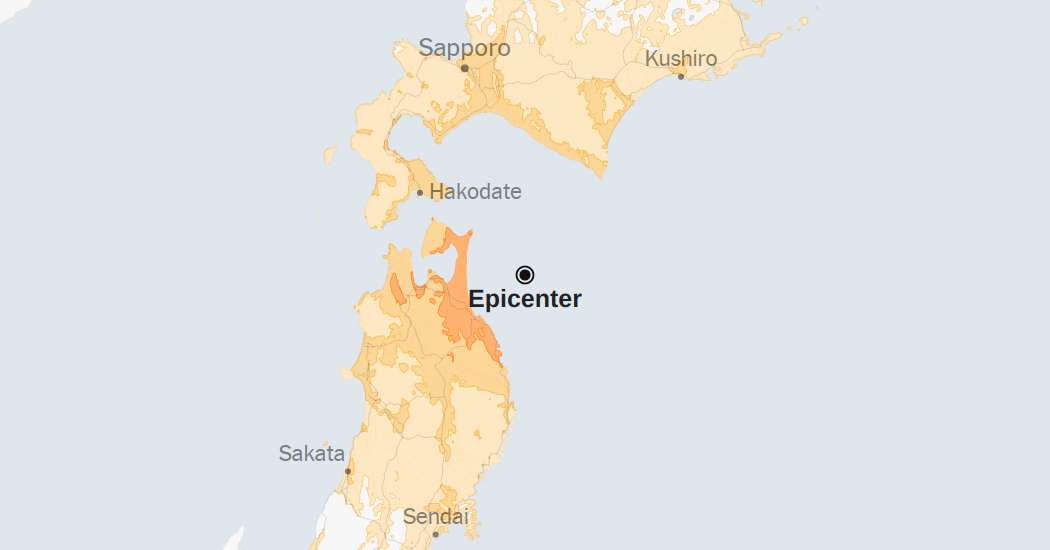
The epicenter of this major earthquake was located approximately 45 miles northeast of Misawa, Japan, positioning it in a seismically active region of the Pacific known for significant tectonic activity. As the earthquake’s energy rippled outward from its deep-sea origin point, monitoring stations across the Pacific basin recorded the event’s substantial magnitude, classifying it among the more significant seismic events to affect the region in recent years. Authorities have begun implementing emergency protocols designed specifically for high-magnitude oceanic earthquakes, which carry the additional threat of tsunami formation due to underwater displacement.
“When we see an earthquake of this magnitude occurring in the ocean, our immediate concern turns to potential tsunami generation,” explained Dr. Hiroshi Watanabe, a seismologist at Tokyo University who specializes in Pacific seismic events. “The displacement of water caused by submarine earthquakes can create powerful waves that travel across the ocean at high speeds, potentially causing devastation when they reach shallow coastal waters and shorelines.” Within minutes of detecting the earthquake, Japan’s Meteorological Agency issued tsunami alerts for vulnerable coastal prefectures, activating emergency broadcast systems that urged residents in low-lying areas to evacuate to higher ground immediately.
Seismic Data Assessment Continues as Scientists Monitor Aftershock Patterns
The initially reported magnitude of 7.6 may be subject to revision as seismologists continue to analyze incoming data from monitoring stations throughout the Pacific region. This refinement process is standard procedure following major seismic events, as the comprehensive assessment of wave patterns and energy release often leads to adjustments in the final magnitude calculation. Additionally, USGS scientists are continuously updating the shake-severity map as new information becomes available, providing crucial intelligence to emergency responders and government agencies coordinating relief efforts.
The Modified Mercalli Intensity scale, which measures the effects of an earthquake on structures and people rather than its raw energy output, indicated significant shaking across parts of northeastern Japan. Areas experiencing an intensity level of 3 or greater – classified as “weak” shaking by USGS standards – extended across a substantial region, though reports suggest the earthquake may have been felt well beyond the areas depicted on initial mapping. “What makes this earthquake particularly concerning is not just its magnitude, but its location relative to populated coastal areas,” noted Dr. Emily Chen, a geophysicist specializing in tsunami prediction models at the Pacific Tsunami Warning Center. “The proximity to Japan’s eastern seaboard, combined with the earthquake’s depth profile, creates conditions that warrant the tsunami warnings currently in effect.”
Aftershock activity is being closely monitored within a 100-mile radius of the initial earthquake, with numerous smaller tremors already recorded in the hours following the main event. These aftershocks, a normal seismic response following a major earthquake, can themselves pose dangers to compromised structures and infrastructure already weakened by the primary event. Seismologists are particularly attentive to the pattern, magnitude, and frequency of these aftershocks, as they provide valuable information about the stability of the affected fault system and help predict whether additional significant seismic events might follow.
Historical Context and Regional Preparedness Highlight Japan’s Advanced Response Systems
This earthquake occurs in a region with a long history of significant seismic activity, including the devastating 2011 Tōhoku earthquake and tsunami that resulted in nearly 20,000 deaths and triggered the Fukushima nuclear disaster. That historical context has profoundly shaped Japan’s approach to earthquake and tsunami preparedness, resulting in one of the world’s most sophisticated early warning and response systems. “Japan has invested billions in creating resilient infrastructure and developing advanced detection systems precisely because of experiences like 2011,” said Akiko Tanaka, director of disaster preparedness for Aomori Prefecture. “From building codes to public education to tsunami barriers, the entire country has been engineered with seismic threats in mind.”
The current emergency response leverages this extensive preparation, with coastal communities practicing regular evacuation drills that are now being executed in real-time. Advanced tsunami warning systems, which include offshore buoys capable of detecting changes in wave patterns and sea floor pressure sensors, have been actively monitoring for signs of tsunami formation since the moment the earthquake was detected. These technological systems are complemented by comprehensive public education campaigns that have trained generations of Japanese citizens in appropriate emergency responses, potentially saving countless lives during events like today’s earthquake.
As assessment teams conduct preliminary damage surveys in the areas experiencing the strongest shaking, international partners including the United States, Australia, and South Korea have offered assistance with both immediate response needs and longer-term recovery efforts. The Pacific Rim’s shared vulnerability to seismic threats has fostered robust international cooperation protocols that activate automatically during significant events, providing affected nations with additional resources, expertise, and support. “What happens seismically in one part of the Pacific affects us all,” remarked Dr. Robert Williams of the USGS International Programs division. “That’s why we maintain such close coordination with our Japanese counterparts and other nations throughout the region.”
Technological Monitoring Systems Provide Critical Real-Time Data for Emergency Decision-Making
The sophisticated network of seismic monitoring stations distributed throughout Japan and across the Pacific Ocean floor has proven invaluable in the immediate aftermath of this earthquake. These highly sensitive instruments measure ground motion and energy waves, transmitting data in real-time to analysis centers where specialized algorithms quickly determine critical earthquake parameters including magnitude, depth, and precise location. This information forms the foundation for emergency response decisions, particularly regarding tsunami threats that require rapid evacuation orders.
“What’s remarkable about modern seismic monitoring isn’t just the sensitivity of the equipment, but the speed at which meaningful analysis can be generated and distributed,” explained Dr. Takashi Furumoto, chief scientist at Japan’s National Research Institute for Earth Science and Disaster Resilience. “We’re talking about complex calculations being performed and verified within minutes, allowing warning messages to reach vulnerable communities with precious time to react.” This technological infrastructure represents decades of scientific advancement and massive financial investment, with Japan maintaining one of the world’s densest networks of seismic monitoring stations.
Beyond immediate emergency applications, the wealth of data being collected will provide scientists with invaluable insights into earthquake mechanics and crustal dynamics specific to this region of the Pacific. Each major seismic event adds to the growing body of knowledge that informs future preparedness efforts, building code revisions, and infrastructure planning decisions. “We learn something new from every significant earthquake,” noted geophysicist Dr. Ken Hudnut. “The patterns of energy propagation, the behavior of specific fault systems, the relationship between primary quakes and aftershock sequences—all of this improves our predictive models and ultimately helps communities better prepare for future events.”
International Implications and Ongoing Monitoring Efforts Underscore Global Cooperation
As coastal communities in Japan implement evacuation protocols and emergency services mobilize to assess and respond to the earthquake’s impacts, the international scientific community remains focused on monitoring potential broader implications throughout the Pacific basin. Tsunami warning centers across the Pacific are maintaining heightened alert status, analyzing oceanic data for signs of unusual wave activity that could affect distant shorelines hours after the initial earthquake. This trans-Pacific cooperation exemplifies how seismic threats have catalyzed international scientific collaboration that transcends political boundaries.
The earthquake serves as a sobering reminder of the geological forces that continually shape our planet and the imperative for continued investment in both scientific understanding and practical preparedness measures. As climate change potentially influences seismic activity through mechanisms like glacial rebound and changing sea levels, the scientific community emphasizes that earthquake and tsunami preparedness must remain priority concerns for all nations bordering active tectonic regions. “We’re dealing with geological processes that operate on timescales much longer than human memory,” observed Dr. Naomi Yokoyama, a geological historian at Kyoto University. “The challenge is maintaining vigilance and preparedness for events that may occur only once in several generations.”
As this situation continues to develop, authorities urge residents in affected areas to remain vigilant, follow official guidance, and stay informed through emergency broadcast channels. With aftershocks expected to continue for days or potentially weeks, the full impact of this significant seismic event remains to be determined. What is already clear, however, is that Japan’s substantial investments in preparedness, early warning systems, and public education are once again being put to the test against the formidable geological forces that have shaped both the Pacific landscape and Japanese culture throughout history.