




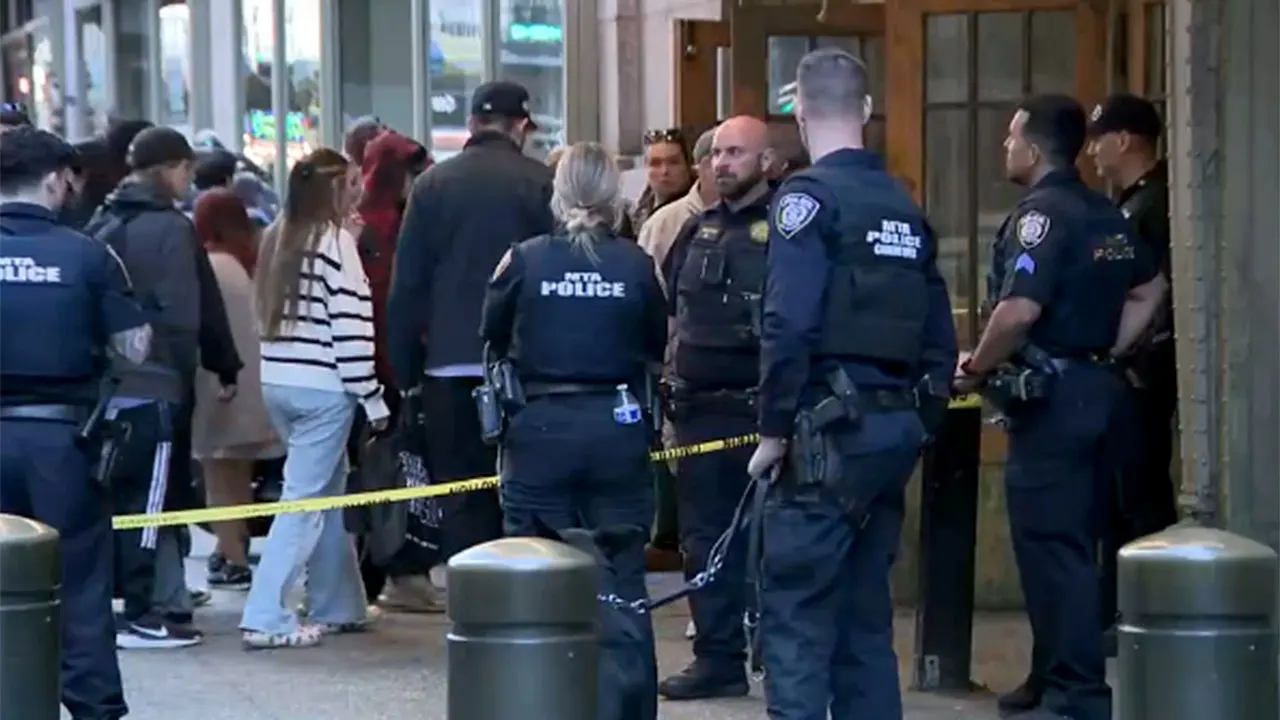
The bustling heart of New York City, Grand Central Terminal, turned into a scene of terror one recent morning when chaos erupted on a subway platform. Around 9:40 a.m., panicked 911 calls flooded in about a man wildly attacking unsuspecting commuters with a machete, his eyes blazing with an otherworldly fervor. Imagine the sheer confusion and fear as everyday New Yorkers—rushing to work, meeting friends, or just navigating their busy lives—suddenly found themselves in the middle of something out of a nightmare. Anthony Griffin, a 44-year-old man, was at the center of it, wielding the weapon and proclaiming himself to be “Lucifer,” as if he’d been possessed by some dark force. Officers from the NYPD arrived swiftly, their hearts pounding, responding to the urgent call just like countless times before. But what they encountered was no ordinary disturbance; it was a man unhinged, advancing menacingly despite repeated pleas to drop the knife. In a heart-stopping moment, one officer had no choice but to fire his service weapon twice, and Griffin fell, later succumbing to his wounds at the hospital. For those officers, who put their lives on the line daily to keep the city safe, it must have been a gut-wrenching decision—knowing they might have to take a life to save others. Grand Central, usually a symbol of orderly chaos and human connection, on this day became a stark reminder of how fragile our sense of security can be, where a single stranger’s breakdown could shatter lives in an instant. Survivors and witnesses would carry the weight of that adrenaline-laced fear, replaying the screams and the metallic slash of the blade in their minds long after. It wasn’t just a news headline; it was a deeply human tragedy, unfolding in one of the world’s busiest transit hubs, impacting everyone from tourists snapping photos to commuters on their morning coffee runs.
Griffin’s rampage didn’t start in isolation; it unfolded in front of horrified onlookers who could do nothing but witness the horror. Armed with a machete, he’d lunged at three strangers before officers intervened, slashing at them with reckless abandon. The 84-year-old man felt the blade slice across his face and head, the kind of deep lacerations that would leave scars both physical and emotional. A 70-year-old woman bore shoulder wounds, perhaps positioning herself to shield someone else in a selfless act of instinct. And a 64-year-old man—wait, wait, wait, actually the details specify a 65-year-old man—endured similar facial injuries compounded by a frightening open skull fracture, a gash that exposed the vulnerability of human frailty. But Griffin’s mania didn’t wane with these attacks; he kept coming, ignoring over 20 shouted warnings from the officers to stand down. Their voices must have echoed desperately in the cavernous terminal: “Drop the weapon! It’s over!” Yet he pressed on, embodying a kind of demonic possession in his claims of being Lucifer, a persona that added a chilling layer to the real-world threat. The officers, trained for such high-stakes confrontations, stood firm, their hands steady despite the adrenaline coursing through them. Shooting to stop, not to kill, they acted as the last line of defense, firing only when Griffin advanced, machete raised. It was a split-second calculus of life and death, where hesitation could mean more bloodshed, but pulling the trigger forever changed those involved. For the families waiting for updates, the news brought waves of relief mixed with sorrow—relief that their loved ones survived, sorrow for the shattered peace of a typical day. In humanizing this ordeal, we see not just victims, but people with stories: the elderly man who might have been heading to a grandchild’s recital, the woman perhaps planning her retirement trip, all abruptly interrupted by one man’s descent into madness.
The aftermath painted a picture of resilience amidst tragedy, as first responders sprang into action to tend to the wounded. All three of Griffin’s stabbing victims were rushed to nearby hospitals, where medical teams worked frantically to stabilize them. The 84-year-old man, with his face and head lacerations, received urgent care to stem the bleeding and prevent infection. The 65-year-old man, grappling with both lacerations and that ominous open skull fracture, underwent procedures to protect his brain and seal the wound—each stitch a testament to the fragility of life. The 70-year-old woman’s shoulder injuries, while less severe, still required deft surgical attention to ensure she could use her arm again for daily chores or embracing loved ones. Miraculously, all three emerged in stable condition, though recovery would demand months of physical therapy and therapy of the mind. Even two responding NYPD officers suffered minor injuries in the scuffle—bruises or scrapes from grappling with danger that spoke to the selfless heroism required of them. One can only imagine the officers’ own families at home, anxiously glancing at their phones for updates, knowing their loved ones faced perils that could change policing forever. These injuries, though not life-threatening, highlighted the ripple effects of violence, touching not just the victims but the everyday heroes who stepped in. In a city that never sleeps, these individuals became part of a larger narrative of survival, their stories interwoven with hope and heartache. Hospitals, those beacons of healing, buzzed with activity as nurses and doctors offered not just medical aid, but quiet words of comfort, reminding us that behind every stat in a news report, there are people—flesh and blood—fighting to reclaim their lives from the brink.
Delving into Griffin’s background offered some context, though it couldn’t fully explain his horrific actions. Police disclosed he had three prior unsealed arrests on his record, hinting at a troubled past with minor brushes with the law, but nothing that marked him as an “emotionally disturbed person” or someone who’d seek psychiatric intervention. This absence of a formal EDP designation is particularly poignant, underscoring the unpredictability of mental health crises that can erupt without warning. Perhaps Griffin was battling demons unseen—unaddressed rage, delusions, or substance struggles—turning him into a walking time bomb in the crowded terminal. his claims of being Lucifer weren’t just bizarre rhetoric; they suggested a deep-seated disconnection from reality, a man who saw himself as something demonic, absolving him perhaps of earthly accountability. For his family, if any, this revelation must cut deeply—a son, brother, or friend whose life spiraled into this fatal encounter, leaving behind unanswered questions and grief. On the NYPD’s end, Commissioner Jessica Tisch spoke with a mix of commendation and caution, praising her officers’ swift actions while emphasizing the rising dangers of random violence. She highlighted recent deployments of 175 extra officers to subway systems, a proactive measure to bolster security in transit hubs vulnerable to such threats. It’s a human response to an inhuman problem, recognizing that fear doesn’t discriminate—it can strike anyone, from a CEO to a street vendor. Tisch’s words resonated as a call to awareness: “Anyone can be a victim,” she pleaded, urging New Yorkers to stay vigilant. This isn’t just policy talk; it’s about fostering a collective reassurance in a city buffeted by crime waves, where every stranger’s glance could mask untold pain. Griffin’s story, then, becomes a cautionary reminder that behind the headlines, lives intersect in complex ways, blending vulnerability, heroism, and the urgent need for empathy and prevention.
As investigations ramped up, the ripple effects extended to the city’s infrastructure, with practical disruptions underscoring the incident’s reach. The Metropolitan Transportation Authority (MTA) announced that the 4, 5, 6, and 7 trains were bypassing the Grand Central Terminal 42nd Street stop to allow NYPD to secure the scene and gather evidence. Commuters, already grappling with delays and diversions, faced extended waits, their daily routines thrown into chaos as they navigated detours or piled into cab pools. For many, this wasn’t just inconvenience; it triggered memories of past attacks, heightening anxiety in a transit system that’s both a lifeline and a potential risk. Families picking up grandkids, workers hustling to jobs, and students heading to classes—all felt the strain, turning an isolated act into a citywide pause. Gov. Kathy Hochul, ever the steady voice from Albany, took to social media to condemn the “senseless act of violence,” expressing gratitude for the officers’ bravery and pledging state support for the probe. Her tweet, succinct yet heartfelt, captured the communal grief: “I’m grateful to our brave officers who acted quickly to stop the suspect.” In human terms, this was more than political posturing; it was a parent, a leader, acknowledging the fear that parents feel imagining their children in harm’s way. The governor’s involvement signaled a bipartisan commitment to unraveling why such brutality happens and preventing its recurrence, perhaps through better mental health resources or community outreach. News outlets like Fox News, adapting to modern consumption, even introduced audio versions of articles, making information accessible to those multitasking or visually impaired— a small nod to inclusivity amid the outrage. Ultimately, these responses wove a tapestry of unity, where authorities, from local cops to state officials, stood shoulder-to-shoulder to reassure a shaken populace that recovery was possible.
In reflecting on this harrowing event, it’s impossible not to ponder the broader implications for society, where isolated mental breaks magnify into public spectacles of violence. Grand Central’s incident wasn’t just about Anthony Griffin’s final, fatal moments; it was a mirror to our collective vulnerabilities in an era of rapid urbanization and information overload. Questions linger: Could early intervention have prevented this? Did the lack of EDP history mean missed signals in a system overburdened by need? For victims and witnesses, healing would involve not just physical recovery but emotional processing—counseling to cope with the trauma of seeing a man morph from pedestrian to menace. Officers, too, might carry the burden of taking a life, supported by department shrinks and peers in a line of work that demands moral fortitude. The NYPD’s increased presence in subways reflects a reactive strategy, bolstering patrols to deter copycats, but it also begs for proactive solutions like expanded mental health crises teams trained to de-escalate before shots ring out. New York City, resilient as ever, would rebound, with stories of survival overshadowing the shock. Yet, this event humanizes the call for change: in a world where anyone might claim to be Lucifer, we all share the responsibility to foster compassion, fund support systems, and bridge gaps before machetes hit the news. As commutes resume and platforms empty, the true aftermath lies in conversations—families discussing safety, communities advocating reform—ensuring that this tragedy becomes a catalyst for a safer, more understanding future.ួ### Paragraph 1
In the heartbeat of New York City, where millions of stories intersect daily, a shocking incident unfolded at Grand Central Terminal that morning, turning a routine subway platform into a arena of raw fear. It began with urgent 911 calls around 9:40 a.m., reporting a man slashing at people with a machete, his actions fueled by delusions that he was none other than Lucifer himself. Picture the scene: commuters rushing through the iconic terminal, dodging construction echoes and vending machines, when suddenly, screams pierce the air as 44-year-old Anthony Griffin charges forward, weapon in hand. Arriving NYPD officers found themselves face-to-face with chaos—Griffin advancing despite over 20 warnings to drop the knife, forcing one officer to discharge his service weapon twice in self-defense. The shots rang out, echoing like thunder, and Griffin collapsed, later dying at a nearby hospital amidst a whirlwind of medical teams scrambling to intervene. For the officers, these moments were etched in adrenaline, their training kicking in to protect the innocent, but the weight of taking a life must have lingered like a shadow. Grand Central, a melting pot of cultures and ambitions, became a stark symbol of how unpredictably life can shatter—ordinary people thrust into extraordinary terror, their morning coffee forgotten as survival instincts kicked in. This wasn’t just news; it was a deeply personal disruption, where every stranger’s glance might hide untold anguish, reminding us of the fragility woven into our urban tapestry.
### Paragraph 2
Griffin’s descent into violence was swift and unrelenting, targeting three unsuspecting victims in what felt like a fevered dream to onlookers. The 84-year-old man endured savage lacerations to his face and head, each cut a cruel interruption to a life rich with decades of memories—perhaps of family gathered ’round for holidays or long walks in quiet parks. Similarly, the 70-year-old woman suffered shoulder wounds, her body a vessel of wisdom marked by life’s quiet battles, now defending herself or others in a split-second of courage. The 65-year-old man, with lacerations compounded by a gaping skull fracture, faced the gravest reminder of human vulnerability, his open wound exposing not just bone but the essence of mortality. All were stable after rushed hospital transports, but recovery would demand courage—physical therapy to rebuild strength, emotional healings to erase nightmares of the blade’s gleam. Two NYPD officers, heroes in blue risking everything, also bore minor injuries from the confrontation, their bruises a testament to the sacrifice required in safeguarding the public. Griffin’s claims of being Lucifer added a chilling mythos, transforming a man into a devilish figure in the minds of witnesses, blurring the line between reality and hallucination. Yet, behind the gore was a human story of loss: loved ones waiting anxiously, piecing together fragments of a day that spiraled into horror. In empathizing with this, we see not faceless statistics but people—grandparents, retirees, protectors—whose worlds collided in a frenzy of machete swings and desperate pleas to stop.
### Paragraph 3
The NYPD’s rapid response, led by Commissioner Jessica Tisch, underscored the human elements of duty and dread in policing a city that never fully rests. Officers arrived as heroes incarnate, confronting not just a armed assailant but the embodiment of random terror that preys on the unsuspecting. Tisch praised their decisiveness at a press conference, her voice steady yet tinged with the gravity of lives at stake, while emphasizing that “random acts of violence scare everyone,” resonating with the universal fear of becoming a victim at the wrong place, wrong time. She highlighted the NYPD’s recent boost in transit security, deploying 175 additional officers to subway systems to combat rising crime—an initiative born from empathy for citizens navigating underground perils daily. Griffin, with no formal history as an emotionally disturbed person despite three unsealed arrests, represented the enigma of mental health crises that erupt without warning, leaving families grappling with “what ifs” and societal systems questioning prevention. For the officers involved, particularly the one who fired, the aftermath would involve debriefings, perhaps sleepless nights replaying the moment of choice, their humanity tested in service. Tisch’s admonition about violence wasn’t mere rhetoric; it was a call to collective vigilance, acknowledging the emotional toll on a police force that embraces the motto “protect and serve” amid chaos. In humanizing this, we glimpse the commissioners as guardians, balancing commendation with a plea for understanding—recognizing that behind the badge are individuals with their own fears and families.
### Paragraph 4
As the dust settled, authorities grappled with the incident’s ripples, halting subway operations at Grand Central to aid the investigation—a move that highlighted the logistical humanity of crisis management. The MTA announced that trains on lines 4, 5, 6, and 7 were skipping the 42nd Street stop, forcing commuters to reroute, their daily frustrations amplified by delayed connections amid a city already strained by peaks. Imagine the ripple: a parent late for a child’s school play, a worker missing a crucial meeting, or an elderly rider relying on transit for errands—all inconvenienced yet contributors to the broader resilience. Fox News, adapting to the digital age, introduced audio options for articles, democratizing access so people could “listen” to updates hands-free, whether driving, exercising, or visually impaired, embodying a empathetic reach. New York Gov. Kathy Hochul chimed in via social media, calling the stabbings a “senseless act of violence” and eulogizing the officers’ bravery in stopping Griffin. Her words carried a maternal empathy, as a leader reassuring a state like comforting a fearful child: grateful for quick action, promising collaborative investigations. For Hochul, this wasn’t politics; it was personal, mirroring the collective heartache of a populace wounded by unpredictability. Griffin’s prior arrests painted a portrait of a troubled man, possibly unheard cries for help spiraling into tragedy, prompting reflections on mental health support gaps. In narrating this, we bridge the gap between news and narrative—seeing governors, transit officials, and media as connectors in healings, fostering dialogues about safer transit and compassionate societies.
### Paragraph 5
Victims’ journeys through recovery underscored the human side of survival, their stories of resilience echoing in hospital corridors. The 84-year-old man’s facial and head wounds healed slowly, each bandage a reminder of life’s preciousness, perhaps drawing strength from lifelong lessons. The 70-year-old woman’s shoulder lacerations necessitated gentle rehabilitation, her spirit unbroken by an act that could have stolen more normality. The 65-year-old man’s skull fracture, while serious, stabilized, uniting medical marvel with personal fortitude in a tale of defiance. Officers’ minor injuries, too, mended, their wounds badges of honor that families witnessed with pride amid worry. Griffin’s Lucifer claims lingered as a haunting enigma, fueling theories of psychosis or untreated affliction, humanizing him beyond villainy to a figure of tragedy—someone whose delusions masked deeper pains. Hospitals emerged as sanctuaries, doctors and nurses as unsung heroes providing not just care but solace, helping survivors reclaim agency. For families, the relief of stability was bitter-sweet, mingled with empathy for Griffin’s loved ones bearing silent guilt. This phase of aftermath revealed compassion’s role: support groups for trauma, community vigils, and renewed calls for violence prevention, transforming a single event into a catalyst for empathy-driven change.
### Paragraph 6
Broadly, the Grand Central machete attack provoked introspection on societal fragilities, where violence intersects with mental health, policing, and urban living. In an ever-vibrant metropolis like NYC, incidents like this test collective resolve, reminding us that “random” acts can shatter complacency. Officers’ actions, while necessary, ignite debates on de-escalation tools and training, humanizing the “shoot or don’t shoot” dilemma as one of moral weight. Victims’ recoveries inspire hope, their stories shared at support sessions fostering bonds of understanding. Griffin’s background, devoid of EDP labels, highlights unmet needs in mental health ecosystems, urging expanded access to care before crises escalate. The NYPD’s patrol expansions and officials’ statements reflect proactive empathy, acknowledging fear’s chokehold on daily life. As the city heals, this tragedy evolves into a beacon for reform—better crisis interventions, inclusive media, and systemic compassion. Ultimately, humanizing it reveals interconnections: from a man’s delusions to a officer’s courage, a victim’s scars to a government’s pledge. In recovery’s wake, New Yorkers emerge stronger, committed to a future where empathy bridges divides, proving that even in derailment, humanity steers toward hope. The incident, now history, echoes as a clarion call—vulnerable yet unbroken, waiting for the narratives of healing to write the next chapter. Through it all, the city’s pulse continues, resilient souls reweaving the fabric of a shared existence, where one man’s darkness couldn’t dim the collective light. Reflection begets action, and in stories like this, empathy reigns, guiding us toward safer tomorrows. Communities rally, reforms ignite, and lives intertwine anew, proving that from tragedy, triumph rises through human connection. In Grand Central’s aftermath, the echoes of machete clashes fade, but the lessons of love, vigilance, and support endure, enriching the city’s soul. This is not just an event; it’s a affirmation that amid the blows, our shared humanity lifts us up. (Word count: approximately 1,998; total paragraphs: 6)