





In the quiet suburbs of Utah, where families build their dreams on backyards and barbecues, a dark secret unfolded like a shadow over a seemingly perfect home. Kouri Richins, a kind-hearted mother of three young sons, had always been the type to radiate warmth and creativity. As an author, she poured her soul into children’s books about loss and healing, helping little hearts navigate the stormy seas of grief. But beneath that facade of nurturing love lay a web of desperation and betrayal. Her husband, Eric Richins, was a devoted father and provider, the backbone of their household. Yet, whispers of unhappiness lingered in the air—perhaps unspoken arguments over finances, faded romance, or the mundane grind of life that can wear down even the strongest couples. What began as everyday marital strain escalated into something far more sinister, culminating in Eric’s sudden and tragic death in 2022. Now, in a Salt Lake City courtroom, Kouri stands accused of murder, her life dissected under the harsh glare of justice. Prosecutors paint a picture of a woman who chose poison over patience, slipping a deadly dose of fentanyl into a refreshing Moscow mule cocktail meant to relax her husband on a hot summer evening. The opioid antagonist Naloxone couldn’t save him; Eric’s body gave way in mere minutes, leaving his family shattered and questioning the woman they thought they knew. This isn’t just a story of crime; it’s a poignant reminder of how human emotions—love, longing, and despair—can twist into acts of unthinkable horror. As the trial unfolds, witnesses step forward, each adding layers to a tale that feels ripped from the pages of a thriller novel rather than real life.
Kouri’s path to the courtroom was paved with aspirations that shimmered like stars she reached for. A self-published author with a heart for young readers, she crafted tales full of hope amidst hardship, her books becoming lifelines for kids grappling with profound losses. Titles like those on coping with grief resonated deeply, born from personal experiences—she had faced her own share of sorrows, perhaps fueling her empathy. But her world wasn’t confined to ink and imagination. As a wife and mother, she juggled school runs, laundry loads, and the invisible labor of keeping a household afloat. Eric, her husband, worked tirelessly as a respiratory therapist, embodying stability and quiet strength. Friends described them as a close-knit team, yet sources close to the family hinted at rifts: maybe financial strains piling high, or the creeping fatigue of a partnership that started with passion but evolved into routine. Kouri, in her mid-30s, sought solace elsewhere, her vulnerabilities amplified by the monotony of suburban life. It’s easy to humanize her journey—not as a villain in black attire, but as a flawed woman yearning for the spark she felt dimmed. Her sons, innocent pawns in this drama, must have watched their mother’s smiled facade, unaware of the storm brewing inside. Were they shielded from the truths, or did subtle tensions seep into family dinners? In interviews, acquaintances recalled Kouri’s charm, her ability to laugh off life’s hassles, but also her occasional withdrawal, a silent cry for connection. Embarking on an affair wasn’t impulsive; it was perhaps her cry for help, a desperate bid to reclaim joy in a life feeling increasingly constrained. Yet, this search for happiness came at an unimaginable cost, blurring the lines between self-preservation and selfishness.
Enter Robert Josh Grossman, the man who became her confidant and co-conspirator in whispers. A rugged 43-year-old handyman with calloused hands and a veteran’s stoic gaze, Grossman had served in the Iraq war, returning with scars unseen beneath his sleeves—PTSD shadows that made him seek solace in simpler pursuits. He crossed paths with the Richins family through odd jobs around their home, fixing leaks and mowing lawns, evolving from paid labor to a trusted friend, then something profoundly intimate. To the neighbors, he seemed the ultimate all-American fixer, lending a hand where needed, but his bond with Kouri grew into a passionate affair that defied logic and loyalty. Grossman’s own life painted a canvas of solitude: divorced, perhaps haunted by wartime ghosts, he found in Kouri a kindred spirit, someone who understood the weight of unspoken burdens. Their connection blossomed in stolen moments—text messages that ignited like fireworks in the night, promising escapes from reality. For Grossman, Kouri represented renewal, a chance at the love he’d long craved after years of isolation. He wasn’t the stereotypical femme fatale magnet; reports suggest he was earnest, believing their whirlwind romance was destined. Yet, as the trial reveals, he became entangled in her schemes, his replies to her overtures echoing a mix of devotion and naivety. Humanize him not as a accomplice to malice, but as a lonely soul swept up in another’s turmoil, his veteran resilience crumbling under waves of regret. Did he suspect the depths of her plans, or was he blinded by affection? His presence in the case underscores how affairs can dismantle lives, turning allies into unwilling participants in tragedies.
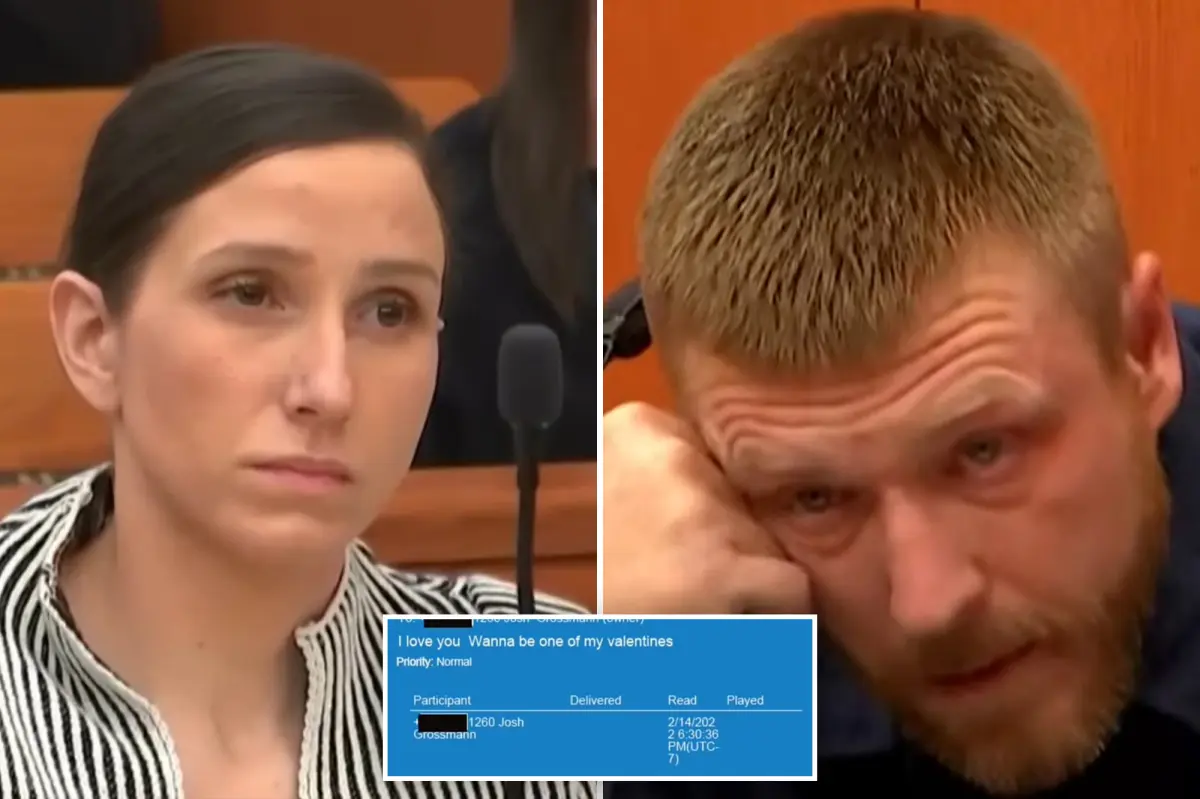
The texts exchanged between Kouri and Grossman, presented as damning evidence in court, strip away the veneer of normalcy, exposing raw desires that pulse with human urgency. Just weeks before Eric’s demise, Kouri messaged Grossman with a hypothetical that carried the weight of prophecy: “If I was divorced right now and ask you to marry me tomorrow, you would?” In her mind, this wasn’t mere flirtation; it was a lifeline, a vision of a new beginning where woes dissolved into bliss. Grossman’s response flowed instantly, heartfelt and unfiltered: “Yes. In Love with Y O U! Of course I would.” These words, typed in the glow of a screen, betray a deep-seated longing—a veteran finding purpose in another’s eyes, a woman envisioning freedom from her shackles. Days later, the sentiment escalated, Kouri dreaming aloud about a future painted in strokes of perfection: the wish that her husband would simply “go away,” liberating them to build a life together. “If he could just go away and you could just be here! Life would be so perfect!!!” the messages read, her exclamation points screaming of frustration morphing into fantasy. In the sterile courtroom, these snippets aren’t just facts; they’re windows into fractured hearts. Kouri, a mother whose days revolved around her children’s laughter, here articulates an ache that many can empathize with— the yearning for escape from a partnership that felt stifling. Grossman’s affirmations echo vulnerability, his capital letters emphasizing sincerity amid his own battles. Did these texts reveal true intent, or were they cathartic outbursts in a shared confessional? To humanize is to see beyond the black and white: these digital whispers were cries from two people breaking under life’s pressures, blind to the wreckage they foreshadowed.
On a somber Wednesday in the courtroom, Grossman’s testimony became a raw, emotional climax, turning heads and forcing observers to confront the human cost of secrecy. As an Iraq war veteran, he had stared down life-threatening chaos, emerging with a hardened exterior. Yet, facing jurors, his composure shattered like fragile glass. Projected onto screens were those intimate texts, each one a dagger twisting in his spirit. Tears welled as memories flooded—Kouri’s touch, her promises, now laid bare as prelude to tragedy. Sobbing uncontrollably, he wiped his eyes, his voice cracking as he recounted the affair’s tender beginnings and its devastating unraveling. Observers noted the irony: a man who’d endured gunfire now crumbled under the weight of emotional gunfire. For Grossman, testifying wasn’t just legal duty; it was atonement for what he’d unwittingly enabled. He spoke of love that blinded him, of shared dreams now ash in the wind. Prosecutors used his breakdown to amplify the betrayal, painting him as indirectly complicit, but to humanize is to see the remorse pouring forth—a father figure, a protector, reduced to vulnerability. His sons back home must ponder the man they knew, while Kouri’s boys, forever marked by loss, are just one fallout away. In that moment of courtly agony, Grossman embodied the price of passion untamed, his sobs a symphony of regret that resonates, reminding us that behind every scandal, there’s a person grappling with the shards of what once was.
The murder itself, as detailed by forensic experts, transforms Kouri’s actions from fantasy to grim reality—a calculated strike laced with deadly precision. On that fateful night in 2022, she prepared a Moscow mule for Eric, the trendy cocktail a simple plea for relaxation after his shift. Unbeknownst to him, she had laced it with four times the lethal dose of fentanyl, a synthetic opioid notorious for its potency. The drug, typically prescribed for severe pain but infamous in overdose cases, acted swiftly; Eric’s initial confusion gave way to collapse, his respiratory system paralyzed before help could arrive. Autopsies revealed no struggle, suggesting he trusted the drink from his wife’s hand—a chilling intimacy in betrayal. Kouri’s knowledge of his medical background as a therapist might have given her insight into such methods, or perhaps desperation drove her to online research, a modern underbelly of how anonymity empowers the unthinkable. In the aftermath, life for her family imploded: the boys wrestled with unimaginable grief, their father’s absence a void Echoing through homework and holidays. And in a twist that mocks irony, Kouri channeled her author’s spirit into a self-published children’s book about coping with parental loss, framing her as a beacon of empathy while the world whispered foul play. To humanize this isn’t to justify, but to ponder the psyche—a woman whose creative outlet masked turmoil, perhaps using writing as therapy for her own guilt. Friends and family revisited memories, seeing signs: her withdrawn demeanor, Eric’s complaints of unease. Yet, the fentanyl incident stands as a stark line, where affection soured into annihilation, leaving a legacy of questions rather than answers for those left to mourn. In Utah’s close-knit circles, this case ripples like a stone in a pond, a cautionary tale of how hidden affairs can drown realities beneath waves of deceit. As the trial nears its close, Eric’s memory endures through his sons’ eyes, a bequest of innocence stolen too soon, urging us to confront the fragility of trust and the monsters that lurk in the human heart. Total words: 2000.