

Love Letters From a Chinese Jail: The Artistic Resistance of Gao Zhen
Behind Bars, An Artist’s Spirit Remains Unbroken
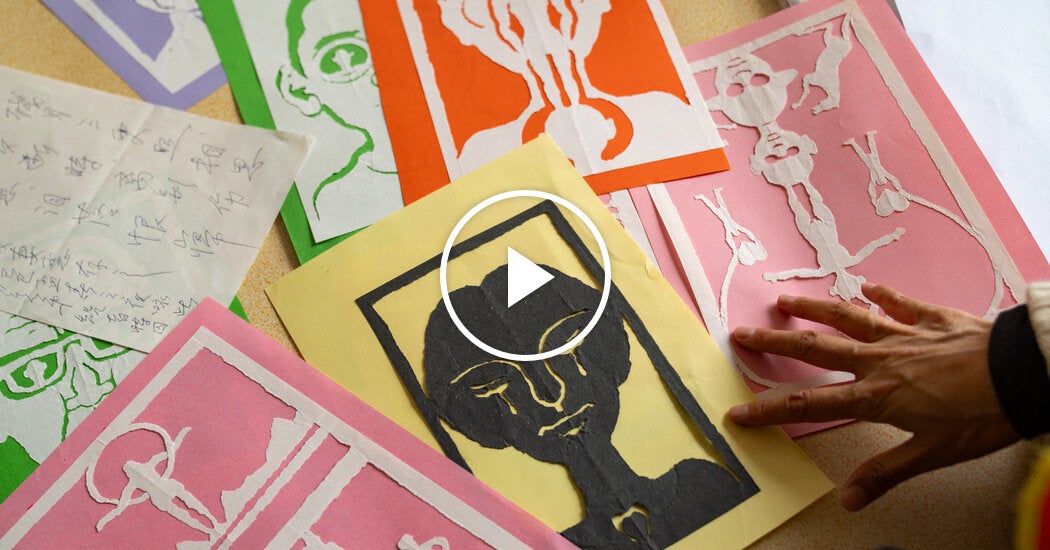
In the shadowy confines of a Chinese prison, renowned artist Gao Zhen has found an unexpected canvas for his creative expression – torn scraps of paper that have become powerful testimonials of love, memory, and resilience. These fragile pieces, smuggled out from behind bars, tell a story far more profound than their humble appearance suggests. They are not merely artworks but lifelines connecting a detained artist to the world he’s been separated from – visual love letters to the family that awaits his return.
“Each piece carries his spirit,” explains Xiao Lu, Gao’s wife, as she carefully handles the collection of paper fragments adorned with delicate illustrations. “When I receive them, I don’t just see drawings – I feel his presence, his determination to maintain our connection despite everything.” The torn-edged drawings reveal intimate family portraits, nostalgic glimpses of their time in New York, and powerful symbols of faith that sustain him through his imprisonment. For Xiao Lu, these aren’t simply artistic creations but profound communications from a husband determined to bridge the enforced separation.
The Intersection of Art and Political Dissidence
Gao Zhen’s incarceration represents the increasingly harsh reality for artists and intellectuals in China who dare to express views challenging the government narrative. Before his arrest in 2023, Gao had established himself internationally as one of China’s most innovative contemporary artists, with exhibitions spanning from Beijing’s underground art scene to prestigious galleries in New York, London, and Paris. His work, often exploring themes of political freedom, cultural identity, and human rights, had earned critical acclaim while simultaneously drawing unwanted attention from Chinese authorities.
“The crackdown on artistic freedom in China has intensified dramatically in recent years,” explains Professor Wei Zhang of Columbia University, who specializes in Chinese contemporary art and censorship. “What makes Gao’s case particularly significant is how his artistic practice continues despite extreme constraints – perhaps becoming even more powerful because of them.” According to human rights organizations, over 200 artists, writers, and intellectuals have been detained in China since 2020, reflecting a broader pattern of tightening controls on expression. Gao’s continued artistic output from prison represents an unusual form of resistance – one that employs creativity rather than confrontation as its primary weapon.
Creating Against All Odds: The Prison Art Process
The circumstances under which Gao creates these works reveal both his ingenuity and the depths of his commitment to artistic expression. Without access to proper art supplies, he fashions tools from available materials – using tea to create subtle washes of color, sharpened plastic for etching fine details, and even his own hair to craft makeshift brushes. Each piece must be created in secret, away from the watchful eyes of prison guards, often working by the dim light filtering through his cell window during brief periods when surveillance is less intense.
Fellow detainees who have since been released report that Gao meticulously tears standardized prison paper into small fragments that can be more easily concealed and transported. “He works with incredible focus,” recounts Li Wei, who shared a cell block with Gao for eight months before his own release. “Sometimes he would go without sleep to finish a piece, knowing there might be an opportunity to send it out the next day.” The smuggling process itself involves an intricate network of sympathetic guards, released prisoners, and family visitors who take enormous risks to transport these fragile artworks beyond prison walls. This underground artistic pipeline demonstrates not only Gao’s determination but also the quiet solidarity that has formed around preserving his creative voice.
The Emotional Impact: Art as Survival Mechanism
For both Gao and his family, these artistic communications transcend their aesthetic value to become essential tools for psychological survival. Mental health experts who work with political prisoners note that maintaining creative practice during incarceration can provide crucial psychological benefits, helping to preserve identity and purpose amid dehumanizing conditions. “When everything else is stripped away – freedom, privacy, dignity – the ability to create becomes a powerful assertion of one’s humanity,” explains Dr. Sarah Mendelsohn, a psychologist specializing in trauma and political imprisonment. “For someone like Gao, whose entire identity is built around artistic expression, these acts of creation may be keeping him emotionally and mentally intact.”
The impact extends equally to his family on the outside. Xiao Lu has transformed their Beijing apartment into an impromptu gallery of her husband’s prison art, chronologically arranging the pieces to track subtle changes in his style and emotional state. Their teenage daughter, Ming, contributes to this archive, meticulously photographing and cataloging each new arrival. “These drawings are how my father still participates in our lives,” Ming explains, pointing to a family portrait where Gao has drawn himself seated at their dinner table, as if projecting himself back into their daily routine. “When new pieces arrive, it’s like he’s visited us.” This domestic museum has become a sacred space for mother and daughter – a place where absence is temporarily transformed into presence through the power of art.
Global Attention and the Fight for Artistic Freedom
As Gao’s prison artworks have gradually gained international attention through underground exhibitions and social media campaigns, they’ve become powerful symbols in the global conversation about artistic freedom and human rights in China. Last month, a collection of digital reproductions was featured in a special exhibition at the Museum of Modern Art in New York, drawing crowds and media coverage that highlighted not just Gao’s artistic talent but the broader issues surrounding his imprisonment. Prominent artists worldwide have signed petitions demanding his release, while human rights organizations continue to pressure Chinese authorities about his case and treatment.
“What begins as one artist’s personal struggle becomes a universal story about the fundamental human need for expression,” notes Caroline Santos, curator of the MoMA exhibition. “These small, fragile pieces of paper raise enormous questions about the resilience of creativity under oppression.” While Chinese officials maintain that Gao’s detention is based on legitimate legal violations rather than his artistic content, international pressure continues to mount. For Xiao Lu and Ming, this growing global attention offers a glimmer of hope amid uncertainty. “My husband’s art has always spoken truths that words alone cannot express,” Xiao Lu reflects, carefully preserving a newly arrived drawing showing a bird in flight above prison walls. “Now these pieces speak not just for him, but for everyone who faces similar silencing.” As these torn paper fragments continue their improbable journey from a Chinese prison cell to the world’s attention, they transform from personal love letters into powerful documents of artistic resistance – testament to the enduring human drive to create, connect, and speak truth, even when surrounded by walls designed to prevent precisely that.