





Vice President Vance’s Bold Stand Against Attacks on His Wife
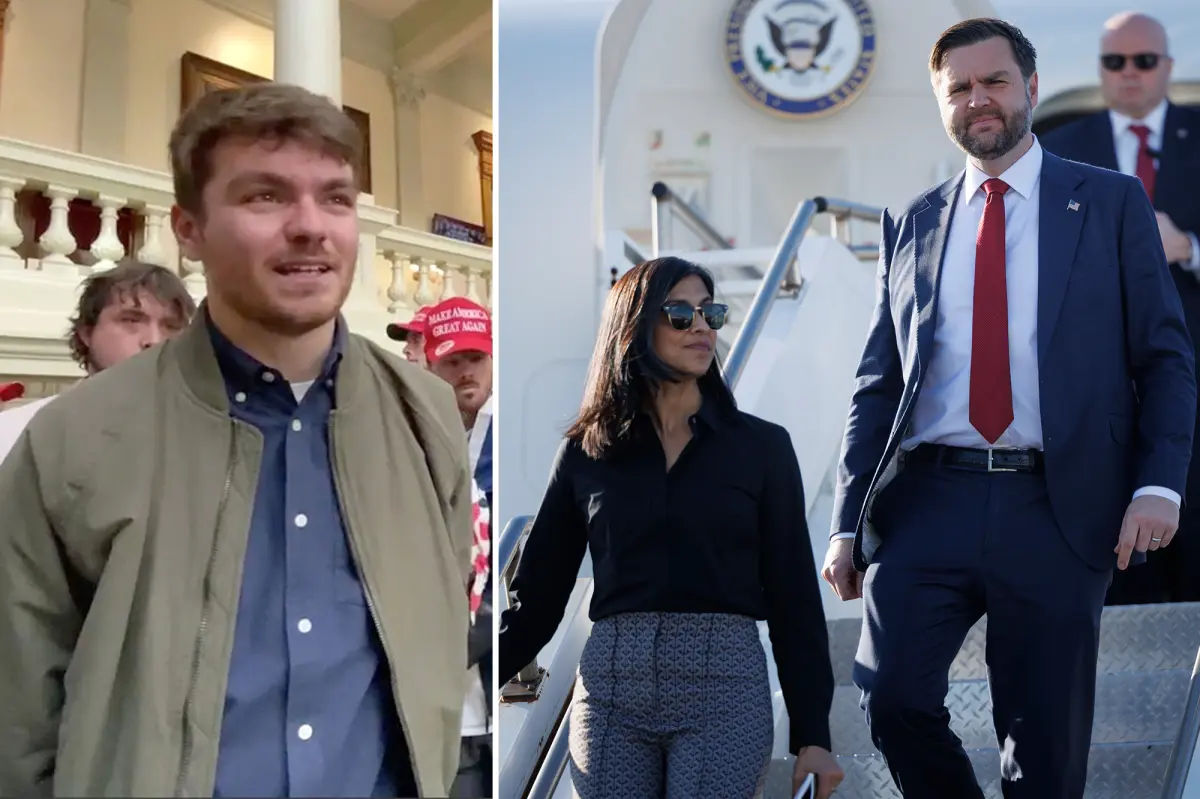
In a recent interview with UnHerd, Vice President JD Vance took a firm stance against those who have attacked his wife, Usha Vance, regardless of their political affiliations. “Let me be clear. Anyone who attacks my wife, whether their name is Jen Psaki or Nick Fuentes, can eat s–t,” Vance declared, calling it his “official policy as vice president of the United States.” His blunt response came after both far-right figure Nick Fuentes and former Biden press secretary Jen Psaki made disparaging remarks about his marriage. Fuentes, a known white supremacist, had called Vance a “race traitor” for marrying Usha, who is the daughter of Indian immigrants. Meanwhile, Psaki suggested on a podcast that Usha needed to be “rescued” from her husband, saying, “I always wonder what’s going on in the mind of [Vance’s] wife. Like, are you OK? Please blink four times. Come over here. We’ll save you.” These personal attacks against the second lady from both extremes of the political spectrum prompted Vance’s passionate defense of his family.
The vice president didn’t stop at defending his wife; he took a clear position against bigotry in all its forms. “Antisemitism and all forms of ethnic hatred have no place in the conservative movement,” Vance stated emphatically in the UnHerd interview. He expanded his condemnation to include all forms of racism, adding, “Whether you’re attacking somebody because they’re white or because they’re black or because they’re Jewish, I think it’s disgusting.” This statement is particularly notable given the recent controversies involving Nick Fuentes, who is not only known for his racist comments but also for denying the Holocaust. Fuentes had specifically questioned Vance’s commitment to “white identity” because of his interracial marriage and the fact that the Vances named one of their children Vivek. In drawing this hard line, Vance appears to be attempting to establish clear boundaries about what is acceptable discourse within conservative circles.
The timing of Vance’s comments is significant, coming just hours after his appearance at Turning Point USA’s AmericaFest, where he spoke against the practice of publicly criticizing fellow conservatives. At that event, Vance emphasized unity within the conservative movement, saying, “President Trump did not build the greatest coalition in politics by running his supporters through endless, self-defeated purity tests.” He also noted that he hadn’t “brought a list of conservatives to denounce or to deplatform,” which seemed to be a veiled criticism of conservative figures who engage in public call-outs of their ideological allies. These remarks appeared to be directed at conservative podcaster Ben Shapiro, who had recently criticized right-wing commentators Candace Owens and Tucker Carlson – the latter of whom had been named “Antisemite of the Year” by the organization StopAntisemitism following his interview with Fuentes.
The vice president’s strong defense of his wife highlights the increasingly personal nature of political discourse in America today. Usha Vance, a Yale Law School graduate and former law clerk to Supreme Court Chief Justice John Roberts, has largely maintained a private profile despite her husband’s high-profile political career. The attacks against her from both Fuentes and Psaki represent how political figures’ families are increasingly becoming targets in our polarized political climate. Vance’s forceful response indicates not just his personal feelings as a husband, but perhaps also suggests a growing concern about the boundaries of political criticism and when it crosses into unacceptable personal territory. His willingness to equally condemn attacks from both the far-right and the left demonstrates that, at least in this instance, his defense transcends partisan lines.
Vance’s condemnation of antisemitism and racism comes at a time when such sentiments have been increasingly visible in American political discourse. The mention of Tucker Carlson being named “Antisemite of the Year” following his interview with Fuentes points to ongoing concerns about the normalization of extreme views in mainstream conservative media. Fuentes himself has a long history of making inflammatory racist and antisemitic statements, and has been banned from numerous social media platforms as a result. By explicitly rejecting such bigotry, Vance appears to be attempting to establish his own position distinct from these controversial figures, while simultaneously criticizing what he sees as unfair attacks from liberal commentators like Psaki. This balancing act reflects the complex position Vance occupies within the current political landscape, where he must appeal to a broad coalition while also defining boundaries.
The controversy surrounding Vance’s defense of his wife also reflects broader tensions within the conservative movement about inclusion and identity politics. As the Republican Party becomes more diverse, figures like Vance who have interracial families face scrutiny from certain elements on the far right who espouse ethno-nationalist viewpoints. At the same time, his call for unity at the Turning Point USA event suggests he’s wary of the conservative movement fracturing through internal criticism and “purity tests.” The reference to honoring Charlie Kirk, the founder of Turning Point USA, by avoiding the practice of denouncing fellow conservatives that Kirk “refused to do in life” indicates Vance’s preference for building coalitions rather than narrowing them. Yet his strong stance against antisemitism and racism shows there are lines he’s not willing to cross in the name of unity. As the Trump-Vance administration begins to take shape, these tensions between coalition-building and defining clear moral boundaries will likely continue to be a central challenge.