






The Fragile Lifeline: How War Threatens Middle East Water Supplies
Amid the escalating turmoil of the Iran-Israel conflict, which marks its second week of intense military engagements, two critical desalination plants in the region have sustained damage, sparking widespread alarm over the precarious state of water infrastructure that sustains millions across the arid landscapes of the Middle East. These facilities, pivotal for converting seawater into potable water, serve as the backbone of daily life in countries grappling with chronic water scarcity. With the Persian Gulf nations increasingly dependent on technology to quench their thirst, the recent hits underscore vulnerabilities that could ripple far beyond the battlefield, affecting civilian populations in profound and immediate ways.
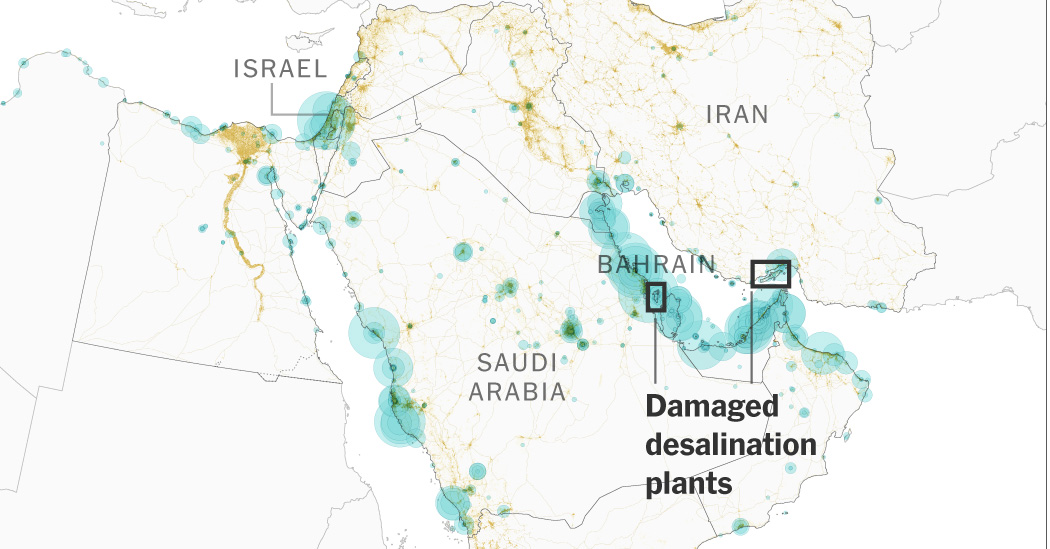
The incidents began with Iran pointing fingers at external forces. Iran’s Foreign Minister Abbas Araghchi publicly condemned an attack on a desalination plant on Qeshm Island in the Persian Gulf on March 7, claiming it disrupted water delivery to around 30 rural communities. Tehran accused the United States of orchestrating the strike, but both the Pentagon and Israeli authorities denied any involvement. Meanwhile, in neighboring Bahrain, the Interior Ministry attributed “material damage” to a local desalination facility to an Iranian drone, although the country’s water and electricity authority assured the public that supplies remained unaffected. These events, unfolding against a backdrop of heightened tensions, highlight how geopolitical confrontations can imperil essential services. As water experts analyze the blows, they warn that even minor disruptions could illustrate the systemic fragility inherent in a region where climate patterns increasingly dictate survival strategies.
Over the past century, the art of desalination—transforming salty seawater and brackish groundwater into drinkable resources—has evolved from a niche innovation to an indispensable pillar of Middle Eastern economies. Countries like Qatar and Bahrain now derive more than half their freshwater needs from these high-tech plants, a testament to technological leaps that have outpaced dwindling natural reserves. The proliferation gained momentum as droughts, exacerbated by climate change, turned episodic dryness into prolonged crises. By the 1990s, global warming induced shifts in rainfall patterns, making traditional water sources unreliable. Engineers and policymakers responded by scaling up desalination operations, investing billions in plants that now dot coasts from Oman to the Levant. Yet, this surge in reliance comes with caveats; desalination is energy-guzzing and costly, often intertwined with polluting industries like oil refining.
What makes these plants so susceptible? Damage to a single major facility, as experts warn, could cascade into humanitarian crises. Menachem Elimelech, a respected environmental engineer at Rice University, emphasizes that shutting down a plant isn’t merely an inconvenience—it’s a lifeline severed for potentially millions. Consider Bahrain’s Al Dur plant, which daily delivers water to over a million residents, accounting for more than a third of the nation’s total supply. Repairing extensive harm from military actions could span months, leaving communities scrambling. Some nations, like the United Arab Emirates, have fortified emergency stockpiles, but analysts caution these buffers might evaporate within days under sustained strain. The response often involves logistical gymnastics: deploying bottled water convoys, mobile desalination units, and tanker ships. David Michel, a fellow at the Center for Strategic and International Studies specializing in global water security, describes this as “a chaotic scramble,” noting that while supply chains exist, the sheer scale of disruption turns recovery into a monumental challenge for resource-starved societies.
International norms attempt to shield such vital infrastructure, forbidding attacks on systems crucial for civilian survival, including water, food, and energy networks. Yet, the targeted strikes on Qeshm Island and in Bahrain appear deliberate, sending a chilling message about the risks. Michel’s assessment rings true: these weren’t accidental collateral hits but calculated moves that signal the weaponization of essential services. Mohammed Mahmoud, the Middle East lead for the U.N. University Institute for Water, Environment and Health, frames the issue starkly: “When you target water infrastructure, you’re attacking the very fabric of civilian life—it’s categorically a war crime.” This perspective echoes humanitarian concerns, where combatants on all sides face repercussions for transgressions that jeopardize non-combatants. The incidents also raise questions about proportionality in warfare, probing whether such actions comply with laws of armed conflict that demand avoiding unnecessary suffering.
Beyond direct assaults, indirect threats loom large, amplifying the desalination sector’s exposure. Plants often sit near industrial complexes, drawing seawater feeds vulnerable to contamination from nearby damage. Elimelech illustrates the peril vividly: an oil spill near intake pipes could essentially “kill” a facility by fouling filters and pipelines, halting operations abruptly. Historical precedents underscore this risk; during the 1991 Gulf War, Saddam Hussein’s forces dumped millions of barrels of Kuwaiti crude into the Persian Gulf, aiming to sabotage desalination efforts and impede invasions. The oily slick stretched for miles, forcing Saudi Arabia into a frantic cleanup to shield Riyadh’s main plant—from which half the capital’s drinking water flowed. On land, Kuwait’s aquifers were infiltrated, poisoning underground reserves. Energy dependencies compound these woes; desalination demands vast power, often sourced from adjacent oil, gas, or renewable plants. A strike on power infrastructure could black out desal operations, while water transmission lines—like those piping from coastal facilities to inland Riyadh—extend vulnerabilities hundreds of kilometers. In a region where subsidies make desalinated water artificially cheap, enabling lavish uses like golf course irrigation, economists argue this has bred inefficiency and deeper dependence, delaying investments in conservation.
Despite these perils, glimmers of resilience emerge. Countries are bolstering reserves through advanced storage and urging regional cooperation for shared water networks. Yet, as Mahmoud notes, deep-seated rivalries and distrust thwart progress; nations cling to autonomy over collective solutions. “Self-reliance feels safe until your lifeline snaps,” he observes. Innovations in drought-resistant crops, recycled water systems, and solar-powered plants offer pathways forward, but implementation lags amid geopolitics. As the Middle East navigates its water wars—both literal and metaphorical—the recent attacks serve as a stark reminder: in a desert transformed by human ingenuity and conflict, the quest for hydration demands not just technology, but diplomacy to safeguard shared resources for future generations.