


Tensions Escalate: Trump’s Warning Shadows the Strait of Hormuz
In the volatile world of Middle Eastern geopolitics, where oil flows dictate fortunes and alliances shift like desert sands, President Donald Trump’s latest declaration has sent shockwaves rippling across the Atlantic and into Tehran. The American leader, known for his unflinching rhetoric, has raised the stakes in a longstanding standoff with Iran by threatening devastating military action unless the strategically vital Strait of Hormuz is reopened. This narrow waterway, a chokehold on global energy supplies, has become the latest flashpoint in a saga of mistrust, economic sanctions, and naval posturing. As the White House doubled down on its “maximum pressure” campaign, Iranian officials scrambled to respond, their defiance tinged with a chorus of voices lamenting a perceived erosion of American ideals. The incident underscores how a single maritime route can ignite international crises, drawing in allies from Europe to Asia and forcing ordinary Iranians to ponder the cost of pride in a diplomacy that has turned increasingly bellicose.
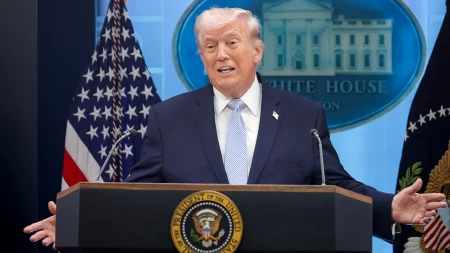
Diving deeper into the core of the controversy, Trump’s remarks came amidst mounting frustrations over Iran’s closure of the strait in response to heightened sanctions. During a press conference in Washington, the president proclaimed, “If they don’t open the Strait of Hormuz, there will be consequences like they’ve never seen before.” His words, delivered with characteristic bombast, evoked memories of past escalations, such as the U.S. drone strike that killed Iranian General Qasem Soleimani in 2020. Analysts point out that Trump’s administration has portrayed the closure as an act of economic warfare, disrupting the passage of oil tankers and inflating global prices. The threat of “devastating attacks” – potentially involving airstrikes or naval blockades – was framed as non-negotiable, a bold maneuver to reassert American dominance in a region where adversaries have tested the limits. White House aides clarified that this wasn’t a call to immediate conflict but a stark warning, urging Iran to reconsider its position. Behind the scenes, however, military planners in the Pentagon prepared contingency options, highlighting how one man’s tough talk could cascade into real-world ramifications for sailors, civilians, and economies alike.
The Strait of Hormuz, often hailed as the world’s most important maritime corridor, serves as the jugular vein for petroleum exports. Stretching just 21 miles wide at its narrowest point, it funnels about 20% of the planet’s oil supply daily, linking the Persian Gulf producers like Saudi Arabia and the UAE to international markets. Iran’s ability to shut it down, even temporarily, has historically been a powerful bargaining chip, demonstrated in 2012 when Tehran threatened to do just that during sanctions disputes. Yet Trump’s threat flips the script, positioning the United States as the gatekeeper rather than the bystander. Veteran diplomats recall how the strait has been a hotspot for decades – from the 1980s tanker wars between Iran and Iraq to more recent incidents like the 2019 attacks on shipping lanes, blamed on Iran by Washington. Environmental groups have warned of the ecological disaster a blockade could unleash, with oil spills poisoning the Arabian Sea. Amid this backdrop, Trump’s stance resonates with supporters who see it as decisive leadership, protecting American interests, while critics decry it as brinkmanship that could spark an unnecessary war, drawing parallels to the Vietnam quagmire or the Iraq invasion.
On the Iranian home front, the response was a mix of indignation and introspection. Government spokespersons in Tehran dismissed Trump’s warnings as “bluster from a desperate administration,” accusing the U.S. of hypocrisy for imposing crippling sanctions that have starved the economy. Supreme Leader Ayatollah Ali Khamenei, in a televised address, vowed that Iran would “never bow to imperialist pressures,” portraying the strait as integral to national sovereignty. Yet, beneath the official defiance, a groundswell of public sentiment echoed through social media and street protests. Citizens in major cities like Tehran and Isfahan shared anecdotes of hardships wrought by inflation and medicine shortages, fueling debates about whether closing the strait was worth the risk. One engineering student, interviewed anonymously, remarked how the threats evoked fears of full-scale conflict, disrupting lives already frayed by economic turmoil. This internal divide reflects Iran’s complex societal fabric, where nationalist fervor clashes with war-weary pragmatism, and highlights how geopolitical gambles resonate personally in a nation of 83 million.
Perhaps most poignantly, some Iranians have directed their ire inward, using Trump’s threats as a lens to scrutinize America’s self-proclaimed moral compass. In cafes and online forums, voices questioned what had become of the cherished American values of liberty, democracy, and human rights. One retired teacher in Mashhad expressed bewilderment: “We expected more from the land of the free – dialogue, not destruction.” Such sentiments draw from a deep historical well of Iranian disillusionment, tracing back to the 1953 CIA-backed coup that toppled a democratic government and the 1979 Revolution’s anti-imperialist fervor. Critics argue that Trump’s approach, prioritizing military might over multilateral solutions, contradicts the U.S. Constitution’s preamble of justice and domestic tranquility. A young journalist in Tehran, aspiring to bridge divides, noted how these doubts extend beyond Iran, mirroring global sentiments about American leadership in an era of populism and polarization. This introspection isn’t mere rhetoric; it’s a mirror held up to the U.S., prompting reflections on whether the world’s superpower has traded its founding principles for a zero-sum game of dominance.
Looking ahead, the standoff in the Strait of Hormuz carries profound implications for global stability and diplomacy. Experts warn that any miscalculation could escalate into broader conflicts, involving allies like Israel and Saudi Arabia, who view Iran as a existential threat. The European Union has urged de-escalation through the remains of the 2015 nuclear accord, which Trump unilaterally abandoned. Meanwhile, market analysts fret over oil price spikes that could strain economies from Europe to Asia. For Iranians grappling with their future, the episode serves as a wake-up call about the fragility of peace in a resource-rich region. As diplomats shuttle between capitals, the question lingers: Can words alone avert catastrophe, or must nations confront the lessons of history to forge a path forward? Trump’s threat, in essence, is more than a policy stance – it’s a testament to how a single waterway can test the very fabric of international norms, reminding us all that in the theater of power, values are often the first casualties.