






Iran Halts Execution of Protester Amid International Pressure and Domestic Unrest
Execution of 26-Year-Old Erfan Soltani Suspended as Global Community Watches Iran’s Human Rights Crisis
In a dramatic development that highlights the ongoing tension between Iran’s authoritarian regime and its citizens fighting for freedom, Iranian authorities have reportedly suspended the planned execution of 26-year-old protester Erfan Soltani. The execution, which was scheduled for Wednesday, would have marked a significant escalation in the government’s crackdown against the latest wave of anti-government demonstrations that have rocked the Islamic Republic. This last-minute reprieve comes amid mounting international pressure and represents a critical moment in Iran’s ongoing human rights crisis.
Soltani’s case has drawn worldwide attention as he would have been the first demonstrator executed in connection with the current protest movement. The protests, which began as expressions of frustration over economic hardship and political repression, have evolved into one of the most significant challenges to the clerical regime in years. Human rights organizations have documented extensive use of force against peaceful protesters, including mass arrests, torture in detention, and now, the threat of capital punishment as a tool to silence dissent. “We have been notified and pretty strongly, but we’ll find out what that all means,” said one diplomatic source involved in negotiations. “But we’ve been told that the killing in Iran is stopping. It’s stopped, it’s stopping. And there’s no plan for executions or an execution or executions. So I’ve been told that on good authority. We’ll find out about it.”
Protesters Defy Regime Despite Brutal Crackdown
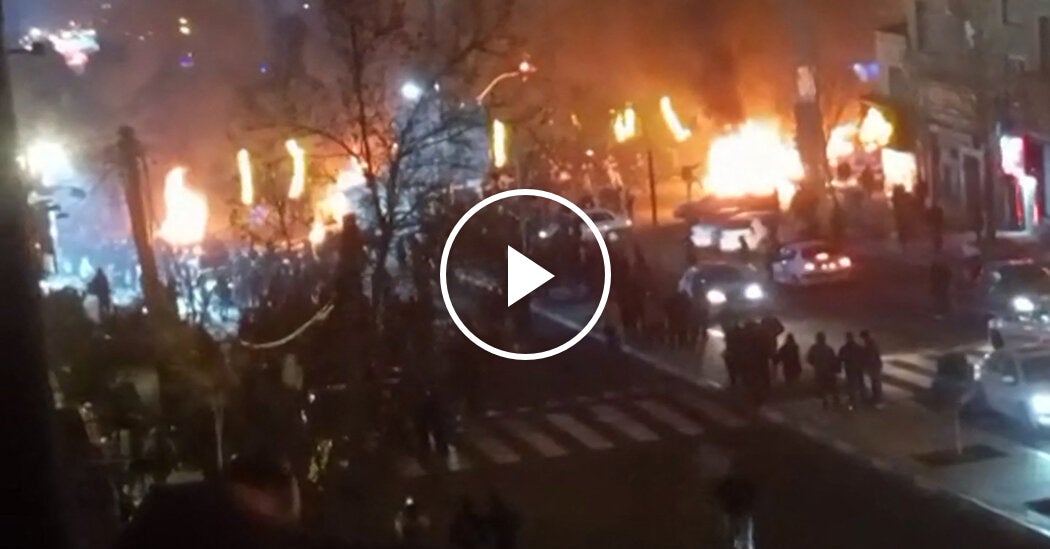
The Iranian protest movement has demonstrated remarkable resilience despite facing overwhelming odds and brutal state violence. Eyewitness accounts describe scenes of chaos on streets filled with fires, vehicles, and crowds of determined demonstrators facing security forces. What began as isolated demonstrations has transformed into a sustained movement demanding fundamental political change, greater personal freedoms, and economic justice. Social media platforms, despite government restrictions on internet access, continue to circulate images of protesters from all walks of life – students, professionals, laborers, and even some former regime supporters – risking everything to demand reform.
One Iranian human rights activist, speaking on condition of anonymity, expressed a sentiment echoed by many observers: “It makes me feel horrified. I’m actually horrified. I think the most horrifying part of this is that the Iranian people know their own enemy. They know the Iranian regime. They knew the cruelty that this regime would unleash on them, but they still went out onto the streets because as I said, they’ve got nothing to lose.” This powerful testimony underscores the desperation and determination driving the protest movement – citizens willing to face imprisonment, torture, and death because the status quo has become unbearable. Independent analysts estimate that hundreds have been killed and thousands detained since the demonstrations began, though exact figures remain difficult to verify due to the regime’s information blackout.
International Response and Diplomatic Pressure
The international community’s response to Iran’s human rights violations has been mixed but increasingly forceful as evidence of abuses mounts. Western governments have imposed targeted sanctions against Iranian officials and entities responsible for the crackdown, while human rights organizations have documented specific cases of torture and extrajudicial killings. The threatened execution of Erfan Soltani appears to have been a tipping point, triggering urgent diplomatic interventions from multiple countries and international bodies. United Nations human rights experts have called the trials of protesters “grossly unfair” and lacking in basic due process, with confessions often extracted under torture.
The apparent suspension of Soltani’s execution suggests that international pressure may be having some effect, though human rights experts caution against premature optimism. “The regime often makes tactical retreats when global attention becomes too intense, only to resume abuses when the spotlight moves elsewhere,” explained one international human rights lawyer who specializes in Iranian affairs. “What’s needed is sustained engagement and consequences for human rights violations.” Diplomatic sources report increased behind-the-scenes negotiations, with several countries leveraging economic and political relationships to pressure Iran. The European Union has threatened additional sanctions specifically targeting officials involved in approving death sentences for protesters, while various human rights mechanisms at the UN have launched special investigations into the situation.
The Broader Context of Iran’s Human Rights Crisis
Erfan Soltani’s case cannot be viewed in isolation but rather as part of a systematic pattern of state repression in Iran. The judiciary, firmly under the control of hardline elements loyal to Supreme Leader Ayatollah Ali Khamenei, has increasingly used the death penalty as a political tool. Legal experts point out that the charges against protesters often include vague national security offenses like “corruption on earth” or “enmity against God” – capital crimes that allow for wide judicial discretion and minimal evidentiary standards. According to human rights monitors, Iran executes more people per capita than almost any other country in the world, with a disproportionate impact on ethnic and religious minorities.
The current protest movement represents a convergence of long-simmering grievances: economic mismanagement exacerbated by international sanctions, political repression, mandatory hijab laws and restrictions on women’s rights, discrimination against minority groups, and endemic corruption. Many protesters no longer call for reform within the existing system but instead demand fundamental regime change. “What we’re witnessing is not just about specific policies but a rejection of the entire post-1979 political order,” noted one political analyst specializing in Iranian affairs. “The demographic reality – a young, educated population with access to global information despite censorship – creates an existential challenge for a regime founded on revolutionary principles that increasingly seem anachronistic to many Iranians.”
Looking Forward: Uncertain Future for Iran’s Protest Movement
The suspension of Erfan Soltani’s execution, while a momentary reprieve, does little to resolve the underlying tensions driving Iran’s unrest. Both the regime and the protest movement face critical strategic decisions in the coming weeks and months. For authorities, the fundamental question is whether continued repression will succeed in crushing dissent or instead further alienate the population and deepen the legitimacy crisis. For protesters, the challenge remains how to sustain momentum and organization in the face of overwhelming state power and the risk of severe punishment. International actors must determine how to effectively support human rights in Iran without playing into the regime’s narrative that portrays protesters as foreign agents.
Human rights advocates emphasize that regardless of the immediate outcome of current protests, the courage demonstrated by ordinary Iranians has permanently altered the political landscape. “Even if this wave of demonstrations is suppressed, the regime cannot erase the memory of people standing together against injustice,” said one veteran Iranian civil society activist. “Each protest builds on previous movements and creates new networks of resistance.” The case of Erfan Soltani – his near execution and apparent last-minute reprieve – epitomizes both the brutal tactics of the regime and its potential vulnerability to coordinated pressure. As the world watches Iran’s unfolding drama, the fundamental struggle remains between a system determined to maintain control through force and a population increasingly willing to risk everything for the chance at a different future. Whether this particular moment represents a turning point or another painful chapter in Iran’s long struggle for human rights remains to be seen, but the courage of protesters like Soltani has already written an indelible page in that history.