


The Intriguing Saga of Olivia Nuzzi and Robert F. Kennedy Jr.
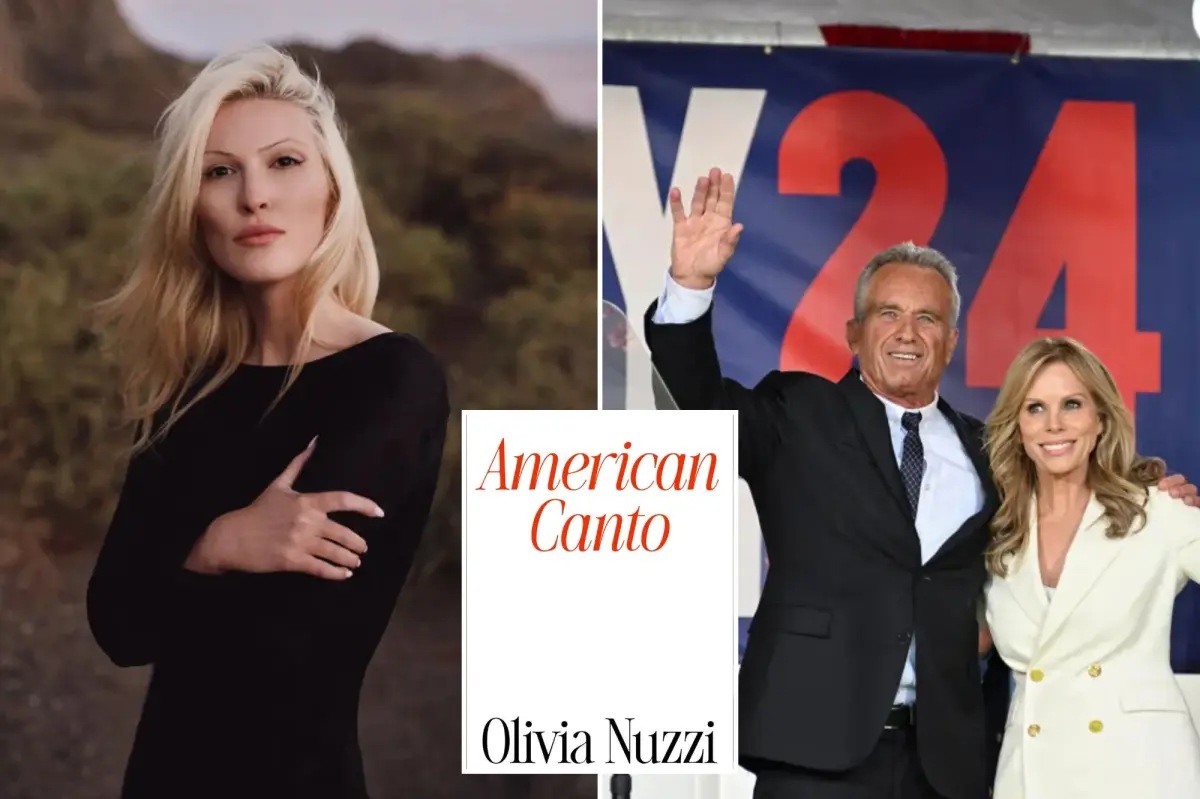
Olivia Nuzzi’s revealing memoir “American Canto” offers readers an intimate glimpse into her complicated relationship with Robert F. Kennedy Jr., whom she refers to only as “The Politician” throughout the narrative. The book details a passionate, secretive connection between the 32-year-old former New York Magazine journalist and the 71-year-old Kennedy scion, now serving as Secretary of Health and Human Services. Their story began innocuously enough in 2023 when Nuzzi interviewed Kennedy during his presidential campaign, despite her engagement to fellow journalist Ryan Lizza and Kennedy’s marriage to actress Cheryl Hines. What followed, according to Nuzzi’s account, was an emotionally intense relationship that ultimately cost her both her relationship and her career. She describes moments of raw vulnerability where Kennedy allegedly wept while telling her, “I wish I could just be with you,” and claimed she made him feel as free as a childhood moment when he was thrown from a runaway horse. Though Nuzzi maintains they never consummated their relationship, the emotional entanglement ran deep, with Kennedy allegedly expressing desires to have a child with her and sending her explicit poetry about his intentions.
The book portrays Kennedy as a complex figure with a troubled past and present contradictions. Despite his public persona as someone who overcame substance abuse issues, Nuzzi writes that he would secretly smoke the hallucinogenic drug DMT when his wife was away. She recounts his colorful stories from younger years, including a summer spent living with musicians Keith Richards and John Phillips, where the latter allegedly purchased a pharmacy to ensure access to amphetamines. Their video calls often revealed intimate glimpses of his life, including a toiletry bag bulging with prescription medications. During one call on his tenth wedding anniversary, Nuzzi noticed a framed photo of Kennedy and Hines in the background, which he promptly turned face-down. The relationship intensified to the point where Kennedy allegedly told her, “I need everything from you, Livvy,” and expressed desire to father her child. Nuzzi also mentions the infamous stories about Kennedy, including the “worm” in his brain that troubled her and his admission about dumping a bear carcass in Central Park in 2014, which he strategically addressed to appeal to different voter demographics.
The relationship took a dramatic turn when Nuzzi’s mentor (identified as podcaster Kara Swisher) discovered the affair and reported it to Nuzzi’s superiors at New York Magazine. Nuzzi admits to initially lying when confronted, and claims her boss suggested she write a “tell-all” for the magazine to “write your way out of this.” When the relationship became public in September 2024, Kennedy’s priorities seemingly shifted overnight. According to Nuzzi, he reported that Hines was “hysterical” in Milan and refused to be seen with him publicly until after the election, while his alliance with Trump had become “fragile.” The most telling moment came when Kennedy allegedly asked Nuzzi to “take a bullet for me,” suggesting that if the relationship was portrayed as “just sex,” he could survive the scandal, but anything deeper would be politically devastating. This marked a stark contrast to his previous declarations of devotion, including his claim that he would “take a bullet” for her.
The fallout continued when Kennedy allegedly threatened to involve the FBI, accusing Lizza of privacy violations and stalking Nuzzi. Paradoxically, Kennedy then referred to Nuzzi herself as a “stalker,” a characterization that left her incredulous. When she confronted him about this contradiction, his response was simply, “I’m sorry, I had to exculpate myself.” The relationship had transformed from passionate declarations of love to political damage control, with Kennedy seemingly willing to sacrifice Nuzzi’s reputation to protect his own. This betrayal came at an enormous cost to Nuzzi, who lost not only her fiancé but also her job at New York Magazine and her home. She subsequently relocated to Malibu, California, and was hired as West Coast Editor at Vanity Fair, though the book suggests this position may now be uncertain.
Despite the personal and professional devastation, Nuzzi admits she continued to monitor Kennedy’s confirmation hearing. In a surprising twist, she received a message via his bodyguard after everything had fallen apart: “Just, well, he’s sorry. I told him to let me handle this. I need you to read between the lines.” This cryptic communication serves as a final, ambiguous note in their tumultuous relationship, leaving readers to wonder about Kennedy’s true intentions and feelings. Throughout the book, Nuzzi portrays their relationship as one marked by intensity, secrecy, and ultimately, betrayal when political ambitions took precedence over personal connections. The saga reveals the complex interplay between power, politics, and personal relationships, and how quickly priorities can shift when public scrutiny threatens carefully constructed public personas.
In a moment of reflection that encapsulates the entire experience, Nuzzi writes: “A politician’s greatest trick is to convince you that he is not one. And what is a politician? Any man who wants to be loved more than other men and through his pursuit reveals why he cannot love himself.” This poignant observation speaks to the heart of the narrative, suggesting that beneath Kennedy’s passionate declarations and romantic gestures lay a fundamental need for public adoration that ultimately trumped his capacity for authentic connection. “American Canto” thus emerges not merely as a scandalous tell-all, but as a cautionary tale about the intersection of power, vulnerability, and the human desire to be loved. Nuzzi’s account, while deeply personal, raises broader questions about the authenticity of public figures and the often invisible emotional casualties of political ambition. Through her experience, readers are invited to consider the complex nature of relationships where public and private selves collide, and how easily romantic narratives can unravel when confronted with the harsh realities of political survival.