






Minnesota’s Somali Community: Beyond the Headlines
In the heart of America’s Midwest, Minnesota has become home to the nation’s largest Somali population, a community whose presence has transformed neighborhoods and sparked national conversations about immigration, integration, and cultural change. Recently thrust into the spotlight by President Trump’s controversial remarks claiming Somalis have “ripped off the state for billions” and “contribute nothing,” the community finds itself once again defending its collective reputation against broad generalizations stemming from the actions of a few. This renewed scrutiny follows a major COVID-19 fraud case involving some community members, reviving debates about welfare abuse, immigration policies, and the challenges of assimilation. For many Somali residents, these sweeping characterizations feel deeply unfair, obscuring their substantial contributions to Minnesota and their ongoing efforts to build meaningful lives as Americans.
The story of Somali migration to Minnesota began in the 1990s, driven by civil war that forced thousands to flee their homeland. Through refugee resettlement programs and family reunification, the population has grown to somewhere between 80,000 and 160,000, depending on who’s counting. The question many outsiders ask is why Somalis would choose Minnesota, with its famously brutal winters and traditionally Scandinavian, Christian culture. The answer lies partly in early resettlement patterns, economic opportunities, and the strong social support networks that eventually developed. Like immigrant groups throughout American history, Somalis have brought their own customs while adapting to their new environment, establishing restaurants, working in healthcare, transportation, manufacturing, and creating vibrant commercial centers like the Somali-themed Karmel Mall in Minneapolis. Community advocates emphasize that the true Somali narrative in Minnesota isn’t about isolated criminal incidents but about hard work, civic engagement, and the ongoing process of becoming American while honoring their heritage.
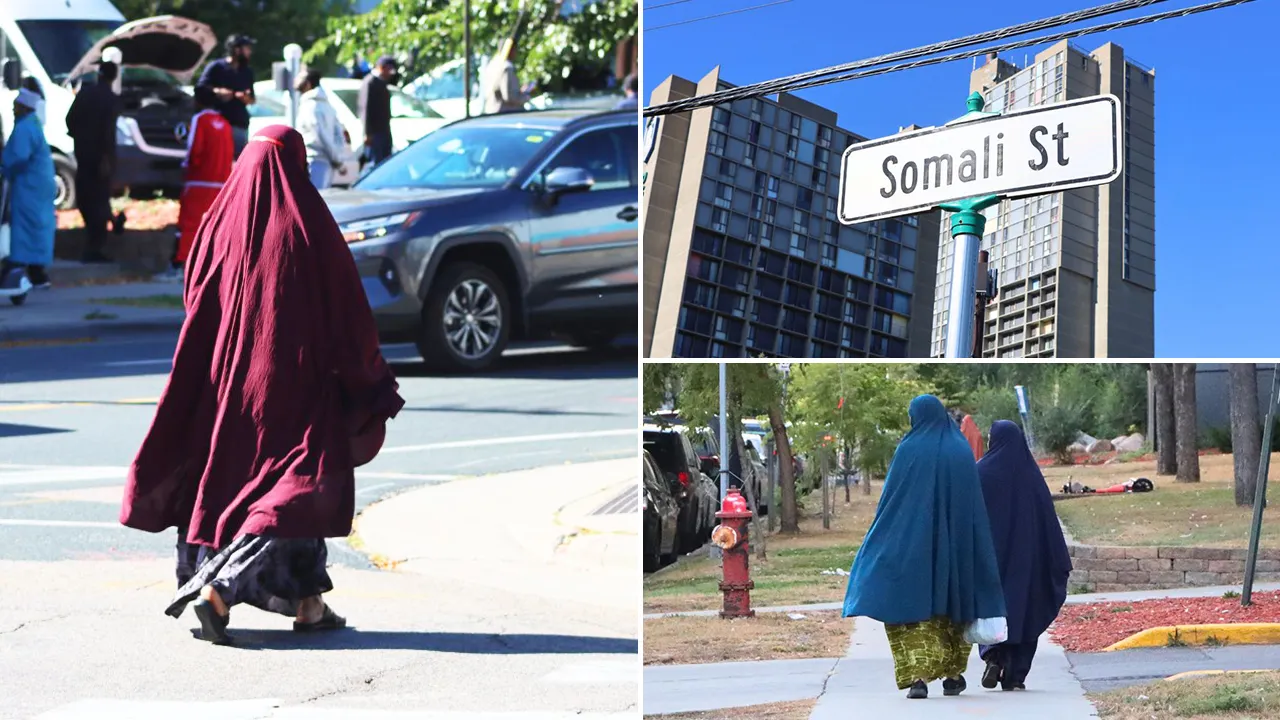
Cedar-Riverside, nicknamed “Little Mogadishu,” represents the most visible concentration of Somali residents in Minneapolis and showcases the demographic shift that has occurred over decades. Visitors to the neighborhood encounter a landscape that feels both worn and in transition – shuttered storefronts with faded English signs now feature Arabic notices, while the distinctive Riverside Plaza towers loom over streets where the Islamic call to prayer regularly sounds from mosques that were once commercial buildings. The neighborhood that was previously home to European immigrants and later became a hub for university students and music lovers has undergone a profound transformation. Many of the old bars and music venues have closed or been purchased by mosques, reflecting the community’s religious values that prohibit alcohol. The presence of women in hijabs and abayas and men in traditional Muslim attire has become commonplace, signaling a cultural and religious shift in what was once predominantly Christian territory. This transformation hasn’t been without challenges – signs of poverty and substance abuse are visible, yet community volunteers work actively to address these issues.
Faith remains central to Somali identity in Minnesota while also serving as a bridge to their new homeland. As Jaylani Hussein of CAIR-Minnesota explains, “Religion grounds us. It helps us build discipline and community, and it’s part of why Somalis have been able to succeed here.” The growth from just a handful of mosques in the 1990s to approximately 90 statewide today illustrates the community’s commitment to maintaining its religious traditions. For younger Somalis, navigating dual identities creates both challenges and opportunities. Abdi Fatah Hassan, who arrived in the U.S. at age 13, describes Minnesota as welcoming: “Thank God I’m in a great community. It’s close-knit, kind of feels like back home. You’re not just thrown in the deep end; people show you things, help you grow, help you adapt to the country.” Yet economic challenges persist – about 36% of Somali Minnesotans live below the poverty line, more than triple the national average, and Somali households report a median income significantly below the national median. Despite these obstacles, Hussein emphasizes that Somalis are “hard-working folks – many of them work two jobs” and are increasingly establishing themselves in various professional fields.
Karmel Mall, a multi-story complex housing over 200 Somali or East African-owned businesses, represents the community’s entrepreneurial spirit and serves as its social heartbeat. Walking through its maze-like corridors packed with clothing stalls, salons, jewelry stores, and halal eateries offers a glimpse into Somali American life beyond the stereotypes. Mahmoud Hussain, a barber who arrived in the 1990s, expresses gratitude for American opportunities while acknowledging the cultural balancing act: “Growing up here, you have a generational gap between your parents and understanding the society here. But America’s a melting pot – we’re trying to get our own foot into our roots while embracing the country that accepted us.” Professional success stories abound, like the software engineer who proudly works at eBay while overcoming multiple minority status challenges – “First of all, we’re black in tech. Then we’re women, then we’re Muslim women, then we are Somalis.” Young women working in a salon discuss the complexities of wearing hijab and navigating American perceptions, with one noting that while some people seemed confused by their religious dress, “they were always respectful about it.” The mall functions not just as a commercial space but as a community center where Somali Minnesotans shop, socialize, and strengthen cultural bonds.
After thirty years in Minnesota, many Somalis no longer consider themselves newcomers but established Minnesotans whose children were born and raised in the state. As evening falls in Cedar-Riverside, behind the concrete towers of Riverside Plaza, young Somali men gather for soccer games under floodlights – an ordinary scene of community life far removed from political controversies and negative stereotypes. Najma Mohammad, a hair stylist who came to the U.S. as a child, captures the community’s frustration with being defined by its worst elements: “Most people think just because some people are bad and Somali, that every Somali is bad – which is just a stereotype. We’re not the people we are seen as. Most of us are here to make a difference in the world and to make our parents proud.” This sentiment reflects the broader reality of Minnesota’s Somali population – a community working to define itself on its own terms while navigating the complexities of American life. As CAIR’s Hussein emphasizes, “Minnesota has had thirty years with the Somali community – and ninety-five percent of it has been positive. We’ve been here thirty years. We’re no longer newcomers. Our children were born here – they are Minnesotans now.” For most Somali residents, life in Minnesota isn’t defined by headline-grabbing controversies but by the everyday rhythms of work, prayer, family, and community – the universal building blocks of the American experience.