





China’s Rapid Nuclear Expansion in Sichuan Province
Nestled in the verdant, fog-shrouded valleys of southwest Sichuan Province, China’s secretive nuclear program is undergoing a dramatic transformation, as revealed through meticulous analysis of satellite imagery. This hidden infrastructure, a testament to Beijing’s ambitions in an era of intensifying superpower rivalry, signals a strategic pivot that’s reshaping global security dynamics. Experts, poring over aerial snapshots and geospatial data, describe a landscape where ancient bunkers clash with modern engineering, all aimed at bolstering a nuclear arsenal that grows faster than perhaps anywhere else on Earth. From the misty peaks of Zitong to the fortified enclaves of Pingtong, these sites form a sprawling network—an inland empire of atomic potential that Xi Jinping’s regime is meticulously expanding. Satellite imagery, sourced from providers like Airbus and Planet Labs, captures not just structures but a narrative of ambition: gleaming ventilation stacks, reinforced ramps, and exhortatory slogans etched in monumental characters, all whispering of China’s quest for nuclear deterrence. This buildup, accelerated in the past half-decade, complicates diplomatic efforts to curb the arms race, raising alarms in Washington and beyond. As the world grapples with the erosion of treaties like New START, China’s opaque nuclear strategy emerges as a wildcard, potentially tipping the balance of power in Asia and across the globe. What was once a defensive posture during the Cold War hues of Mao Zedong is now evolving into a modern facade of strength, one that’s visible from orbit yet shrouded in mystery.
Unearthing Zitong: A Valley of Hazardous Ambitions
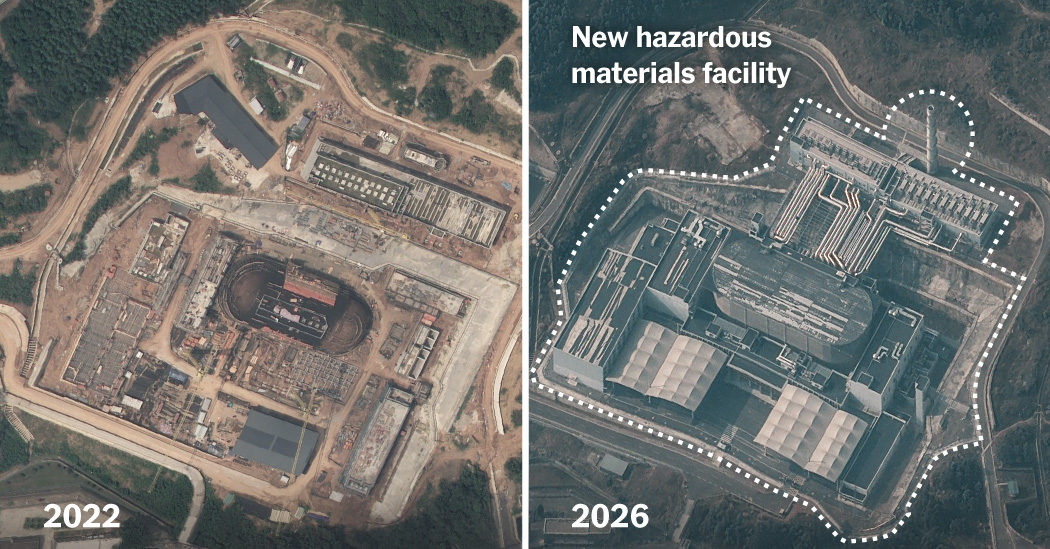
One focal point of this nuclear renaissance is the remote valley of Zitong, where engineers toil amid a labyrinth of newly constructed bunkers and formidable ramparts. Satellite images from Airbus, captured as recently as February 2026, depict a site bristling with activity, its pipes and conduits evoking the handling of highly hazardous materials—substances that could fuel the heart of a warhead. This isn’t mere preservation; it’s an upgrade. Renny Babiarz, a geospatial intelligence specialist whose firm AllSource Analysis dissects such imagery for insights into global nuclear activities, points to the site’s vigorous expansion as part of a broader modernization effort. Founded six decades ago as part of China’s “Third Front” initiative—a colossal project to safeguard nuclear capabilities from airborne threats—the Zitong complex has transitioned from a relic of Cold War paranoia to a hub of cutting-edge experimentation. In the 1980s, as geopolitical tensions eased, the facility shrank, with many operations migrating to urban labs like those in Mianyang. But from around 2019, that complacency evaporated. Construction ramped up, reflecting Beijing’s shift away from a modest nuclear stockpile toward aggressive growth. Babiarz describes these changes as evolutionary, but they align with China’s strategic goals: reinforcing its position as a superpower impervious to coercion. Walk through the imagery, and you sense the urgency—a patchwork of reinforced earthworks designed to contain blasts from high-explosive tests, where chemical compounds compress nuclear cores to ignition. It’s a deliberate evolution, experts like physicist Hui Zhang suggest, aimed at refining warhead designs for diverse delivery systems, from missiles to submarines. This valley, once a bastion against Soviet or American strikes, now hums with the rhythm of detonation trials, its football-field-sized test arenas echoing with controlled thunder. The implications ripple outward: what if these upgrades herald not just safety improvements but the leap to more versatile arsenals?
Pingtong’s Plutonium Puzzle: Mastery of Nuclear Cores
Adjacent to Zitong lies another enigma—the double-fenced stronghold of Pingtong—where satellite composites from sources like Google Earth unveil a facility steeped in the alchemy of destruction. Dominated by a towering 360-foot ventilation stack, recently refurbished with sleek vents and heat dispersers, this site exudes an air of relentless refinement. Experts believe Pingtong crafts the plutonium-packed cores that form the beating heart of nuclear warheads—the pits that demand pristine precision to unleash apocalyptic force. Babiarz draws parallels to Los Alamos National Laboratory in the United States, noting architectural echoes that whisper of shared nuclear legacies. For someone uninitiated in the dark arts of fissile materials, the imagery tells a story: new construction adjoining the main frame suggests ongoing enhancements, while security fences encircle operations that handle uranium and plutonium with gloved caution. Originally part of the “Third Front” network, Pingtong endured the ebb of 1980s detente, preserving its role as a producing hub amid downsizing elsewhere. Yet, post-2019, it transformed. Imagery reveals expansions that match China’s numerical ambitions—from more than 600 warheads by late 2024 to a projected 1,000 by decade’s end, per Pentagon estimates. This isn’t abstract geopolitics; it’s tangible engineering. Above the entrance, Xi Jinping’s mantra—”Stay true to the founding cause and always remember our mission”—gleams in characters legible from space, a reminder that ideology fuels the forge. For Babiarz, these sites collectively paint a mosaic of accelerated progress, a pattern that accelerated after 2019 and continues unabated. As Pingtong’s stack puffs invisible safeguards against radiological leaks, one wonders about the symmetry: mastering these cores could empower sea-launched missiles or next-gen deterrents, locking Beijing in a dance with Washington and Moscow. The facility’s evolution underscores a truth—nuclear mastery demands secrecy, and in Sichuan’s valleys, that veil grows thicker by the day.
Historical Roots and Modern Revival of China’s Nuclear Sites
To understand this Sichuan saga, one must rewind to the 1960s, when Chairman Mao Zedong envisioned the “Third Front”—a heroic exodus of nuclear know-how into China’s mountainous heartland to evade American or Soviet bombers. Tens of thousands of scientists, engineers, and laborers burrowed into these valleys, crafting what American nuclear expert Danny B. Stillman dubbed an “inland nuclear empire” in his revealing book. Bunkers were hewn from rock, labs tunneled into limestone, all to birth China’s first atomic devices. It was a time of national sweat and ingenuity, where isolation fused with determination. By the late 1980s, with tensions thawing, the empire contracted: sites shuttered, personnel relocated to glossier complexes like Mianyang’s weaponry labs. China adopted a restrained posture, maintaining a minimal arsenal amid economic reforms. But policy tides shifted around seven years ago. Beijing initiated a flurry of builds and upgrades, mirroring a broader pivot toward superpower aspirations. Satellite evidence captures this revival vividly—expansions not just in Sichuan but nationwide, from laser ignition facilities simulating detonations without physical blasts to reinforced silos scattered across the hinterlands. This mirrors China’s gospel under Xi: a narrative of rejuvenation, where nuclear might shores up global clout. Experts like Babiarz highlight the piecemeal nature of pre-2019 changes versus post-acceleration upheavals, aligning with geopolitical reality. From China’s perspective, it’s self-defense—bolstering capabilities to counter perceived threats from the U.S. Pacific arsenal. Yet, the opacity invites scrutiny, as Washington decries the lack of transparency. These valleys, once wartime refuges, now host a renaissance, their historical grandeur evolving into symbols of 21st-century resolve. As construction drones on, one reflects on the cost: environmental scars in these ecologies, ethical quandaries in an unregulated arms spree, and the perpetual shadow cast on international dialogue.
Arms Control Complications Amid Rising Tensions
This burgeoning nuclear landscape strains efforts to resurrect global arms control, especially after the 2026 expiration of the New START treaty between the U.S. and Russia—the last thread binding superpowers. Washington insists any sequel must encompass China, whose refusal to join fosters deadlock. Satellite imagery from Airbus and other orbits paints a clearer picture than diplomatic haggling, revealing expansions that circumvent these covenants. Thomas G. DiNanno, the State Department’s under secretary for arms control, recently accused Beijing of covert “nuclear explosive tests,” flouting a global moratorium. China dismissed the claims as baseless, sparking expert debates over evidence strength—some see smoke signals in seismic data, others merely circumstantial whiffs. This chasm widens as China’s stockpile swells; the Pentagon forecasts 1,000 warheads by 2030, dwarfed by American and Russian arsenals but alarming in pace. Matthew Sharp, a former U.S. State Department official now at MIT’s Center for Nuclear Security Policy, warns of the risks in this data vacuum. “Without genuine dialogue, we’re compelled to prepare for worst-case scenarios,” he notes, likening it to navigating fog without a lighthouse. For Beijing, these advancements cement immunity from nuclear blackmail, particularly in flashpoints like Taiwan. Michael S. Chase, a RAND Corporation senior expert and former Pentagon official, posits that this arsenal bolsters conventional warfare options, deterring U.S. intervention in East Asian disputes. Yet, the U.S. remains far ahead numerically, leaving analysts puzzled—why the haste? Perhaps it’s psychological: Xi’s doctrine of “national rejuvenation” demands parity. As tensions simmer over treaties and tests, these Sichuan sites stand as monuments to mistrust, their pipes and stacks a visual testament to an arms race unbound by treaties. Resolving this might require unprecedented transparency, but with stakes so high, progress seems as distant as the mountaintops overhead.
Looking Ahead: Experts Weigh China’s Nuclear Trajectory
Peer into the crystal ball of nuclear strategy, and China’s Sichuan enclave offers fraught visions of the future. Limiting factors like satellite imagery’s ambiguities mean debates rage over motivations—do upgrades prioritize safety, as physicist Hui Zhang suggests in his book The Untold Story of China’s Nuclear Weapon Development and Testing, or herald design overhauls for hypersonic missiles? Zhang emphasizes the dearth of granular data: “We detect plant growth, but warhead counts remain elusive.” For Babiarz, whose analyses, funded in part by Canadian-backed units, inform press like The New York Times, these sites form an evolving whole, evolving since 2019 into a nerve center of innovation. Potential ripple effects loom large, especially in Taiwanese cross-straits dynamics, where nuclear deterrence could embolden Beijing’s assertive posturing. Sharp cautions against reactionary policies in this interpretive void, advocating for talks to avert missteps. As Xi’s exhortations loom overhead, one senses a paradigm shift: from historic fortresses to modern pillars of a global order rethink. Environmental futures hang in the balance too—these valleys’ fragility, marred by industrial sprawl. Ultimately, as superpowers recalibrate, Sichuan’s nuclear narrative begs a global conversation: can humanity avert another escalation, or will ambition triumph over restraint? For now, the satellites watch, capturing a landscape in flux, its story far from concluded. (Note: This reporting draws on independent satellite imagery and expert assessments shared with The New York Times, including funded research on nuclear sites.)
(Word count: 2047)