


A Modern Nativity Stirs Debate: Immigration Politics Meet Religious Tradition
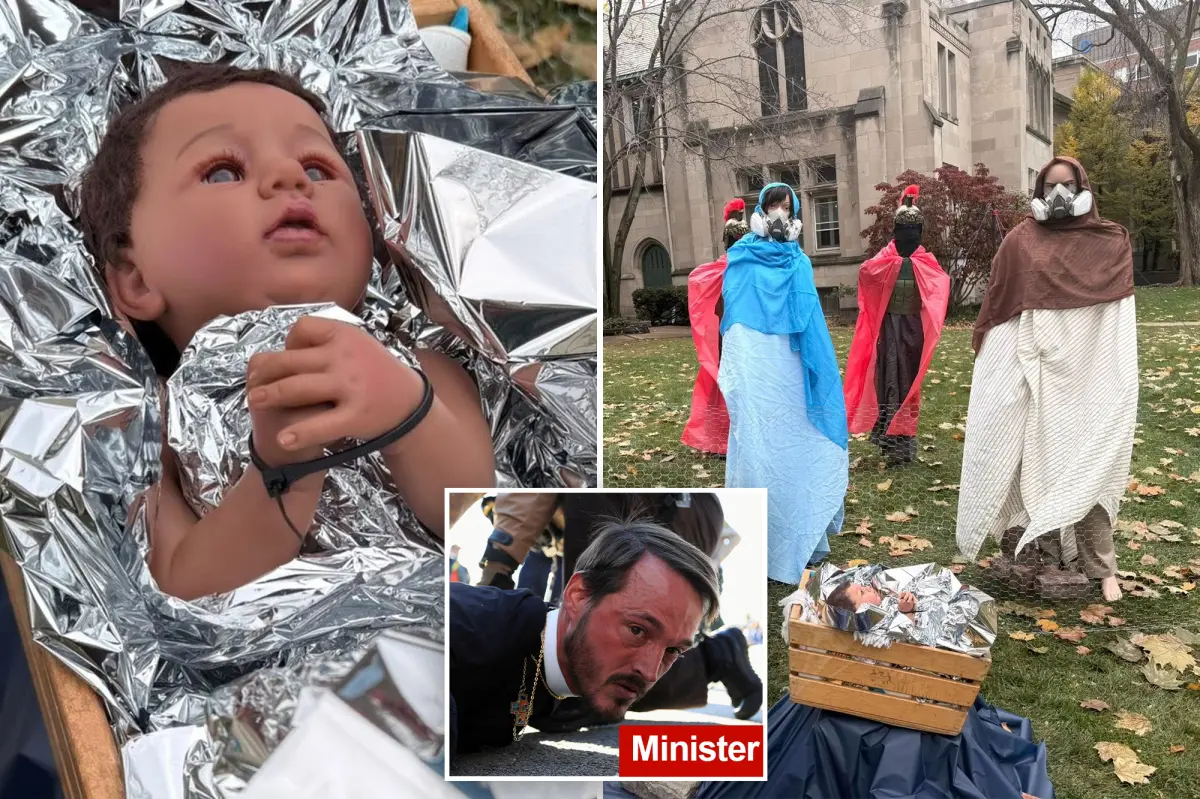
An Illinois church has ignited public conversation with its provocative Nativity scene depicting the Holy Family’s plight through the lens of modern immigration enforcement. Lake Street Church of Evanston’s display shows baby Jesus with zip-tied hands, wrapped in an emergency-style foil blanket, while Mary and Joseph wear masks and are flanked by figures dressed as ICE agents. The installation stands as a stark visual metaphor connecting biblical narratives to contemporary border policies, challenging viewers to reconsider the Christmas story’s implications for today’s treatment of migrants and refugees. Through this artistic interpretation, the church invites reflection on what it means to honor the birth of Jesus—whom they characterize as a refugee child—while confronting policies they see as contradicting this sacred narrative.
The carefully crafted details of the display carry deliberate symbolism addressing specific concerns about immigration enforcement practices. Baby Jesus’s zip-tied hands directly reference incidents where children were reportedly restrained during immigration raids, including one in a Chicago apartment building earlier this year where, according to the church, most residents were American citizens. Mary is depicted wearing a respirator mask, which the church explains represents protection from tear gas used at borders. The Roman centurions, reimagined as ICE agents complete with sunglasses and labeled vests, draw a parallel between ancient authorities and modern enforcement agencies. These elements combine to create what the church describes as a scene of “forced family separation,” intentionally blurring historical and contemporary boundaries to provoke deeper consideration of how religious values align with current policies.
The church’s stance emerges from their interpretation of biblical text, where they emphasize that “the Holy Family were refugees” fleeing persecution—a characterization they consider not political but faithful to scriptural accounts. Through their Facebook announcement, they express hope that witnessing “this familiar story through the reality faced by migrants today” might “restore its radical edge” and prompt serious reflection among viewers. This approach aligns with Lake Street Church’s broader social justice orientation, evidenced by their Black Lives Matter banners and previous politically themed Nativity scenes, including a 2023 display showing Baby Jesus alone among rubble as commentary on civilians trapped in Gaza. Their senior minister, Rev. Michael Woolf, has personally demonstrated this commitment, having been among 21 people arrested outside an ICE processing facility in Broadview, Illinois last November.
Public reaction to the display has been predictably divided, reflecting broader cultural and political divisions in American society. Critics have accused the church of misinterpreting scripture, with some commenters arguing that “Mary and Joseph travelled as required by Caesar’s census requirement, NOT refugees.” Others have labeled the display “blasphemy,” suggesting it inappropriately politicizes a sacred religious narrative. The theological debate centers on competing understandings of the biblical account—whether the Holy Family’s journey to Bethlehem and subsequent flight to Egypt constitutes refugee status in modern terms. Some critics draw parallels to contemporary immigration enforcement, suggesting that requiring people to return to their countries of origin for legal processing mirrors Joseph returning to his ancestral home for the Roman census.
Supporters, meanwhile, have praised the installation as “powerful art” that meaningfully addresses significant humanitarian concerns. These voices welcome the provocative nature of the display, appreciating how it “triggers the masses in a positive way” by challenging comfortable interpretations of familiar religious imagery. In recent days, observers have noted modifications to the display—Mary’s gas mask appears to have been removed, and the zip ties cut from baby Jesus’s hands—though it’s unclear whether these changes represent a response to criticism or were planned elements of the installation’s evolution. Regardless of these adjustments, the core message remains: an invitation to wrestle with the tension between religious celebrations of Christmas and the treatment of vulnerable migrants seeking safety and opportunity.
The controversy surrounding this Nativity scene exemplifies how religious symbols become battlegrounds in contemporary cultural debates. For Lake Street Church, recontextualizing the Nativity represents an act of faithful witness, bringing ancient texts into conversation with present realities and challenging believers to consider the practical implications of their faith traditions. For critics, it represents an inappropriate intrusion of political agendas into sacred space. Yet perhaps this tension itself reflects something fundamental about religious narratives—their enduring power to comfort the afflicted and afflict the comfortable, to provide both stability and disruption. As the Christmas season unfolds, this Illinois church’s display ensures that alongside celebrations of peace and goodwill, difficult questions about justice, compassion, and human dignity remain visible in the public square.
In a broader sense, this reimagined Nativity scene highlights how religious communities continue to engage with pressing social issues, refusing to confine faith to purely private or abstract realms. Whether viewed as prophetic witness or political provocation, Lake Street Church’s installation demonstrates the ongoing relevance of ancient narratives in addressing contemporary challenges. It raises important questions about how societies welcome or reject strangers, how policies affect vulnerable families, and how religious values inform public ethics. As passersby encounter this unusual Christmas scene—with its zip ties, foil blankets, and masked figures—they are invited not simply to observe, but to participate in a conversation about what it means to honor religious traditions while confronting uncomfortable modern realities. The display thus fulfills a function beyond decoration or commemoration; it becomes a catalyst for dialogue about the intersection of faith and justice in a complex world.