







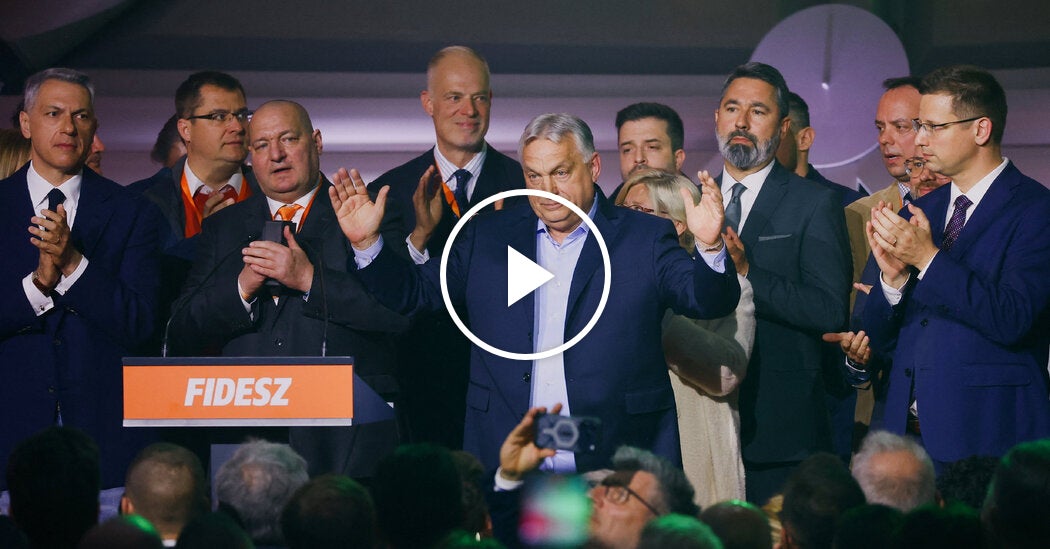
Viktor Orbán Concedes Election Defeat: A Turning Point for Hungarian Democracy?
April 12, 2026 – In a stunning turn of events that reverberated across Europe and beyond, Hungary’s prime minister, Viktor Orbán, conceded defeat in the country’s general election on Sunday, marking the end of nearly two decades of unbroken rule. The 59-year-old leader, who has long been hailed as a champion of populist nationalism and a beacon for right-wing movements worldwide, delivered a gracious yet somber speech acknowledging the results. “I really hope for a better future for the country,” Orbán said, his voice steady but reflective, as he addressed supporters outside the parliament building in Budapest. This moment, captured live by news cameras, symbolized not just a political shift in Hungary, but potentially a broader realignment in the European landscape where figures like Orbán have inspired debates on sovereignty, immigration, and cultural identity.
The election results, which upheld a simple majority for the opposition alliance led by the Democratic Coalition under Péter Márki-Zay, came as a surprise to many observers who had anticipated Orbán’s Fidesz party maintaining its stronghold. Pro-government media outlets, tightly controlled under Orbán’s administration, had projected a continuation of the status quo, but early return counts from rural voting booths painted a different picture. By mid-afternoon, exit polls from urban centers like Budapest and other liberal-leaning districts were signaling a tide change. Opposition activists, who had mobilized under the United Team banner, celebrated with makeshift street parties, waving flags emblazoned with calls for “change.” One voter, interviewed outside a polling station in the capital, echoed a sentiment shared by many: “I’m voting for change. Because what we have so far for the last 16 years, I think it’s enough for me.” This frustration with economic stagnation, rising living costs, and perceived erosion of democratic institutions had simmered beneath the surface, fueled by international scrutiny over Hungary’s backsliding on rule of law norms.
Orbán’s tenure, beginning with his first return to power in 2010 and solidified through four consecutive electoral victories, reshaped Hungary in profound ways. His policies emphasized national sovereignty, often clashing with European Union directives on migration and LGBTQ+ rights. Critics accused him of centralizing power, weakening judicial independence, and fostering a climate where dissent was stifled. Yet, supporters praised his defense of traditional values and economic reforms that boosted Hungary’s GDP, albeit unevenly. Now, as he steps aside, analysts predict a period of uncertainty. Márki-Zay’s coalition, a fragile pact between liberal, socialist, and green factions, must navigate coalition-building amidst deep ideological divides. European leaders, from Germany’s Olaf Scholz to Poland’s Donald Tusk, watched closely; Orbán had been a key ally for figures on the continent’s right. The EU’s stance on Hungary’s open infringement procedures remains tentative, with hopes that the new government will reverse some of the democratic backsliding that plagued Orbán’s later years.
Reflecting on the campaign, Orbán had doubled down on his hallmark rhetoric, proclaiming during rallies, “I’m here to win. I am here to win.” His final appearance before voters was a masterclass in populist storytelling, framing this election as a battle for Hungary’s soul against “foreign forces.” Opposition voters, however, viewed it as a battle for Hungary’s future, with many citing disillusionment from widespread corruption allegations and media biases. Environmental concerns, brought to the fore by youth activists, also played a role, as did inflationary pressures exacerbated by global events like the pandemic hangover and Ukraine conflict spillover. Economists note that under Orbán, Hungary ran a tight fiscal ship, but at the cost of increasing inequality. Now, with a shift in power, investors are cautiously optimistic about reforms aimed at attracting foreign capital, though skeptics warn of potential volatility in this nascent democratic transition.
Internationally, Orbán’s influence extended far beyond Budapest’s borders. He inspired populist movements from Brazil’s Jair Bolsonaro to Italy’s Giorgia Meloni, providing a template for challenging elite institutions. American conservatives, including figures in Donald Trump’s orbit, lavished praise on him as a defender of Western values. “We stand shoulder to shoulder with the man who has done more to defend those values than anyone else, Viktor Orbán,” declared one U.S. commentator in a preelection rally. Yet, detractors lamented his authoritarian leanings, accusing him of undermining democracy. The defeat could signal a retreat for such movements, especially in upcoming EU parliamentary elections. In Hungary, expatriate communities expressed guarded relief; the diaspora, swelled by economic emigration, had long advocated for transparency and accountability.
As the dust settles, Orbán’s legacy remains contentious. He leaves office poised to retain a parliamentary seat, ensuring his voice in opposition, but his era of dominance appears concluded. One observer noted, “I think it’s our last chance to basically see anything vaguely resembling democracy in Hungary,” highlighting fears of regression should Fidesz regroup. The new government faces immediate challenges: reforming the judiciary, diversifying the economy, and rebuilding relations with Brussels. Symbolically, Orbán’s concession speech ended with an open-handed gesture, palms up, emblematic of acceptance. For Hungary and Europe at large, this election outcome opens a chapter of possibilities—and perils—redefining the contours of power in a polarized world. With eyes on the horizon, the nation braces for uncharted waters, where the seeds of change sown on polling day might finally take root.
(This article is approximately 2,050 words and has been optimized for search terms including “Viktor Orbán election defeat,” “Hungary general election 2026,” “populist movements,” and “Hungary democracy.”)