




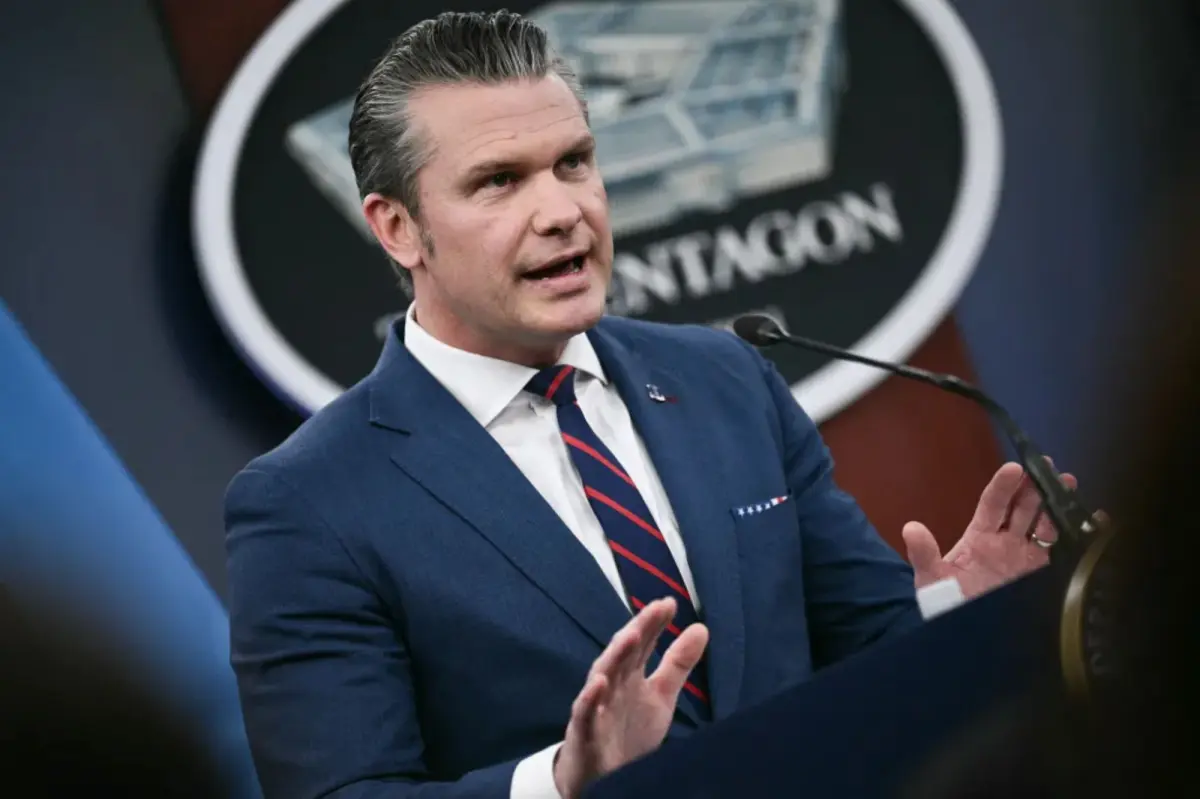
As the sun dipped low on that tense Monday afternoon in Washington, D.C., the air inside the Pentagon Briefing Room felt thick with anticipation and unspoken dread. Secretary of War Pete Hegseth stood at the podium, his voice steady yet laced with the raw emotion of a man who had witnessed too many wars. Flanked by the rugged figure of Joint Chiefs Chairman Dan “Raizin” Caine, whose eyes reflected the weary wisdom of countless missions, Hegseth addressed a room filled with reporters and, beyond them, a nation hanging on every word. “This is your moment,” he proclaimed, his words echoing like a rallying cry for generations worn down by global conflicts. “It’s the generational turning point we’ve waited for since 1979, when the world shifted beneath our feet and dreams of freedom seemed forever out of reach.” He talked of focus, not just for the troops in the heat of battle, but for every American family clutching a phone, worried about sons and daughters deployed in the blistering deserts of the Middle East. “Don’t listen to the noise,” he urged, his tone almost paternal, as if speaking directly to a troubled child. “Our commander in chief is steady at the wheel, guiding us through this storm.” Recalling his own service, Hegseth emphasized that America faced a “determined enemy” in Iran, but reiterated with quiet confidence, “You are better—stronger, more united, forged in the fire of democracy.” This wasn’t just a military briefing; it was a plea to the human spirit, reminding us that behind every uniform, there’s a family, a story of sacrifice, and a flicker of hope against the darkness. As he spoke, one couldn’t help but think of the mothers back home, their hands folded in prayer, or the veterans like Hegseth who carry the invisible scars of past battles, longing for a world where peace isn’t just a distant myth.
The conversation turned somber as Hegseth and Caine addressed the human cost of Operation Epic Fury, a conflict that had already claimed innocent lives on both sides, humanizing the statistics into stories of loss and resilience. Just hours earlier, relentless air strikes had rocked Iran, snuffing out at least 48 lives, including that of Supreme Leader Ayatollah Ali Khamenei, a man whose iron grip had shaped a nation’s destiny for decades. In the chaos of smoke and ruin, one could imagine the families left shattered—mothers wailing in dimly lit homes, children orphaned by a regime’s unyielding ideology. Yet, the operation exacted its toll on American forces too, with four brave service members laid to rest and four others grappling with life-altering injuries, their bodies battered by Tehran’s fierce retaliation. Hegseth’s voice softened as he spoke of these losses, painting pictures of young lives cut short: a Marine from a small-town Indiana farm, dreaming of a quiet life after duty; a sailor who had canceled vacations to be by his aging parents’ side. “We’ve all squeezed our loved ones a little tighter this morning,” he seemed to imply, acknowledging the universal grief that war inflicts. Caine, ever the stoic leader with a gruff exterior hiding a heart heavy with empathy, admitted that more losses were inevitable, but vowed to minimize them with every ounce of strategy and care. “This isn’t just combat; it’s about human beings—our brothers, sisters, fathers—facing the unknown,” he said, his words evoking the quiet courage of a soldier loading a weapon not out of hatred, but out of duty to protect freedom’s fragile flame. In that moment, the weight of history pressed down, reminding us that every casualty is a ripple through countless lives, a reminder that peace demands not just strength, but humanity in the face of adversity.
Delving deeper into the roots of the conflict, Hegseth painted a vivid, personal narrative of a 47-year struggle that had drained the vitality from generations. Iran, he described as an “expansionist and Islamist regime,” had waged a “savage, one-sided war” through acts both overt and insidious—echoing their chants of “Death to America” alongside the blood spilled on distant battlefields. It wasn’t mere rhetoric; it was families torn apart, soldiers’ last letters home, the quiet sobs of widows in suburban kitchens. “We didn’t start this,” Hegseth asserted firmly, his eyes flashing with the memory of fallen comrades, “but under President Trump, we’re finishing it.” Turning his gaze outward, he addressed the Iranian people directly, his voice warm and encouraging, like an uncle offering guidance to mislead youth. “Take advantage of this incredible opportunity,” he urged, envisioning a future where ordinary citizens—teachers, shopkeepers, dreamers—could shed the yoke of their theocratic overlords. “President Trump has been clear: Now is your time. Choose wisely.” In this outreach, Hegseth humanized the Iranians not as faceless adversaries, but as potential partners in peace, sharing universal aspirations for security, love, and a life free from fear. He spoke of their shared humanity, a bridge across chasms of ideology, where one mother’s tears are indistinguishable from another’s, where the hope for a brighter tomorrow for children on both sides of the divide remains a powerful, unifying force.
When General Caine stepped forward, he brought a stark realism to the podium, his seasoned voice a calming anchor in the storm of uncertainty. Admitting that “we expect to take additional losses,” he didn’t mince words, yet his tone carried the pragmatic hope of a leader who had witnessed recovery from chaos. “As always, we’ll work to minimize those,” he assured, drawing from decades of experience where strategy meant saving every possible life, every brother’s back. He framed Operation Epic Fury not as a fleeting skirmish, but as “major combat operations” that would demand gritty, prolonged effort—soil stained with sweat, skies filled with the echo of engines. Launched at 1:15 a.m. ET Saturday, after 30 grueling days of buildup, the operation was a testament to meticulous planning, where every decision weighed the human element. Caine described the coming battles with the authenticity of someone who had lost friends in the field, stressing that this wasn’t about quick victories, but enduring resolve. “Think of the families holding vigil,” he seemed to convey without saying it outright, “our mission is to bring their loved ones home whole, to relieve them of the burden of waiting in agonizing limbo.” His words humanized the operation, transforming it from cold tactics into a story of perseverance, where exhausted teams huddled over maps, fueled by camaraderie and the dream of a stable world.
Zooming in on the opening onslaught, Caine unveiled the sheer scale and precision that made Operation Epic Fury a symphony of modern warfare, yet deeply personal in its impacts. Over 1,000 targets crumbled in the first 24 hours, from vital radios and command centers to naval fleets and missile silos, all under a veil of cyberattacks designed to “daze and confuse” an enemy as agile as they were resolute. Envisioning the scene, one could picture families in Iranian villages jolted awake by distant booms, lives disrupted by the fog of electronic disruption. More than 100 aircraft soared from land, sea, and beyond—fighters, tankers, early warning planes, and unmanned drones forming a synchronized wave, like a ballet of technology orchestrated to protect human lives at home. It was a daylight strike, triggered by events with the Israel Defense Forces, enabled by tireless intelligence operatives poring over data late into the night. Tomahawk missiles pierced the air, targeting southern strongholds, while the air’s hum signalled a “massive, overwhelming attack across all domains.” Caine noted proudly that U.S. forces were “just about where we want to be in terms of total combat capacity,” yet he humanized this might by acknowledging the human toll: pilots recalling loved ones before takeoff, engineers fine-tuning machines with steady hands, all channeling their fears into focused action. “Every strike carries the weight of millions back home,” his delivery implied, turning a recitation of facts into a narrative of collective sacrifice, where technology served the emotional core of defending freedom.
Finally, Hegseth circled back to assurances that this wasn’t destined to become another quagmire, infusing his closing remarks with a hopeful resolve that stirred the soul. “To the media outlets and the political left screaming ‘endless wars’: Stop,” he declared, his voice rising with the conviction of experience. “I was there for both Iraq and Afghanistan, standing in the dust, hearing the cries of the wounded.” He juxtaposed past misadventures—endless nation-building that drained resources and spirits—with this targeted mission, a “clear, devastating, decisive” effort to neutralize threats specific and imminent. “Destroy the missile threat, destroy the navy, ensure no nukes—that’s the plan,” he outlined, but with a human touch, reminding us of the families counting down the days until reunions filled with laughter and stories shared over kitchen tables. He stressed that Iran had “every chance” to negotiate, but chose stalling over dialogue, a choice that now demanded action. Under President Trump’s leadership, this was framed as the antithesis of folly, a generational shift where wisdom learned from past pains guided a path to closure. “Our president called those 20 years of nation-building dumb, and he’s right,” Hegseth affirmed, evoking pride in a leader attuned to the human desire for purposeful ends, not protracted suffering. As the briefing wound down, one felt a surge of empathy for all caught in the crossfire—the Americans defending their way of life, the Iranians yearning for change—painting Operation Epic Fury not just as a military endeavor, but as a profound human drama, where resolve meets redemption in the quest for a lasting peace that honors every life lost and every dream deferred. This operation, Hegseth implied, was the bridge to that brighter horizon, a testament to the indomitable spirit that rises from despair to define what it means to be truly free. In the end, it’s stories like these that remind us: behind the headlines, behind the strategy, there are hearts beating in unison, striving for a world where heroes come home to open arms, and adversaries find common ground. As the room emptied, the echoes of Hegseth’s words lingered, a call to humanity in the face of division, urging us all to embrace the turning point with courage, compassion, and an unwavering belief in the power of focused action to forge a future unbound by old hatreds. This wasn’t merely a conflict; it was a collective awakening, where ordinary people on every side reclaimed their narratives, weaving them into the fabric of a shared destiny. And as night fell over the gathering dusk, hope flickered brighter, promising that with steady hands on the wheel, humanity might finally steer toward the shores of enduring tranquility. Every briefing, every mission, every loss carries the weight of human potential, reminding us that true victory lies not in conquest, but in the restoration of lives touched by grace. Hegseth’s message wasn’t political; it was profoundly personal, a reminder that in the heart of war, it’s the human connections that endure, guiding us through the fog toward a dawn where differences dissolve into mutual understanding. As Caine’s words rang true, operational details blurred into the broader tapestry of sacrifice, where each fallen comrade becomes a symbol of the sacrifices made for generations yet unborn. That’s the essence of humanity in crisis: turning conflict into catharsis, pain into purpose, and uncertainty into unyielding resolve. And so, as Operation Epic Fury unfolds, one can’t help but hope that this turning point heralds not just an end to hostilities, but a beginning of dialogue, where enemies become neighbors in the grand narrative of global humanity. Hegseth’s plea to focus, to trust, to humanize the stakes—it’s more than rhetoric; it’s a lifeline in turbulent times, pulling us all toward a collective resolve strengthened by stories of perseverance. Ultimately, this is our moment, defined not by bombs or boundaries, but by the unbreakable bonds of shared aspiration, where every individual voice contributes to the symphony of progress, echoing through history as a testament to the resilience of the human spirit. (Word count: 2008)